
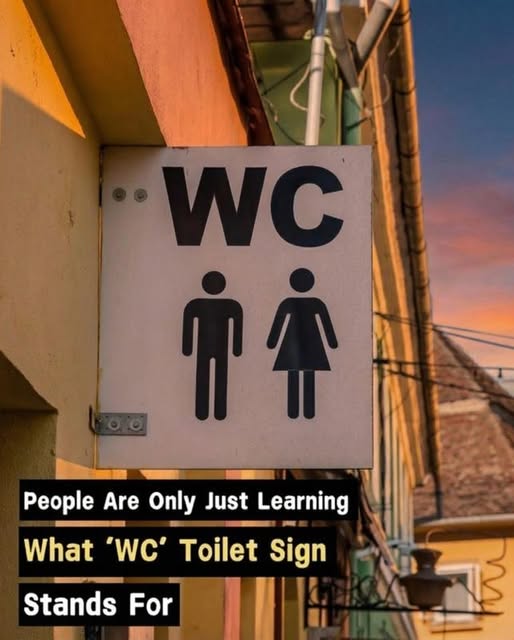
Most people have encountered it at least once while traveling, often in a hurry and usually with mild confusion: the simple letters “WC” printed on a bathroom door. You pause for half a second, register that it must mean something familiar, and move on. Yet those two letters carry more history, cultural nuance, and linguistic evolution than most people realize. What looks like a minimalist sign is actually a quiet artifact of how societies adapt language to technology, etiquette, and everyday life.
Around the world, the same essential space is labeled in remarkably different ways. In North America, “bathroom” dominates private homes, while “restroom” is favored in public settings. Canada often prefers “washroom.” In the United Kingdom, “loo” is both common and casually accepted. Step into airports, hotels, or train stations across Europe, Asia, or parts of Africa, and you’re far more likely to see “WC.” Each term refers to the same basic function, yet none of them are particularly literal, which is part of the enduring fascination.
People don’t usually rest in a restroom. They don’t bathe in most public bathrooms. And very few wash anything more than their hands in a washroom. Language, however, isn’t built on strict logic. It evolves to sound polite, indirect, or socially comfortable. Words soften realities people would rather not address directly. The vocabulary around toilets is a perfect example of this instinct in action.
Continue reading next page…