
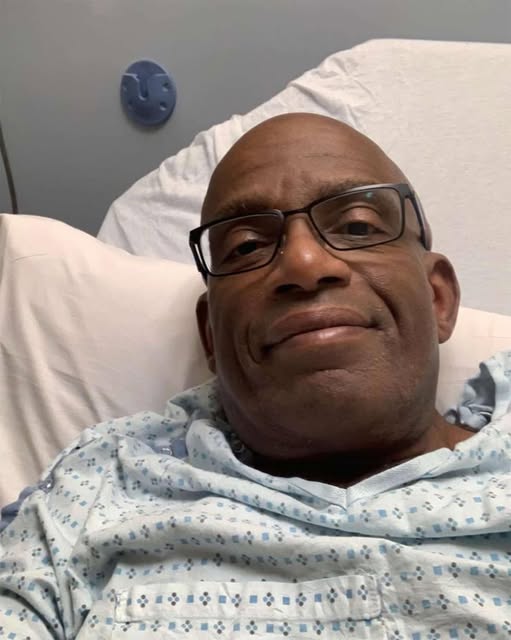
For more than four decades, Al Roker has been a trusted fixture in American homes. His familiar smile, comforting humor, and steady presence didn’t just deliver weather updates—they became part of the daily routine for millions of viewers. Al Roker wasn’t simply a television personality; he felt reliable, reassuring, and constant. So when he suddenly vanished from The Today Show in late 2022, concern spread quickly. What many assumed would be a brief medical absence turned into one of the most serious health crises of his life—one that deeply affected his family, colleagues, and a nationwide audience.
The situation began quietly in November 2022, when Roker was admitted to the hospital for blood clots in his leg. Those clots had traveled to his lungs, resulting in a pulmonary embolism—a life-threatening condition that requires immediate care. As he later did publicly, Roker initially minimized the severity with humor, comparing it to “medical whack-a-mole.” But behind the jokes, doctors were uncovering a much more dangerous reality.
As treatment progressed, physicians discovered severe internal bleeding caused by ulcers. The bleeding was extensive—so severe that Roker lost nearly half of his total blood supply. What began as a serious but manageable diagnosis rapidly escalated into a full medical emergency. His condition worsened quickly, leaving doctors racing against time.
Emergency surgeries followed. What was expected to be a relatively short operation turned into a seven-hour procedure as surgeons encountered complications involving his colon and gallbladder. For a critical 48-hour period, his survival was uncertain. The man who had spent decades calming others during storms was now at the center of one himself.
Throughout the ordeal, his wife, journalist Deborah Roberts, carried an enormous emotional burden. Later, she described those weeks as the most terrifying experience of their lives. While Roker remained in intensive care, she made a deliberate choice to protect him from knowing just how close he came to dying. She believed his recovery depended not only on medical intervention, but also on maintaining hope and mental strength.
This wasn’t Roker’s first serious health challenge. Over the years, he has spoken openly about his medical history, including his 2020 diagnosis of aggressive prostate cancer and multiple surgeries. But this hospitalization was different. It was the first time his life truly hung in the balance.
Ironically, doctors later said that his physical conditioning helped save him. Only months earlier, Roker had completed the Brooklyn Half Marathon. His cardiovascular fitness and commitment to an active lifestyle gave his body the resilience it needed to withstand massive blood loss and prolonged surgery. Without that foundation, the outcome could have been tragically different.
While Roker fought to recover behind hospital walls, his absence was deeply felt on morning television. His Today Show co-hosts—Savannah Guthrie, Hoda Kotb, Craig Melvin, and Dylan Dreyer—shared updates with viewers, often struggling to hold back emotion. Their concern was genuine and unscripted, reflecting how personal the situation was for the entire team.
His absence was especially noticeable during long-standing traditions. For the first time in 27 years, Al Roker did not host the Macy’s Thanksgiving Day Parade. His voice, long associated with the holiday, was missing. To many Americans, it felt as though something essential was absent from Thanksgiving itself. His absence at the Rockefeller Center Christmas tree lighting only reinforced how deeply he was woven into national traditions.
After nearly two months of hospitalization, rehabilitation, and intensive physical therapy, Roker returned to Studio 1A in January 2023. His return was emotional and powerful. The audience stood. His colleagues cried openly. It wasn’t about ratings or spectacle—it was collective relief and gratitude.
Sitting beside Deborah Roberts, Roker spoke honestly about the experience. He joked that he went in for one surgery and came out with “four,” but he didn’t hide the seriousness of what he endured. He acknowledged losing half his blood volume and admitted it was the most frightening experience of his life.
Roberts spoke about the overwhelming support they received—from family, friends, coworkers, and complete strangers. Letters, messages, and prayers poured in from across the country. That sense of community, she said, carried them through their darkest moments.
In the years since—continuing through 2025 and into 2026—Roker has used his platform to advocate for preventive healthcare. He has become especially vocal about prostate cancer screening, urging men, particularly men of color, to monitor PSA levels and seek early medical advice. Marking the five-year anniversary of his cancer surgery, he emphasized that early detection saves lives.
The experience fundamentally reshaped his outlook. Roker now speaks openly about gratitude, faith, and the reality that tomorrow is never guaranteed. He credits his family, his beliefs, and public support for helping him heal. His commitment to walking, staying active, and prioritizing health is no longer routine—it’s intentional living.
Today, Al Roker is back doing what he loves. He delivers forecasts, shares laughter, and brings comfort to viewers once again. But there is a quiet difference. He carries the knowledge of how close he came to being gone.
The news of his health crisis initially broke hearts nationwide. His recovery, however, did more than reassure—it reminded people of resilience, preparation, and the power of community. His story stands as proof that even when life takes a sudden and frightening turn, healing is possible—and that after the fiercest storm, the sunshine feels more meaningful than ever.