
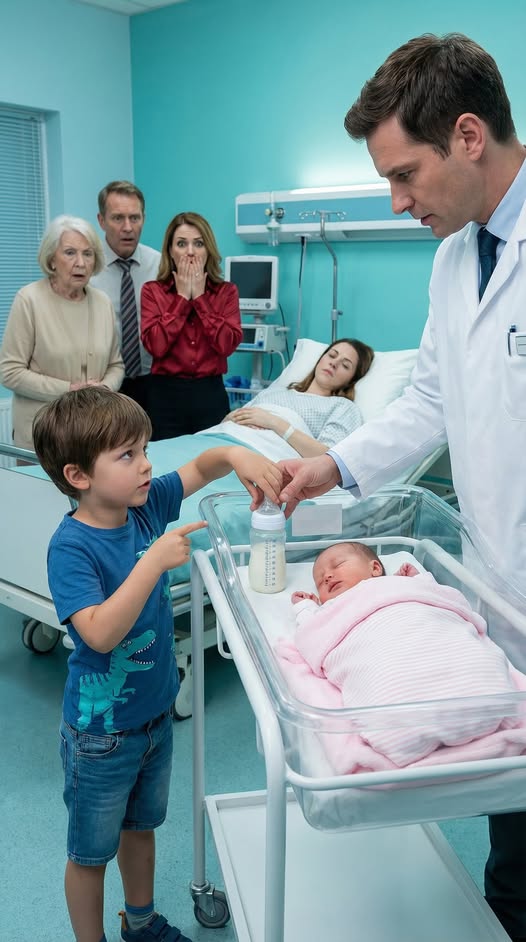
Hospitals usually hum with routine: quiet corridors, monitors beeping steadily, nurses exchanging clipped words. But that night, the calm shattered. The air felt heavy, suffocating, as if the building itself had stopped breathing.
Phones rang urgently at the nurses’ station. Security appeared at the doors without explanation. Police officers followed, belts clanging against the quiet. People moved faster, spoke less. The room where my newborn had slept hours earlier now felt unrecognizable.
My mother-in-law, Margaret, was being escorted down the hall.
She screamed, struggling every step. “This is God’s will!” she shouted. “You can’t corrupt this family! You can’t interfere with purity!” Her eyes darted past me as if I didn’t exist.
My sister-in-law, Claire, followed behind, sobbing. “It’s a misunderstanding! Mom is confused!” she pleaded, but her words dissolved into the sterile air.
My husband, Daniel, froze near the empty bassinet. His hands shook as he whispered my name repeatedly, trying to anchor himself.
From my hospital bed, I watched numbly. Heart hammering, mind detached.
They took the bottle.
They took the cart.
They took my statement.
And just like that, the room where my baby should have rested became a crime scene.
Understanding Margaret
From the beginning, Margaret’s evaluation of me was relentless. She never showed dislike outright—just judgment.
“Your family has depression history, yes? And your father passed young?” she’d asked, sipping tea delicately. “Weak stock. Daniel’s family survives. We protect the bloodline.”
Daniel always excused her eccentricity. “That’s just Mom,” he said. “She means well.”
But scrutiny escalated with the birth of our first son, Noah. Every detail—grip, eyes, temperament—was inspected.
When I became pregnant again, Margaret stopped pretending. She spoke openly about genetic risk, saying it was reckless to “double down” on uncertainty.
Our second son, Evan, was born prematurely but healthy.
Margaret’s gaze on him was cold, calculating. “He’s frail,” she whispered, more judgment than concern.
The Poison in the Milk
The toxicology report came back almost immediately. The milk contained a prescription sedative Margaret had been taking for years—harmless to adults but deadly for a newborn. The pill had been crushed deliberately and mixed to dissolve completely.
Detective Miller’s voice was calm beside my bed: “We believe this was intentional.”
Daniel already understood. Margaret had told the police she was “protecting the family,” claiming my postpartum history meant I would harm another child. She said God would forgive her “mercy.”
Before sunrise, Margaret was arrested for first-degree murder.
Complicity and Silence
Claire eventually admitted she saw her mother crush something near the bottle cart and did nothing. Fear, loyalty, paralysis—whatever the reason, her silence made her complicit.
Even my eight-year-old, Noah, became a witness. Clutching his comic book, he told the social worker, “She said she was fixing it so Evan wouldn’t cry.”
Noah remembered Margaret warning Daniel: “He’ll be cold soon. Better that way.”
Daniel admitted he had recognized that look from her past—how she decided the weak didn’t deserve to live. “I was afraid of her,” he whispered.
The Aftermath
Evan’s death wasn’t an accident. It wasn’t fate. It was fear, ideology, and silence turned deadly.
Hospitals issued apologies, policies were revised, and settlements offered. But none of it brought Evan back.
The media sensationalized it: “Killer Grandma,” “Religious Extremism,” “Eugenics disguised as devotion.”
Daniel left soon after. We divorced quietly. Noah and I relocated, moving to a sunlit home with a backyard and a rescue dog Margaret would have despised.
I volunteer in hospital advocacy now. Evan’s Law ensures two-nurse verification and restricted access to newborns. It’s not justice—but it is prevention.
Letters from Margaret go straight into the fire. Cards from Daniel are shredded.
Awake to the Truth
Strength doesn’t describe what I feel. I’m awake. Awake to how ordinary people can become monsters, how silence can kill, and how a child’s question can reveal the truth adults fear.
Noah keeps Evan alive in stories of the bike he never got to ride and the toys they never shared. Memory is all we have, and we protect it fiercely.
If Noah hadn’t spoken up, Margaret might have gone free, and Evan’s death dismissed as tragedy. Instead, the truth survived.
And for us, that has to be enough.