
The night my life changed began with a knock at the door.
It was two in the morning, the rain hammering against the windows. I had dozed off on the couch, the television murmuring softly, when the sound startled me awake. Something in my chest told me that whatever waited outside wasn’t good.
When I opened the door, two police officers stood under the porch light.
One of them removed his hat.
“Margaret?” he asked gently.
My throat went dry. “Yes.”
“I’m very sorry, ma’am, but your son David was in a car accident tonight.”
The rest of his words blurred.
Wet roads. Loss of control. A tree.
Dead at the scene.
His wife, Vanessa, had survived with barely a scratch.
I gripped the doorframe to keep from falling. My boy—my only child—was gone.
Two days later, we buried David. I barely spoke. People offered hugs, whispered prayers, brought casseroles I couldn’t eat. Vanessa cried loudly beside the coffin, shaking with raw emotion. At the time, I believed her grief was real. I had no idea it was the last time she would pretend.
Two days after the funeral, Vanessa showed up again.
My twin grandsons, two years old, were with her in their pajamas. Jeffrey clutched a stuffed dinosaur, and George leaned against his brother, sucking his thumb. Behind them, a black trash bag overflowed with clothes.
Vanessa shoved it toward me.
“I’m not cut out for this poverty stuff,” she said flatly. “I want to live my life.”
I stared at her.
“Vanessa… these are your children.”
“They’re better off with you,” she said. “You don’t have much else to do anyway.”
Then she turned and drove away.
Jeffrey tugged at my sleeve. “Up?” he asked softly.
I knelt and pulled both boys into my arms.
“It’s okay,” I whispered, though nothing about it was. From that moment, they were mine.
Raising toddlers at sixty-three wasn’t easy. My retirement savings vanished quickly. I returned to work, pulling double shifts at a small grocery store. At night, I mixed herbs into jars—chamomile, mint, dried orange peel. A neighbor suggested I sell them at the farmers’ market.
I tried.
The first weekend, I earned forty-seven dollars. The next month, three hundred. Slowly, my idea grew. Within two years, I had an online shop, then a warehouse, then employees. Coffeehouses across the state began ordering my blends.
But to the boys, I was just Grandma.
Jeffrey grew into a quiet thinker, devouring thick books. George was loud, full of laughter. Sometimes, they’d sit at the kitchen table while I packed tea orders.
“Grandma,” George asked one day, “did Dad like baseball?”
“He loved it,” I said. “Couldn’t throw straight to save his life, though.”
Jeffrey smiled.
“Did Mom like baseball?”
I hesitated. “She liked different things.”
Vanessa never called. No birthday cards. No visits. Not once in ten years. And honestly, I didn’t mind.
By then, my little tea business had grown far beyond my dreams. But the best part of my life was always those two boys. I thought we were safe—until three weeks ago.
The security gate buzzer rang. I assumed it was a delivery. Instead, Vanessa stood outside with a lawyer.
She didn’t ask about the boys. She didn’t ask how they were. She handed me papers. Full custody.
“You abandoned them,” I said quietly.
Her smile was thin. “Temporary guardianship can change,” she said.
I called my lawyer immediately.
“Courts sometimes favor biological parents if they claim they’ve reformed,” he said carefully.
“She disappeared for ten years!”
“I know. But we have to prepare.”
Before I could process, Vanessa walked into my kitchen as if she owned the house.
“I’ll make this simple,” she said. “Sign over fifty-one percent of your business, and I’ll drop the custody case.”
“You want my life’s work?”
“I want security,” she said. “Think of it as fair exchange. Refuse, and I’ll take the boys out of state. You’ll never see them again.”
I said no.
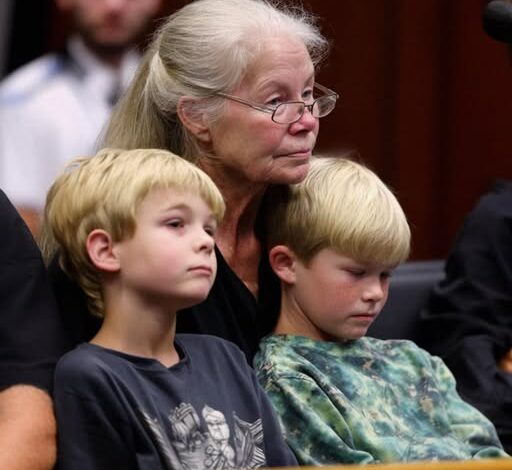
Three weeks later, we were in court. Vanessa sat polished and confident. When she took the stand, tears appeared instantly.
“I made mistakes when I was young,” she told the judge. “But I want to reconnect with my sons.”
She glanced at me. “Your mother-in-law is seventy-three. I worry about her ability to care for them.”
Then something unexpected happened.
Jeffrey stood. “Your Honor,” he said quietly, “she gave us away already.”
George stood beside him. “She never visited,” he added. “Not once. No calls. No letters. Nothing.”
The courtroom fell silent.
Then I spoke. “Your Honor, someone else needs to testify.”
A woman in her thirties rose. “Her name is Sarah,” she said.
Vanessa scoffed.
“Ten years ago,” Sarah said, “I was the one who called 911 the night David died. David was alive, but he wasn’t in the driver’s seat. Vanessa was. She panicked and begged me to move him to make it look like he caused the crash.”
Vanessa shouted. “That’s a lie!”
Sarah held up her phone. A photo, timestamped that night, showed David in the passenger seat. Vanessa at the driver’s door. The twins in the back.
The judge studied the image. “No grounds exist to remove the children from their grandmother’s care. Full custody remains with her.”
My knees nearly buckled.
“This testimony also suggests the original accident investigation may have been incomplete. David’s case will be reopened.”
Vanessa’s face turned white.
Outside, Jeffrey and George wrapped their arms around me.
“You did it, Grandma!” George said.
I shook my head. “No,” I said. “We did.”
For the first time in ten years, the weight of that terrible night finally lifted. On those courthouse steps, I realized something important: families aren’t always the ones who stay—they’re the ones who choose to fight for you, no matter how long it takes.