
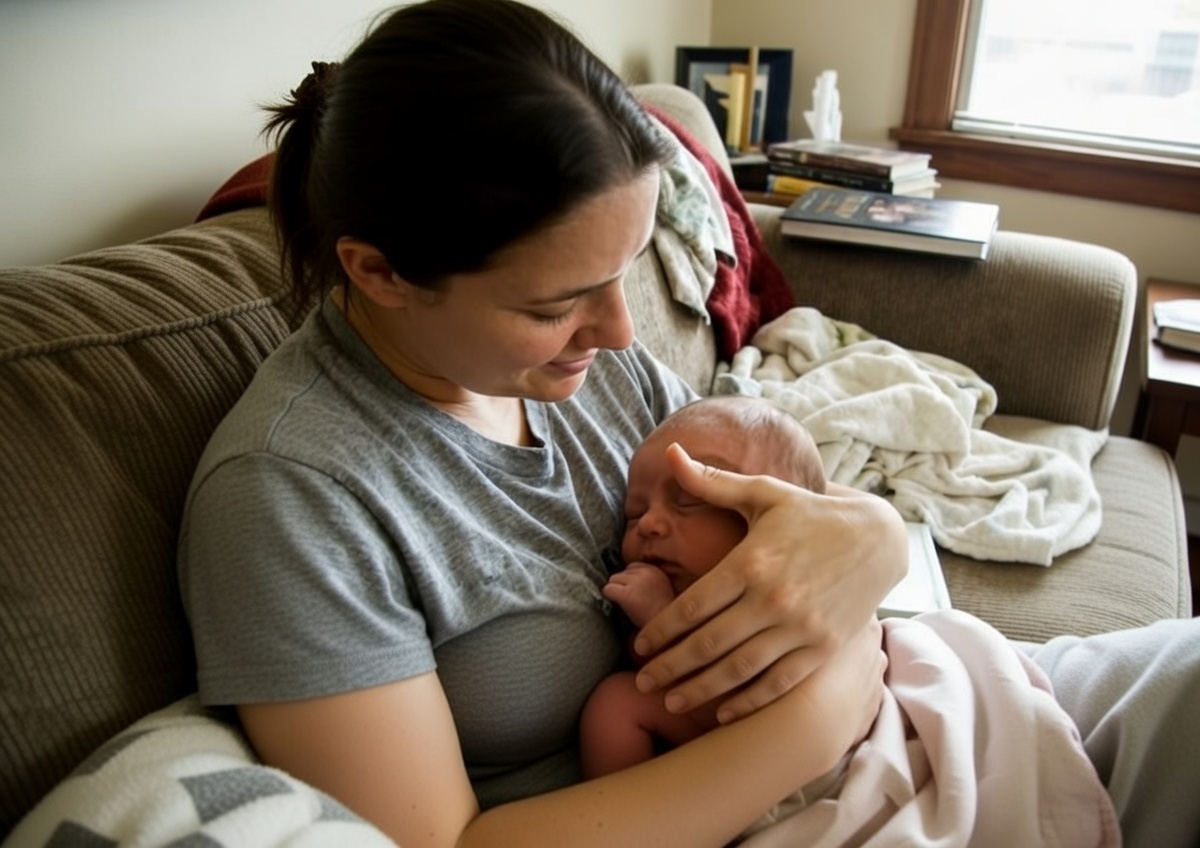
When Noah was born, the room fell into a hush I didn’t understand at first. Then I saw it—the port-wine stain spreading across half his tiny face, deep and unmistakable. Pity filled the air, heavy and uninvited. I panicked instantly, imagining cruel stares, whispered judgments, a lifetime of explanations.
Caleb never hesitated. He kissed Noah’s cheek—right over the birthmark—and whispered, “Hey, buddy. We’ve been waiting for you.”
That was the moment I understood the depth of his love.
Deborah, however, saw something else entirely. She stared too long. Asked questions that weren’t questions. Made comments about “not knowing what really happened.” She let doubt hang in the air like poison, subtly suggesting Noah wasn’t Caleb’s. Each time, Caleb brushed it off. “She’ll come around,” he told me. He believed people were better than their worst instincts. That faith made his sudden death at twenty-seven feel even crueler.
One day, he was planning our future. The next, a massive heart attack froze time.
The funeral passed in fragments—flowers, murmured condolences, Deborah’s loud, theatrical grief. It wasn’t until a week later that her true intentions surfaced. She informed me the apartment was in the family’s name. I was no longer welcome.
Her final accusation was delivered without hesitation:
“You got pregnant somewhere else and tried to trap my son.”
After that, life became a series of borrowed spaces. Friends’ couches. Cheap motels with thin blankets. I learned how to warm bottles in sinks and muffle a newborn’s cries so I wouldn’t disturb strangers. I learned how exhaustion can hollow you out without fully breaking you.
The turning point came on a rainy afternoon. A car splashed a puddle over us as I walked home from the grocery store. The driver stopped immediately—a young woman named Harper. She rushed out to apologize, but her words faltered when she saw my face.
Something in me cracked open. The whole story spilled out there on the sidewalk, rain soaking my shoes, Noah sleeping obliviously against my chest. Harper listened without interrupting. When I finished, she said quietly, “I’m a lawyer.” Then, after a pause, “And I can help you.”
A few days later, Deborah called. Her voice had softened into something syrupy and warm. She invited me to dinner, claiming she wanted us to be “family again.” Against my better judgment, I went—clinging to the fragile hope that she had finally seen Caleb in Noah’s eyes.
The dinner was a performance. Smiles. Polite conversation. Then the blade slid out smoothly. Deborah mentioned money Caleb had saved—money he had left to me in his will. She demanded most of it, claiming her role as a mother outweighed mine as a wife. When I asked for legal proof, she threatened to drag me through court until I had nothing left.
This time, I didn’t crumble. I called Harper.
The legal battle that followed was brutal, but Deborah was unprepared. Paper trails surfaced. Documents Caleb had quietly arranged. Protections he had put in place without fanfare. He had known, on some level, that I might need shielding from his mother’s bitterness.
When Harper finally told me it was over, I didn’t feel victorious. I felt emptied—then relieved. The money was mine. Noah’s. Proof that love could reach forward from the past and still protect us.
A month later, I signed the deed to a small house with a sunlit kitchen and a patch of grass out back. It wasn’t grand. It was safe. It was ours.
On moving day, I watched sunlight fall across Noah’s face. The birthmark glowed warm instead of ominous. I no longer saw it as something to explain away. I saw it as part of him—beautiful, unmistakable, and real.
Deborah never apologized. She likely never will. But I learned something she never understood: family isn’t possession. It’s presence.
As I rock Noah to sleep in our new home, I feel Caleb everywhere—in the walls, in the quiet protection he left behind, in the strength I found when I thought I had none left. Love doesn’t end. It adapts. It shelters. It stays.