
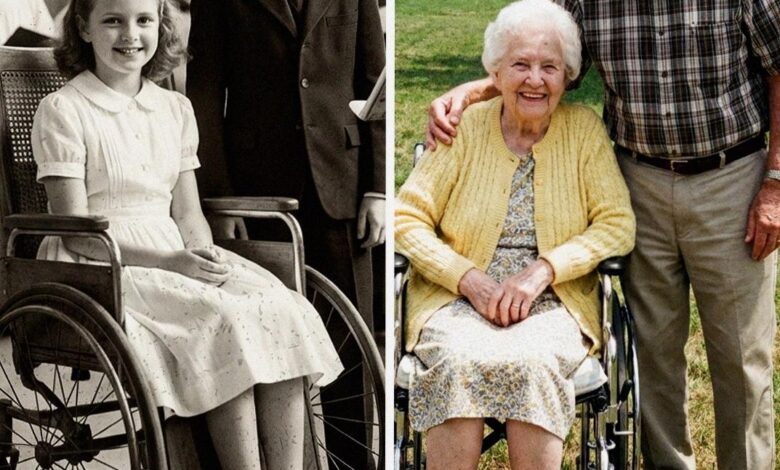
I was already using a wheelchair then. I’d learned early what it meant to be watched, pitied, avoided, or treated like a problem people didn’t know how to solve. Most kids kept their distance.
Martin didn’t.
He rolled right up to me like it was the simplest thing in the world and said hello—no awkward pause, no careful wording, no pretending he didn’t notice my chair. Just warmth. Just normal.
That one moment set the tone for everything that came after.
We grew up side by side. He teased me about hymns, argued with me about which songs were best, and sat close even when there were plenty of empty seats. He helped without making it feel like charity. He stayed without making it feel like obligation.
Somewhere between friendship and habit, we fell in love.
When he proposed, there were no grand speeches, no dramatic gestures.
He just said, “I don’t want to do life without you.”
And that was it. That was the promise.
We married young and built what people like to call a “good life.” We had two children—Jane and Jake. We watched them grow into adults, then watched our home fill again with grandchildren, noise, and the kind of laughter that makes you forget the hard years ever happened.
After 65 years, Martin didn’t feel separate from me. He felt like my history. My routine. My safety.
So when he died, it wasn’t only grief.
It was disorientation.
I sat beside him at the end, holding his hand and searching for the perfect final words—the kind you see in movies. But real life doesn’t always give you a script. When the moment came, I only managed, “I’m right here.”
Then came the silence.
For a while, the house was crowded—neighbors dropping off food, family checking in, friends offering condolences. And then, slowly, everyone returned to their own schedules.
I was left with mine.
And every room felt like evidence of him: his chair, his glasses, his coffee mug, the sweater he always reached for. I couldn’t bring myself to change anything. It felt like touching his things would make the loss permanent in a way I wasn’t ready to accept.
I kept telling myself I’d handle it later.
But later kept moving.
Until my daughter Jane finally said what I didn’t want to hear.
“You don’t have to do this alone,” she told me.
Somehow, that was the sentence that got me moving.
We started with Martin’s office. I stayed near the doorway at first, as if stepping fully inside would make my chest tighten. Jane began sorting papers with the focused energy she always uses when emotions get too heavy.
That’s when I noticed it.
A drawer in his desk—locked.
It didn’t make sense. Martin never locked anything away from me. Not money. Not documents. Not in all our years together.
I heard myself ask, quietly, “Jane… did you know about this?”
She looked up, confused. “No. Dad never mentioned it.”
I went to our bedroom and found his favorite jacket—the one he wore so often I used to joke it had become part of him. My fingers searched the pockets on instinct.
Keys.
Back in the office, my hands shook as I tried them one by one. Jane hovered beside me, her voice gentle.
“Mom, you don’t have to do this today.”
But something in me needed to know. Not out of suspicion—out of grief. Out of the strange feeling that my life had a missing page.
The key turned.
The drawer opened.
Inside was a thick bundle of letters, tied neatly together. Dozens. Maybe more. Some were sealed. Some were opened and re-read. Some were returned to sender, edges worn, stamps still attached. And mixed among them were replies in a woman’s handwriting.
My heart thumped so hard it felt loud in the quiet room.
Then I saw the name on one envelope.
A name I hadn’t spoken in more than fifty years.
Dolly.
For a second, my mind refused to connect the dots. Martin… writing to Dolly? Over and over? For years?
I opened one letter with hands that didn’t feel like mine.
The first line hit me like a physical blow:
“She still talks about you in her sleep.”
I don’t even remember dropping the paper, but suddenly it was on the floor. Jane picked it up, her face pale, reading fast and then slower, as if she couldn’t believe the words were real.
More letters followed—some from Martin, some from Dolly. Dates stretched across decades. The ordinary details of life were there: updates about our children, small moments from holidays, the way Martin described the house, the weather, the memories he couldn’t seem to stop carrying.
One line said, “She started humming again in the kitchen. It reminded me of when we were all younger.”
In another, Dolly wrote, “I don’t know how to fix something that’s been broken this long.”
It wasn’t a scandal in the way people imagine secrets—no flashy betrayal, no dramatic confession.
It was something quieter and, in its own way, heavier: a long bridge built in private, plank by plank, between two people who had once been close and then disappeared from each other’s lives.
I sat there, stunned, trying to make sense of what I was holding.
Was I supposed to feel angry? Hurt? Replaced?
Instead, what I felt first was confusion—because Martin had loved me. I knew that. I had lived inside that love.
So why had he kept this locked away?
Jane and I found the most recent address among the envelopes. We looked at each other, and we didn’t need to say much. Curiosity and grief can be powerful partners.
We drove.
The trip felt longer than it was. My thoughts ran in circles: old memories, half-forgotten names, moments I hadn’t questioned at the time.
When we finally arrived, it was a modest house with a small garden out front—quiet, well-kept, the kind of place that looks like someone is trying to make peace with the world.
When the door opened, Dolly stared at me like she’d seen a ghost.
Her voice trembled. “Martin promised he wouldn’t tell you… unless you were ready.”
And then, after more than fifty years of silence, we stood there—two women connected by one man’s loyalty, one man’s choices, one man’s complicated kind of love.
We didn’t argue. We didn’t perform a lifetime of pain in one conversation. We did something simpler.
We embraced.
Not because everything was suddenly easy, but because time had already done its damage—and Martin, in his own imperfect way, had tried to soften it. He had carried a silence that didn’t belong to one person alone. He had kept a thread tied between past and present, maybe hoping that one day it wouldn’t feel like a wound—maybe hoping it could become closure.
On the drive home, the world looked the same, but I didn’t feel the same inside it.
For the first time since Martin died, I didn’t feel completely hollow.
Because as shocking as those letters were, they also revealed something I hadn’t expected: not a second life, but a hidden act of care. A quiet attempt to mend something old without breaking what we had built.
And somehow, after all those years, it mattered more than the secret itself.
Closing Thoughts
Grief has a way of turning ordinary objects into answers—drawers, keys, envelopes, names you thought you’d left behind. And sometimes the truth isn’t there to punish you. Sometimes it’s there to finally let you breathe.
If this story touched you, share what you think: Have you ever discovered something after a loss that changed the way you saw a loved one? Leave a comment and join the conversation—your experience might help someone else feel less alone.