
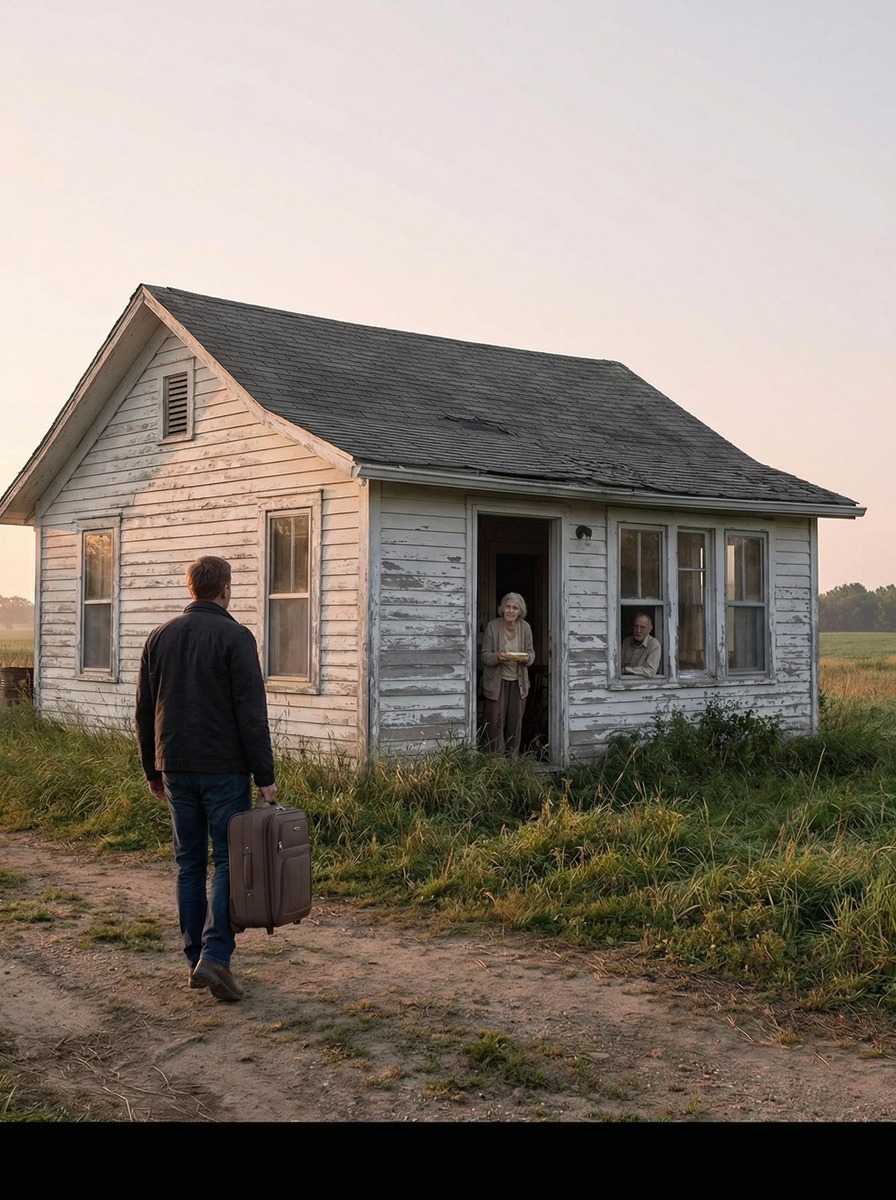
Then came a winter morning that changed everything.
Matthew had just finished a delivery before dawn, the sky still dark and heavy with cold. Frost crawled across his windshield as he sat in the cab, hands resting on the wheel, engine idling. There was no urgent thought, no crisis—just a sudden, sharp ache for his mother’s voice. He remembered how she always ended calls too quickly, as if she didn’t want to burden him, as if holding him longer might reveal something she’d worked hard to hide.
Without planning it, he turned the truck west.
He didn’t call ahead. He didn’t explain. He simply drove, letting the road lead him back to where it all began. By the time Redwood Falls appeared, framed by bare trees and gray winter light, his chest felt tight with anticipation and unease. The town looked smaller than he remembered, quieter. The house at the end of the street—his house—stood worn but familiar, its paint faded, its porch sagging slightly under the weight of years.
When he knocked, the door opened slowly.
His mother stood there, surprised into stillness. Her hair had gone almost completely gray. Lines traced her face more deeply than he remembered, but her eyes were the same. She didn’t speak at first. She just stared at him, as if afraid he might disappear again if she blinked.
“Matthew,” she whispered finally, her voice shaking like a fragile wind through winter trees.
“Hi, Mom,” he said, feeling his own voice tremble. The words sounded foreign, distant, too small for the years they had to cover.
Inside, the house was warm but sparse. A simple meal sat half-prepared on the kitchen table, meant for two. His father appeared quietly in the doorway, thinner, stooped just enough to notice. They hugged without words, the kind of embrace that carried everything unspoken. In that moment, Matthew understood how much his parents had carried alone—and how carefully they had hidden it from him.
That night, sleep didn’t come easily. Guilt pressed in from all sides. He replayed conversations, remembered how often they’d said they were “fine,” how rarely he’d questioned it. Before sunrise, he left the house again—but not to run. He returned hours later with groceries, medications, household supplies. He filled the refrigerator and cabinets, apologizing clumsily with actions because words still failed him.
Over the following days, Matthew stayed.
He repaired what he could. He patched the roof where leaks had crept in unnoticed. He cleared the yard, shoveled snow, fixed the loose step on the porch. His father watched quietly, offering advice only when asked. His mother hovered in the kitchen, cooking more than necessary, relieved by his presence but careful not to show it too openly.
Neighbors stopped by, offering greetings and small talk, happy to see family gathered again. Redwood Falls hadn’t changed much, but Matthew had. The town no longer felt small—it felt steady.
Evenings became something sacred. They ate together at the table, lingering long after plates were empty. Matthew shared stories of lonely highways and endless motion, of nights when the road felt infinite and hollow. His parents spoke of quiet endurance: medical appointments they hadn’t mentioned, repairs postponed too long, nights spent hoping he was safe somewhere far away.
One afternoon, his mother handed him a folded letter she had tucked away in a drawer for years. It was a note he had written as a child, aged nine, promising to “take care of the family when I grow up.” She smiled softly as she pressed it into his hand. “I think you were trying to tell us something even back then,” she said.
Laughter returned slowly, cautiously at first, then freely. They sat on the porch beneath open skies, wrapped in blankets, watching the stars blink into existence one by one. The silence there was different from the silence on the road. It was full, not empty.
One night, as cold air bit gently at his hands, Matthew realized the truth he’d been avoiding. Success wasn’t measured by distance traveled or money earned. It wasn’t proven by absence. Real success was knowing where you were needed—and choosing to be there.
When he decided to stay, it wasn’t out of obligation or guilt. It was love, simple and undeniable. He found work closer to home, less glamorous, more grounded. The pace slowed. Days gained shape. His parents no longer had to pretend everything was fine, and he no longer had to pretend distance was devotion.
In the weeks that followed, Matthew and his father repaired the old barn behind the house. They sanded and painted, fixed creaky doors, and stored supplies for the coming seasons. His mother started planting bulbs in the small garden, and Matthew helped, his hands in the soil, feeling the quiet satisfaction of creation rather than constant motion.
Home was no longer a place he remembered. It was a place he reclaimed.
By spring, Redwood Falls felt like a town of infinite possibility rather than constriction. Matthew watched the children on his old street play in the sun, their laughter carrying freely over snow-melt puddles. He realized that the foundation he had been building all these years—through miles, paychecks, and delayed returns—was nothing compared to the foundation of love, presence, and shared effort that had been here all along.
In returning, Matthew found what the road had never given him: belonging, purpose, and the quiet, enduring strength of family. And in those small, everyday moments—mending, cooking, laughing—he discovered that coming home wasn’t just a destination. It was a choice. A promise he would keep, every day that he could.