
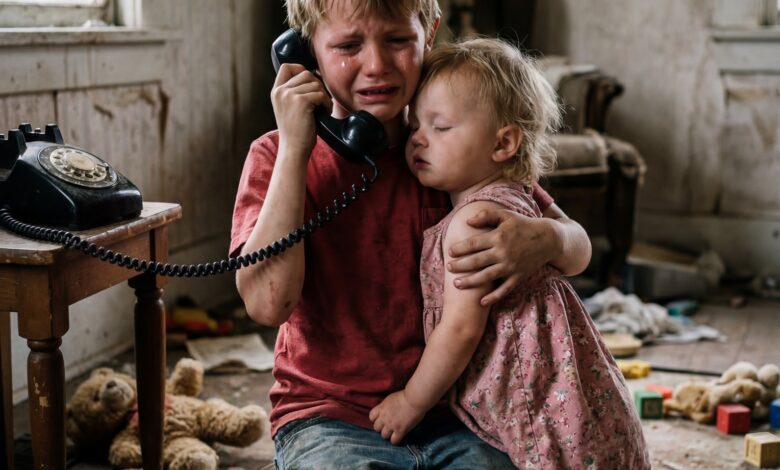
Rowan’s chair scraped back so fast it startled the room. The meeting, the spreadsheets, the numbers on the screen—none of it mattered anymore.
“Micah?” Rowan said, already standing. “Why are you calling from another phone? Where are you?”
The boy sniffed, forcing himself to stay brave in the way only kids can when they’ve been scared for too long. “At home.”
Rowan grabbed his keys and ran.
A House That Was Too Quiet
Earlier that week, Delaney—Rowan’s ex and the children’s mom—had said she was taking the kids to a friend’s lake cabin where cell service was spotty. It was her custody week. Their co-parenting wasn’t perfect, but it had been “good enough” lately.
Until this call.
Rowan drove through downtown Nashville like the world was on fire, calling Delaney again and again.
No answer.
He reached her East Nashville rental in under thirty minutes. When he pulled up, his stomach tightened. There were no toys in the yard. No TV noise. No movement. Just a heavy, unnatural stillness.
He pounded on the door.
It opened.
Unlocked.
Inside, Micah sat on the living room floor clutching a pillow like it was the only thing holding him together. His hair was flattened, his face smudged with dirt, and his eyes looked too tired for a six-year-old.
Micah looked up and barely breathed the words: “I thought maybe you weren’t coming.”
Rowan dropped to his knees. “I’m here. Where’s your sister?”
Micah pointed toward the couch.
Elsie, three years old, lay curled under a blanket. Her face was pale but flushed, lips dry, breathing shallow. Rowan touched her forehead and felt a fever so intense it made his chest seize.
He lifted her. Her head fell against his shoulder without resistance.
“We’re leaving right now,” Rowan said, forcing steadiness into his voice. “Micah—shoes. Now. Stay with me.”
The Empty Kitchen That Said Everything
As Rowan rushed through the kitchen, details burned into his memory: an empty cereal box, a sink stacked with dishes, a nearly finished ketchup bottle in the fridge.
Nothing else.
No fruit. No milk. No leftovers. Nothing a child could use to feed himself—let alone keep a toddler alive.
A small cup sat near the sink with dried juice stuck to the bottom.
Rowan carried Elsie to the car, buckled Micah into the back seat, and drove toward Vanderbilt Children’s Hospital, hazard lights blinking. He kept reaching one hand behind him as if being close could protect them.
From the back seat, Micah spoke so softly Rowan almost missed it.
“I tried to give her crackers,” he said. “But she wouldn’t eat.”
Rowan swallowed hard. “You did the right thing calling me. You did exactly the right thing.”
Emergency Room Reality
The hospital moved fast. A nurse met Rowan with a gurney before he’d taken three steps.
“High fever,” Rowan said. “She’s barely responding. She hasn’t been eating. I think they’ve been alone too long.”
Another nurse knelt in front of Micah. “Hey, sweetheart. Want to stay with your dad while we help your sister?”
Micah grabbed Rowan’s pant leg and nodded, silent.
Rowan knelt beside him even as Elsie was rushed away. “They’re taking care of her,” he said. “I’m not going anywhere.”
He repeated the story again and again—to intake staff, to a doctor, to a hospital social worker with a notepad and a careful expression. Custody schedule. The lake cabin story. The unanswered calls. The empty kitchen. Micah’s quiet admission that this wasn’t the first time they’d been left alone.
The social worker asked, “Do you know where their mother is?”
Rowan’s jaw tightened. “No.”
“Are you prepared to take temporary full responsibility?”
“I’ll do whatever keeps them safe.”
The Diagnosis—and the Call That Changed Everything
When the doctor finally returned, Rowan felt like his body had aged years in a single night.
“She’s stable,” the doctor said. “Severe dehydration and a stomach infection. It got worse because she wasn’t eating or drinking properly. We’re keeping her for observation, but you got her here in time.”
Rowan exhaled a breath he didn’t realize he’d been holding.
Micah, still trembling, ate crackers, applesauce, and half a turkey sandwich with the focus of a child who had learned what hunger really meant.
Then a nurse approached Rowan quietly.
“Mr. Mercer… another hospital contacted us. Your former partner was admitted to Nashville General early Saturday morning after a serious car accident.”
Rowan stared. “What?”
“She arrived unconscious with a head injury and multiple fractures. She’s stable now. She had no ID. She was with an adult male who left before staff could confirm information.”
Anger hit first—sharp and immediate.
Then came the harder truth: whatever happened to Delaney, two small children had been left alone with almost nothing to eat.
Rowan stepped into the hallway and called his attorney.
“I need emergency custody action,” he said. “My daughter is hospitalized. The kids were alone for days. Social services are involved.”
“Can I Stay With You All the Time Now?”
Back in Elsie’s room, Micah sat in a chair too big for him, watching the monitors like it was his job to keep the world from breaking.
“Dad?” he asked. “Can I stay with you all the time now?”
Rowan’s voice softened. “Starting now, you stay with me as much as you need.”
Micah eventually fell asleep under a thin hospital blanket. Rowan sat between both children, listening to the IV drip and the steady beep of the monitor—sounds that were terrifying and comforting at the same time.
The next morning, a pediatric therapist spoke plainly.
“Your son took on far too much responsibility,” she said. “He was brave, but that means he’s carrying fear no child should carry. Your daughter may cling to him because he became her safety.”
Rowan nodded, throat tight.
“What helps now,” she continued, “is routine. Predictability. Calm. Honest answers without adult details. And no promises you can’t keep.”
Rowan realized something he’d never fully understood before: love wasn’t just a feeling. It was structure. It was food in the fridge. Medicine measured correctly. Bedtime even when work ran late. A steady voice at 2 a.m. after a nightmare.
The Conversation at Nashville General
After arranging childcare, Rowan went to see Delaney. She looked smaller in the hospital bed—arm in a cast, bruising across her cheekbone, eyes avoiding his.
Rowan didn’t raise his voice.
He didn’t have to.
“The kids are alive,” he said, words sharp with restraint.
Delaney’s explanation came out in fragments: she’d gone out with a man she was seeing, thinking she’d be gone a couple hours. There was drinking. An argument. A crash. Then darkness.
Rowan’s hands clenched at his sides. “You left a six-year-old and a three-year-old alone with almost no food.”
He paused. “Micah thought Elsie was going to die.”
Delaney covered her mouth, and for the first time, Rowan believed the remorse was real.
“I’m filing for temporary full custody,” Rowan said.
Delaney’s voice cracked. “Are you taking them away forever?”
“No,” he said. “I’m protecting them. What happens next depends on what you do next.”
Before he left, Delaney whispered, “I asked for therapy.”
Healing Isn’t Dramatic—It’s Daily
The weeks that followed were exhausting in ways Rowan never anticipated.
Micah woke up crying at night. Elsie refused to be alone in a room. Rowan burned grilled cheese, shrank sweaters, forgot school paperwork—and learned that children will ask the same scared question ten different ways before they can finally sleep.
He rearranged his work schedule. Packed lunches. Sat through therapy appointments. Made the days steady enough for two little people to lean on.
And slowly, the panic in their home began to loosen its grip.
Delaney did what the court required. She went to therapy. She cut ties with the man from the night of the crash. She moved into a small apartment and started supervised visits.
Micah stayed close but cautious. Elsie hid behind him, studying her mother like she was trying to decide if trust was safe.
Delaney didn’t demand affection. She didn’t push hugs. She showed up. She read books. Colored quietly. Brought photos. Returned every time.
Kids notice consistency the way plants notice sunlight.
A Custody Plan Built Around the Kids
At the first family court hearing, Rowan came with a thick folder: medical documentation, therapy notes, social worker reports. Delaney looked healthier but careful—like she knew how fragile rebuilding can be.
When the judge asked Rowan what he wanted, Rowan’s answer was simple.
“My children need safety first,” he said. “They love their mother. If the professionals say gradual contact is healthy, I won’t block it. But the pace has to match what they can handle.”
The judge approved a temporary plan: primary placement with Rowan, supervised visitation for Delaney, continued therapy support.
Over time, supervised visits became weekday dinners. Dinners became longer afternoons. Delaney made a reading corner for Elsie and stocked games Micah loved. She learned to listen more than she explained.
One day, Micah asked from the back seat, “Can Mom come to my school play if I want both of you there?”
Rowan met his eyes in the mirror. “If that’s what you want, we’ll make it happen.”
Another night, Elsie climbed into Rowan’s lap with a drawing: two small houses connected by a bright rainbow.
“This is us,” she said proudly. “We live in two places, but we go together.”
A New Version of Family
By the final review hearing in early fall, things weren’t perfect—but they were real.
Micah told the judge, carefully, “I like it when nobody fights and everybody tells the truth.”
Elsie handed over a picture of four stick figures holding hands beneath a huge yellow sun.
The judge signed the revised shared custody order.
Outside the courthouse, Micah asked for ice cream. Elsie wanted sprinkles. Rowan and Delaney exchanged a look that wasn’t romance—but it was steadier than anger. It was commitment to doing better.
Later that night, after the kids fell asleep, Rowan stood in the hallway looking at two bedroom doors left slightly open.
He thought about the unknown number on his phone. The empty kitchen. The hospital bracelets. Therapy rooms. Court paperwork. And the small, consistent choices that slowly turned fear into stability.
He had nearly lost the shape of his family.
Instead, through consequences, honesty, and work, they built a new one—one grounded in safety, responsibility, and truth.
For the first time in a long time, it was real.
Closing Thought
If this story moved you, share what part hit you the hardest—and if you’ve ever had to rebuild trust in your family, tell us what helped. Your comment might be exactly what another reader needs today.