
Yet even as candles were lit and prayers whispered, the internet did what it so often does in moments of vulnerability—it turned ruthless. Instead of allowing space for grief, sections of the online political ecosystem shifted focus toward mockery, resentment, and cultural scorekeeping. The Kennedys’ pain became fodder for commentary far removed from compassion.
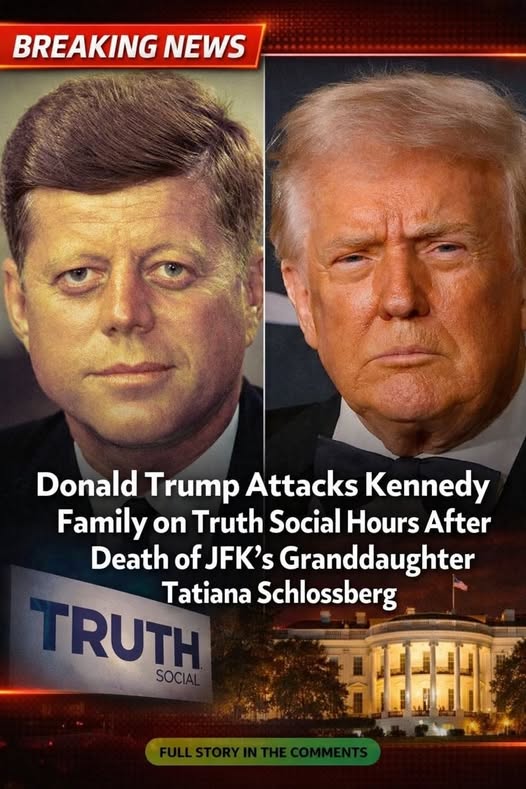
At the center of that storm stood Donald Trump, a figure whose relationship with the Kennedy legacy has long been adversarial. As the family mourned, Trump shared and amplified online posts that critics described as derisive toward the Kennedys’ history and influence. Supporters defended the actions as political commentary; detractors saw them as an unseemly intrusion into a moment of human loss.
The timing intensified the backlash. Concurrently, controversy erupted around a reported initiative to rebrand the Kennedy Center, with proposals circulating that would attach Trump’s name alongside the Kennedy legacy. Allegations surfaced of rushed procedures, muted objections, and a process that many felt lacked transparency. While officials disputed claims of impropriety, the symbolism alone was enough to inflame public debate.
For many Americans, the juxtaposition was jarring. On one side, a family bound together by grief, shielding young children from cameras and noise. On the other, a political machine that never sleeps, where even death becomes another front in a cultural war. The Kennedys’ name—once associated with national optimism, tragedy, and public service—was again being repurposed as a rhetorical weapon.
This was not the first time the family had endured loss under scrutiny. From Dallas to Hyannis Port, the Kennedys have lived with a history where mourning is rarely private. Yet Tatiana’s death felt different to many observers because it unfolded in an era defined by algorithm-driven outrage and performative cruelty. There was no pause, no collective breath—only instant reaction.
Political analysts noted that the episode reflected a broader shift in American discourse. Respect for personal boundaries, once a bipartisan norm in moments of death or illness, has eroded. Social media platforms reward provocation, not restraint. In that environment, empathy often loses to engagement metrics.
For the Kennedys, the focus remained inward. Friends described a family circling protectively around Tatiana’s husband and children, prioritizing quiet remembrance over public statements. Caroline Kennedy was said to be devastated yet resolute, leaning on the same strength that had carried her through decades of loss.
Outside that circle, the debate raged on. Was it fair to criticize political speech during a family tragedy? Should public figures be held to a higher standard when private citizens—especially children—are involved? Or had American politics simply crossed a line from which there is no easy return?
What was undeniable was the contrast itself. A young woman lost her life to leukemia after fighting with courage and dignity. Her family sought only space to grieve. At the same time, their name echoed across headlines for reasons that had nothing to do with her life, her work, or her love for her children.
In the end, the moment served as a stark reminder of what gets lost when politics eclipses humanity. Legacy is not just buildings, surnames, or institutions. It is also how a society behaves when faced with someone else’s pain.
For many watching, the hope was simple: that Tatiana Schlossberg would be remembered not as a footnote in a political skirmish, but as a woman whose life mattered far beyond ideology. And that, somewhere beneath the noise, the country might relearn how to let grief exist without turning it into a battleground.