
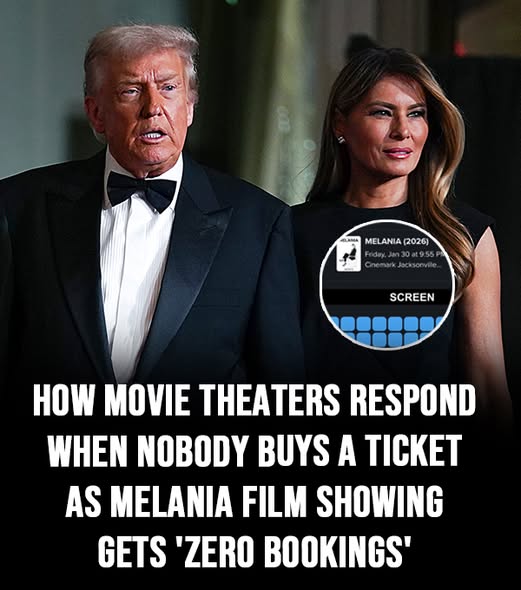
Donald Trump, ever the tireless promoter, took to social media platforms like X to drum up excitement. He hailed the film as a “must-watch” and claimed that tickets were “selling out fast.” But as the premiere date approached, digital seating charts told a very different story. Users across social media began sharing screenshots from major theater chains in cities across the country, showing auditoriums with nearly every seat available. In some regions, entire daytime and evening blocks remained completely unbooked. The discrepancy between the “sold out” rhetoric and the visual evidence of empty rooms triggered a wave of online mockery, with critics labeling the rollout a massive disconnect between political influence and genuine public interest.
The struggling sales reportedly triggered an “emergency” strategy among Republican-affiliated groups. According to entertainment journalist Rob Shuter, there has been a coordinated, quiet effort to “paper” the house. Writing on his Substack, Shuter detailed claims that local GOP clubs in conservative strongholds were instructed to purchase large blocks of tickets—or in some cases, sponsor entire screenings—to ensure that theaters didn’t appear deserted on opening weekend. One industry insider described these tactics as a purely optical maneuver, stating that “empty theaters look terrible” for a brand built on the premise of popularity. Further allegations surfaced suggesting that tickets were being distributed for free or at steep discounts through partisan websites, leading some to describe the screenings as a “loyalty check” for the base rather than a traditional movie-going experience.
The situation has also invited a fascinating look at the logistical reality of modern cinema management. When a film like Melania has zero tickets sold for a scheduled showing, theaters often face a dilemma. According to former theater employees sharing their experiences on Reddit, the standard protocol for an empty auditorium varies. During busy daytime hours, a projector might run the film to an empty room as a matter of automation. However, for late-night or low-traffic slots, managers often “dim the lamp”—shutting down the expensive projector bulb to save on costs—turning the movie back on only if a patron walks in last-minute. These “ghost screenings” are a common, albeit embarrassing, reality for box office flops, often becoming a favorite for cleaning crews who appreciate a room that requires zero maintenance between shows.
Despite the lackluster data, the Trump camp has maintained a front of absolute success and prestige. On January 25, just days before the wide release, a private screening was held at the White House. Melania Trump took to X to describe the event as a “historic moment,” noting that she felt “deeply humbled” to be surrounded by “cultural iconoclasts” and family. Her posts framed the documentary not as a commercial venture, but as a contribution to the national archives—an enduring story of personal value. For her most loyal supporters, this narrative remains intact, viewing the film as a testament to her grace and the challenges she has faced.
However, the broader public reaction has been one of skepticism. Many analysts suggest that the “political documentary fatigue” has finally set in. After a decade of constant exposure to the Trump family’s media cycle, even a $40 million Amazon-backed project may struggle to find an audience outside of the most dedicated supporters. The documentary Melania arrives at a time when the American public is increasingly polarized in its media consumption; while one side sees a “must-watch” history of a First Lady, the other sees a carefully curated PR campaign that lacks the “intimate” honesty it promises.
As the film rolls into its first full week of nationwide screenings, the ultimate fate of Melania remains uncertain. While the coordinated block-buying may temporarily boost the numbers, the “organic demand” that theaters rely on for long-term success appears to be missing. The coming days will provide the final verdict: whether the film will gain a second wind through curiosity and renewed promotion, or whether it will go down as one of the year’s most expensive and public box office misfires. For now, the “Melania” film stands as a case study in the limits of political branding—where even the loudest endorsements from the most powerful figures cannot always fill a quiet, empty theater.