
Not everyone agrees on the details of those years. Her father has publicly disputed parts of Meghan’s recollections, particularly around financial hardship, insisting he provided stability and daily support. But memory is personal, and what lingered most for Meghan was not money or material comfort—it was the emotional experience of feeling different, unseen, and unsure of where she fit.
As her parents separated, Meghan moved between two worlds. She lived with her father full-time after age nine while maintaining a close bond with her mother, who relocated to a predominantly Black neighborhood and found strength in a tight-knit community of women. That village, Doria later explained, played a major role in helping raise her daughter. Their relationship wasn’t always conventional. Doria once recalled asking Meghan whether she felt like her mother, only to hear her reply that she felt more like an older, controlling sister. The honesty between them became a foundation for trust.
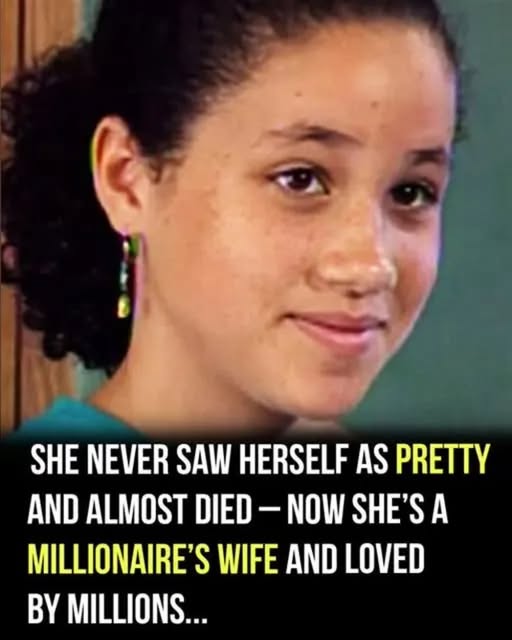
Adolescence sharpened Meghan’s insecurities. She has said plainly that she was “not the pretty one” growing up, identifying instead as the smart girl, the nerd, the overachiever. Intelligence became her armor. At just eleven years old, she challenged a sexist television commercial with a handwritten letter, successfully pushing for change. Even then, her voice carried conviction.
Despite limited resources, Meghan learned to appreciate small luxuries. A salad bar dinner at Sizzler felt like a celebration. Girl Scout outings went to places families could afford, and gratitude was woven into those experiences. When her father later won a substantial lottery sum, it opened doors to elite education and training, accelerating a path Meghan was already determined to walk.
Her work ethic emerged early. By thirteen, she was juggling jobs—babysitting, working at a donut stand—while dreaming far beyond her circumstances. She found her love for acting on the set of Married… with Children, where her father worked. She later joked that it was an unusual place for a Catholic schoolgirl to spend time, but it exposed her to storytelling, production, and performance in a way that felt natural.
Still, the industry didn’t know what to do with her. As a biracial actress, Meghan was often labeled “ethnically ambiguous.” She has said she wasn’t considered Black enough for certain roles or white enough for others. That in-between space, familiar from childhood, followed her into adulthood. It was exhausting—and formative.
Persistence paid off. At thirty-three, she reflected publicly on happiness, self-kindness, and growth. Around that time, her career gained momentum with her role as Rachel Zane on Suits. The show brought visibility, financial independence, and confidence, but it was not the final chapter.
In 2016, Meghan met Prince Harry. Their relationship moved quickly under intense scrutiny. In 2018, they married at Windsor Castle, watched by millions worldwide. The union symbolized change within the British monarchy, but it also triggered unprecedented media pressure.
Motherhood brought both joy and danger. Meghan and Harry welcomed Prince Archie and later Princess Lilibet. Behind the scenes, Meghan faced life-threatening postpartum complications. In 2025, on her podcast Confessions of a Female Founder, she revealed she had suffered postpartum preeclampsia, a rare and serious condition. She spoke not with drama, but with clarity—about trying to show up for her children while navigating a medical crisis that could have ended her life.
Survival was followed by heartbreak. Meghan later shared that she experienced a miscarriage, an event she described with unfiltered vulnerability. These moments stripped away any remaining illusion of a fairy-tale life. What remained was resilience.
Today, Meghan Markle occupies a space few women ever will—global, scrutinized, influential, and still deeply human. Her journey from insecure teen to international public figure is not a straight line of success, but a complex portrait shaped by race, class, ambition, love, and loss. She no longer waits to be understood by institutions that once tried to box her in. She speaks for herself, builds on her own terms, and raises her children with the hard-earned wisdom of someone who has lived many lives in one.
Her story is not about royalty. It is about agency. And it continues.