
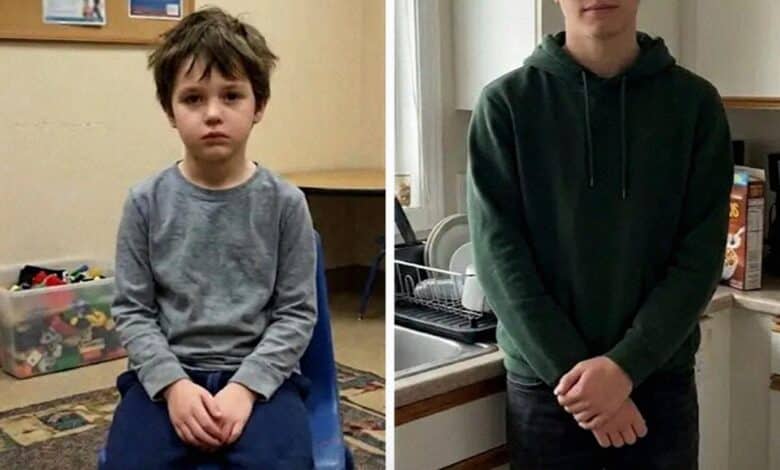
He sat across from me, hands still, eyes fixed on the table like he’d been practicing this moment for years.
“I’m ready to tell you the truth,” he said. “About my past.”
A Child Who Treated Love Like It Could Expire
Mike had always lived like love was temporary.
Even as a little kid, he never reached for joy the way other children did. When I gave him gifts, he didn’t tear into them or laugh or bounce on his toes. He would hold the box carefully, almost respectfully, like excitement might trigger some invisible punishment.
Then he’d look up and ask the same question every time:
“Are you sure this is really mine?”
That one sentence told me more than any case file ever could. Life had taught him that things get taken back. That people change their minds. That safety is rented, not owned.
I met him when he was seven—an age many adoptive families quietly skip past while searching for toddlers. By then, I had already watched my own life collapse in ways I never expected. My marriage ended without a clean explanation, and the future I’d planned disappeared piece by piece.
But the desire to be a mother didn’t disappear with it.
I didn’t want “someday.” I wanted a family I could build, even if I had to build it alone.
The Adoption Warning No One Said Out Loud
The social worker hesitated when she brought up Mike. That pause was the first red flag.
She told me he’d been in the system for years. She mentioned—carefully—that most families preferred younger children. Then she added something else, almost like she didn’t want to give it too much oxygen.
There were “concerns.” Rumors. A reputation that followed him from placement to placement.
When I met him, he didn’t smile. He didn’t even pretend.
He looked at me like he’d already seen this scene play out too many times.
“Hi,” he said, and then—too quickly—added, “I know you’re not going to take me. So we can just get this over with.”
It landed like a punch.
I asked why he’d say that. He shrugged, like disappointment was just the normal weather of his life.
That shrug showed up again and again over the years—in moments when he wanted to hope, but didn’t trust hope enough to touch it.
From that day on, he wasn’t just a child I brought home.
He was my son.
“If I Mess Up… Do I Still Get to Stay?”
Not long after he moved in, I tucked him into bed and kissed his forehead. As I pulled away, he reached out and grabbed my hand with a grip that didn’t match his quiet personality.
“If I mess something up,” he whispered, “I still get to stay… right?”
I told him yes. Of course. Always.
But he nodded like he was trying to force his brain to accept something it didn’t believe yet.
Time passed the way it always does—fast, without asking permission.
Then came his eighteenth birthday.
And the morning after.
The “Curse” He Believed Was Inside Him
At the kitchen table, Mike finally said the thing he’d been carrying since before I met him.
For years, he believed he was the reason bad things happened.
Not in a logical way. Not like a child making up stories.
He believed it in the deep, permanent way that trauma plants itself—like a seed that grows into a truth you never question.
If something broke, he blamed himself. If people argued, he assumed it was because he was there. If plans fell apart, he felt responsible.
Then he said the word that made everything go still:
“They told me I was cursed.”
Someone had convinced him that wherever he went, things fell apart. That people avoided him for a reason. That no one wanted him because misfortune followed him.
And worst of all—he believed I’d sacrificed my life by taking him in.
That was the moment I realized I hadn’t just missed a detail.
I’d missed the entire storm.
The Search for Answers—and the Paper Trail of a Lie
After he left the house that day, I sat alone and replayed his childhood like a film I’d watched too casually the first time.
The apologies for things he couldn’t control.
The panic over small mistakes.
The way he flinched when life got unpredictable, like he expected to be blamed.
I went back to the adoption center and asked for the same social worker. She was older, but her eyes still had that sharp, measured focus.
When I told her what Mike had said, she didn’t look surprised.
She finally admitted what should have been made clear from the beginning:
There had been rumors about him for years—stories spread by someone who decided a child was the easiest place to dump grief, anger, and blame. People repeated it. Placements hesitated. Families backed out. The label stuck.
Then she showed me something that made my stomach drop.
An old newspaper article.
There was my son’s face under a headline that no child should ever have printed beside their name.
This wasn’t just gossip passed between adults.
It had been made public.
The Person Who Started It All
The woman behind the story still lived in the same town.
When I stood at her door and said Mike’s name, recognition flashed across her face immediately—followed by something defensive, like she’d been waiting for this moment and dreading it at the same time.
Her son and his wife had taken Mike in as a baby. They loved him, she said.
Then life broke apart.
A pregnancy loss.
A business that failed.
And later, a tragic accident that took them both.
Mike wasn’t even there when it happened.
But grief doesn’t always look for truth.
Sometimes grief looks for a target.
And she had turned her pain into a story that made a child carry the weight of adult tragedy.
I walked away from that house with one clear thought:
Mike didn’t run from me because he didn’t love me.
He ran because he thought leaving was the only way to protect me.
Finding Him Where He Went When He Needed to Disappear
I called him again and again. No answer.
Then I remembered the place he used to go when he needed space—the spot where he could sit quietly and watch people come and go, convincing himself he didn’t belong to anyone.
I found him there, alone, staring out like he was preparing for the ending he’d always expected.
I walked straight to him and held his face in my hands.
I told him everything: the lies, the article, the woman who needed someone to blame.
And then I said the only sentence that mattered:
“You are not something bad that happened to me. You are the best thing that ever did.”
I told him I didn’t lose my life raising him.
I found it.
He didn’t break down dramatically. He didn’t suddenly turn into a different person.
But I felt the shift—the smallest crack in the weight he’d carried for years, just wide enough for something new to enter.
Relief.
Possibility.
Maybe even hope.
When the Future Finally Stops Feeling Dangerous
We went home together—quieter, but lighter.
Later, he asked about college like the future had finally opened a door instead of raising a wall.
Before he went upstairs, he turned back and said, “Thanks for coming after me.”
And I understood something I’ll never forget:
Sometimes the difference between a life defined by fear and a life defined by healing is one simple act—someone choosing not to let you walk away alone.
If this story moved you, share your thoughts in the comments—have you ever carried a label someone else put on you? And if you want more real-life stories about family, healing, and second chances, follow/subscribe so you don’t miss the next one.