
I never imagined I’d be sharing a story like this. Even now, remembering it makes my chest feel tight and my hands go cold. Some experiences don’t arrive with warning signs. They slip quietly into your life, and only later do you realize they changed everything.
My name is Pauline. I’m thirty-four, a single mother, and I work overnight cleaning office buildings. It’s steady work—physically demanding and often unnoticed—but it keeps a roof over our heads. My daughter, Eve, is six years old. She’s thoughtful beyond her years, the kind of child who notices when adults are tired and tries not to ask for too much. That kind of emotional awareness usually comes from growing up faster than you should.
Three years ago, Eve’s father passed away after a long illness. There was no dramatic moment, no sudden turn. One day he was still trying to be strong, and then he was gone. After that, life became a blur of grief, bills, and quiet evenings. I didn’t have the option to stop moving forward. Eve needed stability, and I was the only one left to provide it.
Since then, it’s been just the two of us, building a sense of normal through routines and small promises. When Eve’s birthday approached, I wanted to give her something meaningful. Not expensive—just something that told her she was seen and loved.
But financial reality has a way of narrowing choices. Rent cleared my account. Groceries took most of what remained. Utilities waited like an unspoken threat. The night before her birthday, I sat at the kitchen table doing the math again and again, hoping the numbers would somehow change.
“Love matters more than presents,” I whispered to myself.
Eve never complained. She never asked for more than she knew we could manage. Still, I noticed the way she lingered in store aisles, how she hesitated before putting things back. She already understood our limits.
The next morning, I left her with my neighbor, Janice—who promised cartoons and cupcakes—and headed to the flea market with twenty dollars and quiet determination.
The air was cold and sharp. The market was full of forgotten items—housewares, old electronics, toys missing pieces. Pieces of other people’s lives, left behind.
That’s when I saw the doll.
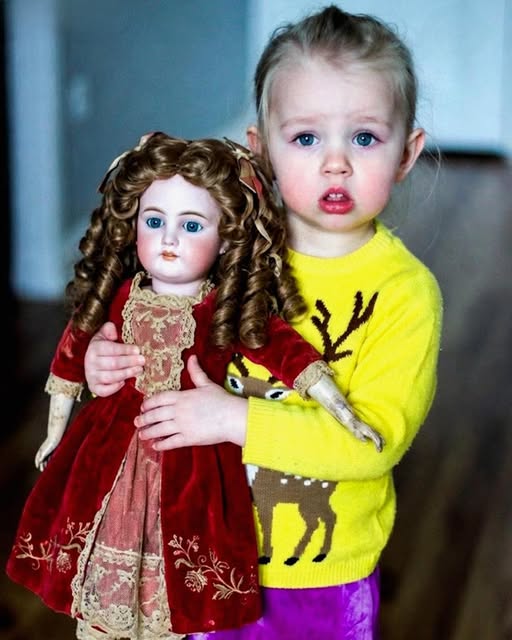
She sat on a faded cloth, her dress worn but clean, yarn hair slightly unraveled. What caught my attention were her eyes—bright blue and calm. She held a smaller baby doll against her chest, positioned carefully, as if someone had taken time to make sure she looked loved.
I picked her up and asked the woman at the table for the price.
Before she could answer, the man beside her spoke quietly. “You can have her.”
I hesitated. The woman looked tired, her expression distant. When she finally spoke, her voice was steady but fragile.
“She deserves to be loved,” she said. “Please take her.”
I didn’t ask questions. I thanked them and carried the doll home carefully, like something fragile and important.
On Eve’s birthday morning, I placed the wrapped box in front of her. She stared at it, wide-eyed.
“You got me something?” she asked softly.
“Of course,” I said. “It’s your birthday.”
When she opened it, her smile filled the room. She hugged the doll tightly, delighted by the tiny baby it held.
“She’s beautiful,” Eve said. “I’ll call her Rosie.”
The name felt right.
I went into the kitchen to start breakfast when I heard it—a faint crackling sound, like static. Eve didn’t react, but I felt something was off. I gently took the doll and ran my fingers along the seam of her dress.
Carefully, I loosened a small stitch. Inside was a folded piece of fabric. Inside that, a note and a small red paper heart.
My hands trembled as I read it.
“Happy Birthday, Mommy.”
Before I could process it, a tiny recorded voice played.
“Happy birthday, Mommy!”
Eve looked at me, her expression suddenly serious.
“That’s not for me,” she said quietly.
The next day, I returned to the flea market with the doll. The same couple was there. When the woman saw Rosie, she froze. When I explained what I’d found, she nearly collapsed, and the man caught her.
“My daughter,” she whispered. “Clara. She hid that inside. She wanted to surprise me.”
She explained that Clara had passed away just before her eighth birthday. The doll had been a gift she never got to give. Hearing her daughter’s voice again reopened the grief—but also brought something close to comfort.
“You gave her back to me,” she said, holding my hand. “Even for a moment.”
We stood there silently—two mothers connected by loss, sharing an understanding that didn’t need words.
A week later, Miriam came to my apartment. She brought some of Clara’s old toys and an envelope with money—far more than I could accept. I tried to refuse, but she insisted.
“It’s for Eve,” she said. “You gave me something priceless.”
From that moment on, Miriam became part of our lives. She taught Eve how to crochet. They baked together. She left notes for Eve when she watched her during my night shifts. She shared stories about Clara, and Eve listened as if each one mattered deeply.
One evening, I found a drawing on the table: three figures holding hands. Above them, Eve had written, “Mama, Miriam, and Me.”
I cried—not from sadness, but because love had found space where grief once lived.
Healing doesn’t always arrive with clear answers. Sometimes it comes quietly—in the form of a secondhand doll, a child’s recorded voice, and two families discovering that love doesn’t disappear when someone is gone.
It changes.
And sometimes, it brings people together who were never meant to face life alone.