
A Stranger Kept Showing Up Wherever She Went
Kayla told me a biker had been appearing everywhere: outside her workplace, near the grocery store, at a gas station close to her apartment. Same man every time—leather vest, gray ponytail, heavy stare that made her skin crawl.
She said he’d tried talking to her. She told him to stop. He didn’t.
After the second week, she called me in tears. I could hear her trying to sound brave and failing. That’s what scared me most.
I didn’t know the first thing about confronting someone like that. But I did know one thing: my daughter sounded hunted.
Small town. Small circles. It didn’t take long to learn the biker’s name—Ray Dalton—and where he lived.
I Drove to His House Ready for a Fight
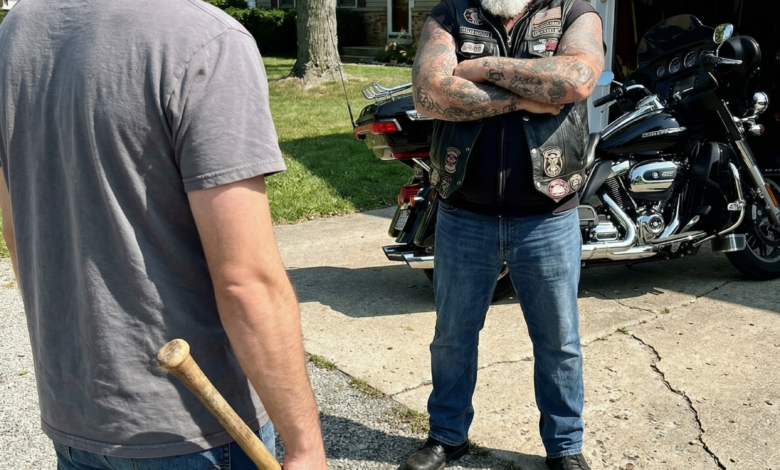
I went over on a Saturday morning with my heart pounding so hard it felt like it was shaking my ribs. I had a baseball bat in my hands, not because I wanted violence, but because fear makes you do irrational things when someone you love might be in danger.
Ray was in his garage working on his motorcycle when I pulled up. He looked up, saw the bat, and didn’t even flinch.
“You Ray Dalton?” I asked.
He wiped his hands on a rag. “Yeah.”
“I’m Kayla’s father. Stop following my daughter.”
He didn’t get loud. He didn’t get defensive. He just stared at me for a long second, then said something that knocked the air out of my chest:
“Put the bat down. There’s something you need to see.”
I tightened my grip. “I’m not going anywhere with you.”
“You don’t know the whole story,” he said. “And this is about keeping her alive.”
The Photo That Changed Everything
Ray pulled out his phone and opened a picture.
“Two weeks ago,” he said, “at the gas station. Your daughter was wearing long sleeves in heat that didn’t make sense. When she reached for the pump, her sleeve moved.”
He turned the screen toward me.
Bruises.
Not random bruises. Not clumsy bruises.
Finger-shaped bruises—purple and yellow, like someone had grabbed her hard enough to leave a signature.
My hands went numb. The bat slipped and hit the concrete with a sound that suddenly felt too loud for the moment.
Ray’s voice dropped. “That’s not from falling.”
Then, quieter: “I know what those marks mean.”
Ray’s Past Explained Why He Wouldn’t Look Away
He disappeared into the garage and came back holding a small, worn wooden box. He sat down like his body suddenly remembered an old grief and didn’t have the strength to carry it standing up.
Inside was a yellowed newspaper clipping from decades ago.
The headline said a young woman had been found dead. A search for her boyfriend had followed.
Ray swallowed hard. “That was my daughter,” he said. “Sarah. She was 22.”
He told me he’d seen bruises back then too. He told me how he wanted to believe the excuses—because believing was easier than admitting the truth.
And then he said the sentence that cracked something open in me:
“I stayed out of it because I didn’t want to push her away. And because I did nothing, I buried her.”
He looked at me like a man who had already lived through the worst possible ending.
“When I saw your daughter with Tyler,” Ray continued, “I recognized the signs. I recognized the way she shrank when he got close. I recognized the control. I’ve been watching because I couldn’t live with myself if I ignored it again.”
The Recording I Was Never Meant to Hear
Ray reached into the box again and pulled out a small digital recorder.
“I followed them to the park last night,” he said. “I stayed back. Listen.”
He pressed play.
I heard Tyler’s voice—Tyler, the guy I’d welcomed into my home—spitting insults that didn’t even sound human. Then a sharp sound. Then my daughter’s sobbing. Then her pleading.
The recording ended, and the silence afterward felt like the world had stopped moving.
Ray leaned forward. “The police are ready. But if they show up without you, she may deny everything to protect him. She needs her father to stand beside her and make it real.”
I couldn’t speak. I couldn’t breathe right.
I’d driven there thinking I was about to confront a threat.
Instead, I’d found the one person who’d been trying to keep my child safe.
We Went to Kayla’s Apartment Together
Ray told me to go. He said he’d follow behind on his bike.
The drive felt unreal—streetlights, red taillights, and the low rumble of his motorcycle staying close, like a guard dog that didn’t need a leash.
When I pulled into Kayla’s complex, Ray stopped beside me and lifted his visor just long enough to give me a look that said: Do it. Don’t hesitate.
I walked up to her door with legs that felt like they belonged to someone else.
I didn’t knock.
I had a spare key I’d never used because I thought “privacy” was respect. I understand now that sometimes privacy is where fear hides.
The Truth Was Waiting Inside
The smell hit me first—stale alcohol and something metallic I didn’t want to identify.
Kayla stood in the kitchen holding a bag of frozen peas to her face.
Tyler was at the table with a bottle in front of him, already wearing that polite, charming expression he used around adults.
“Mr. Morrison,” he started, smiling too wide. “We weren’t expecting—”
“Get your things, Kayla,” I said.
My voice didn’t sound like mine. It sounded older. Harder. Like something in me had finally woken up.
Kayla tried to speak, tried to offer the lie I’m sure she’d practiced.
“Dad, I fell, I tripped—”
I shook my head. “I heard the recording.”
Everything changed in an instant.
Tyler’s mask disappeared. He stood up slowly. “You should leave,” he said, like he had the right to give orders. “This is between me and my girlfriend.”
He stepped toward Kayla, reaching out—not gently, not lovingly, but like she was property.
Kayla flinched.
That tiny movement told me more than any confession ever could.
I stepped between them. “Don’t touch her.”
Tyler laughed, ugly and sharp. “What are you going to do? You’re an accountant.”
He grabbed my collar.
And then the front door swung open.
The Biker Wasn’t the Threat—He Was the Line of Defense
Ray Dalton walked in like he belonged there, like the room had been built for this moment.
He didn’t raise his voice. He didn’t posture.
He just looked at Tyler with the kind of calm that comes from a man who has already lost what mattered most—and refuses to watch it happen again.
“Police are downstairs,” Ray said. “You can sit and wait, or you can try to move past me.”
Tyler let go of my shirt.
He sat down.
Suddenly, he didn’t look powerful at all. He looked like what abusers often are when the spotlight turns on: small, scared, and pathetic.
Bringing My Daughter Home
Kayla started crying like she’d been holding her breath for months and finally couldn’t anymore.
I held her and apologized—over and over—because I didn’t know what else to do with the shame of not seeing it sooner.
“I didn’t want you to be disappointed in me,” she whispered.
“Never,” I told her. “Not for one second.”
Ray helped her pack. He barely spoke, but the way he handed her things was careful—gentle in a way I didn’t expect from a man I’d judged by his leather vest and his motorcycle.
Outside, the police arrived. Lights flashed against the brick walls. Tyler’s future closed in around him, and for the first time in a long time, Kayla wasn’t the one trapped.
I looked at Ray. “How do I thank you?”
He glanced at Kayla, then back at me. “You don’t,” he said. “You just listen to her. You watch closely. And you make sure she never feels alone again.”
Then he rode off into the night, leaving behind the kind of silence that follows a storm.
I drove my daughter home. The bat stayed in the trunk, useless now, because I finally understood something: being a father isn’t about what you’re willing to swing. It’s about what you’re willing to face.
As the sky started to brighten, Kayla reached over and held my hand. She looked exhausted—but she also looked like she could finally breathe.
Closing Thoughts
If you’re reading this and something feels “off” with someone you love—trust that instinct. Ask the uncomfortable questions. Pay attention to the quiet changes. And if you’re the one living in fear, please hear this: you deserve help, and you deserve safety.
If this story hit home, share it with someone who might need it—and leave a comment below: what’s one sign you think people overlook when someone is struggling in a relationship?