
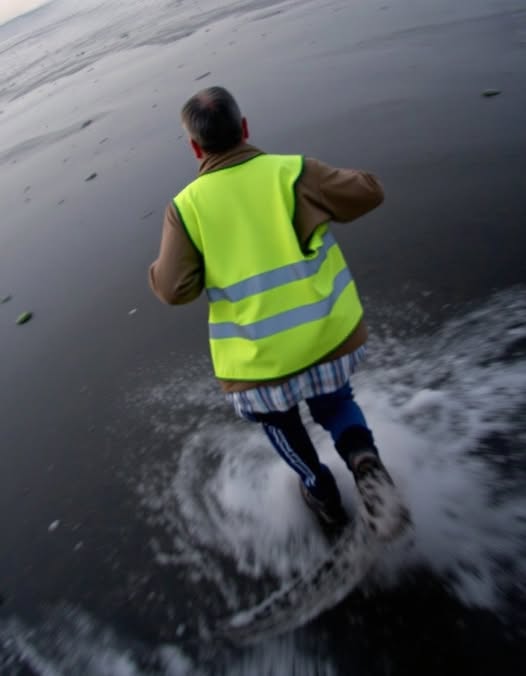
Police arrived quickly. Paramedics wrapped him in blankets, and someone ushered us onto the bus to get out of the cold. My clothes were soaked, my hands numb, adrenaline still roaring in my ears. That’s when my phone vibrated.
“You weren’t supposed to be there.”
No name. No context. Just those words glowing on my screen.
I dismissed it as a cruel joke at first. People do strange things when tragedy hits the news. But then another message appeared.
“He wasn’t supposed to live.”
The weight of those words settled into my chest like ice. I looked at the boy—no more than six years old—sitting silently with a cup of hot chocolate, his face pale but alert. Deputies whispered nearby about a missing child report, a custody issue, details that didn’t yet fit together. My phone buzzed again.
“Put the phone down. Don’t show anyone.”
Fear is a strange thing. It doesn’t always arrive screaming. Sometimes it slips in quietly and rearranges your breathing. I stood too fast, dizzy, forcing myself to look normal when an officer asked if I was okay. I lied and said it was just shock. That wasn’t entirely untrue.
When they took the boy away, he looked back at me and whispered, “You promised.”
“I know,” I said, my voice breaking. “I’ve got you.”
I didn’t know if I could keep that promise.
That night, sleep never came. I sat at my kitchen table long after midnight, staring at my phone, every sound outside making my pulse jump. Then another message appeared.
“You don’t know who that child is.”
I replied before fear could stop me.
Who is this?
The answer came instantly.
“Someone who’s been cleaning up a mess for a long time. The boy’s name is Eli. And his father is very dangerous.”
I called the sheriff’s office.
Within minutes, patrol cars surrounded my house. I handed over my phone, repeated every detail, watched as the gravity of the situation shifted from concern to urgency. By morning, the truth surfaced piece by piece, each fragment more disturbing than the last.
Eli wasn’t just a lost child. He was at the center of a sealed custody case involving wealth, influence, and a history of violence buried beneath legal maneuvering. His mother had tried to disappear with him months earlier. She had been found, hospitalized, declared unstable. Eli had been placed temporarily with his father.
The lake wasn’t an accident.
It was supposed to look like one.
The messages came from a burner phone traced to a private security contractor tied to the father, someone whose job involved “handling contingencies.” My presence—my impulse to stop—had disrupted a carefully planned ending. According to investigators, I had been exactly where I was not meant to be.
For my safety, everything changed overnight. No interviews. No public praise. I was moved quietly to a safe location, cut off from routine, surrounded by officers who drank too much coffee and spoke in low voices. The story didn’t belong to me anymore. It belonged to the system trying to undo what almost happened.
Three days later, a woman came to see me.
She looked exhausted, bruised, held together by determination alone. She introduced herself simply. “I’m Eli’s mother.”
She took my hands as if afraid I might disappear. “You did what I couldn’t,” she said. “You listened to your instincts.”
She told me how Eli had learned that water meant silence. How fear had taught him that running toward the lake was an ending, one way or another. That night, he hadn’t expected rescue. He had expected finality.
“He trusted you,” she said quietly. “He told the doctors you were the bus lady who doesn’t let kids forget their coats.”
That broke something open inside me.
Weeks passed. The father was arrested, not just for what he tried to do to Eli, but for a cascade of crimes that surfaced once scrutiny began. The contractor vanished. The burner phone went silent. Eli went home with his mother.
And I went back to driving my bus.
At first, every route felt heavier. Every stretch of road near water made my chest tighten. Every child stepping onto the bus carried the weight of what almost happened. But children don’t know fear the way adults do. They argued over seats, forgot gloves, shouted my name when they saw me coming. Life insisted on continuing.
One morning, just before winter break, I found a drawing on my driver’s seat.
Crayon. A blue lake. A yellow bus. Two stick figures holding hands.
On the back, in uneven letters, it read: “You kept your promise.”
I sat there longer than I should have, the engine silent, breathing through the truth that courage doesn’t announce itself. It doesn’t come with medals or headlines. Sometimes it’s just being present in a moment you were never meant to witness, refusing to look away when everything tells you to keep moving.
I still can’t swim. I still fear deep water. But I’ve learned something I didn’t know before: heroism isn’t about strength or preparation. It’s about instinct, empathy, and the willingness to act when the cost is unknown. And sometimes, saving a life doesn’t just change the person you rescue. It changes everything you thought you understood about your own.
That night by the lake destroyed the life I had planned—and replaced it with one built on truth, vigilance, and the unshakable knowledge that being exactly where you’re “not supposed to be” can be the difference between silence and survival