
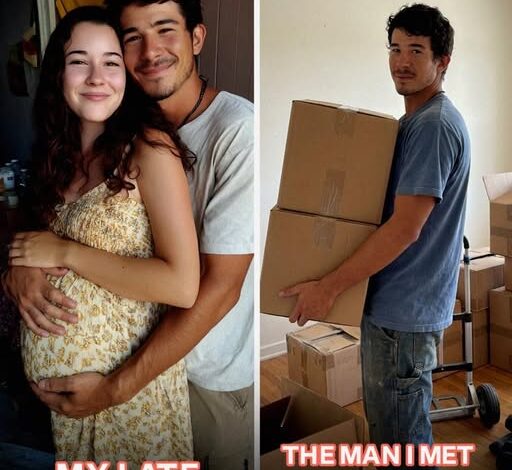
In less than two days, I lost my husband and my daughter—one to a highway, one to what the doctors called trauma. Shock. Grief-induced labor. Clinical words for a pain so big it made my body give up.
After that, I didn’t “move on.” I just… moved.
Three years later, I was in a different city, on the third floor of a quiet apartment building with bare walls and no framed photos. I worked as a receptionist at a dental office, kept my head down, paid my bills, and did my best to live a life small enough that nothing could break it again.
No dreams. No plans. Just days I could survive.
The Day the Past Walked Upstairs
It was a Sunday afternoon when I heard the scrape of furniture on the stairwell. A man’s voice called, “Careful with that corner,” and a woman laughed softly like she felt safe.
I opened my door a crack.
A young family was moving in: a woman with dark hair giving directions, a toddler hugging a pink stuffed rabbit, and a man lifting a couch like he’d done it a hundred times.
Same haircut. Same eyes. Same mouth.
This wasn’t resemblance. This was recognition.
I stepped back so fast I knocked a glass off my counter. It shattered, and I stood there shaking, trying to talk sense into myself.
That’s impossible. He’s dead.
But minutes later, in the hallway, the impossible stood inches from me—holding a child like he belonged in this world.
And then I saw it: his hand.
The same two missing fingers my husband lost when he was ten years old, messing with fireworks behind his uncle’s garage. A detail you don’t forget. A detail you don’t accidentally “find” on a stranger.
The woman appeared behind him. “Is there a problem?” she asked, protective and confused.
I couldn’t stop the words from coming out.
“I married Ron five years ago,” I said, my voice cracking. “I buried him three years ago.”
The Truth He Never Expected Me to Discover
Later, in my kitchen, he told me the story he’d been living inside.
Debt.
Business loans.
Credit cards.
Panic that turned into a plan.
He said he thought I’d be “better off without him.” He said disappearing was supposed to be cleaner than letting his financial problems swallow us whole. He said he never intended for it to become a funeral.
And then he said the part that made my stomach twist:
His aunt handled the paperwork. The closed casket “protected everyone.”
I stared at him. “Protected who?”
My hands were shaking as the words poured out—things I’d swallowed for years because I thought tragedy was nobody’s fault.
“I went into labor alone,” I said. “I buried our daughter alone. Debt collectors froze accounts in my name because legally I was your widow. I spent years rebuilding from a disaster you chose.”
The woman—Carla—stood in my doorway like the floor had vanished beneath her. She was learning the truth at the same time I was.
He’d told her I left him years ago. That I took our child. That I disappeared.
And then she said something that made my throat close:
He’d named their child after me.
When Paperwork Starts to Talk
The next morning, I went to the county office and requested a certified copy of the death certificate.
I’d never looked at it closely before. Back then, I could barely breathe, let alone investigate. I trusted the system. I trusted the adults in the room. I trusted the people who said it was “handled.”
This time, I didn’t trust anything.
The coroner’s signature didn’t match public records.
At the funeral home, the manager hesitated, then admitted the paperwork had been signed by Ron’s aunt. There’d been “special authorization.” No viewing. No questions.
When I confronted his aunt, Marlene, she didn’t even try to deny it.
“You falsified a death,” I said, my voice steady in a way I didn’t recognize. “Insurance fraud. Identity fraud. False documents filed with the state. You let collectors destroy my life while he started over.”
Ron didn’t deny it. Neither did Marlene.
What Justice Actually Feels Like
Carla filed for divorce. She gave a statement. She apologized to me for something she didn’t create—and shouldn’t have had to carry.
Within the week, Ron and Marlene were charged.
I didn’t celebrate.
There was nothing cinematic about it. No swelling music. No satisfying revenge.
Courts don’t feel like victory. They feel like fluorescent lights, hard benches, and the slow, brutal dismantling of lies—one document at a time.
But when the judge read the charges aloud—fraud, falsifying records, conspiracy—something in my chest finally loosened.
For three years, I believed grief stole my child.
Now I knew the truth: my daughter didn’t die because the universe was cruel.
She died because shock broke my body after the man I loved chose escape over responsibility.
That knowledge didn’t bring her back. It didn’t erase the empty nursery or the hospital paperwork I signed with no one holding my hand.
But when the courtroom doors closed behind him—no longer a “dead husband,” no longer a ghost, but a living man who faked his own death—I realized something I never expected.
I wasn’t standing in a cemetery anymore.
And for the first time in three years, I wasn’t the woman who buried her husband.
If this story moved you, share your thoughts in the comments—have you ever uncovered a truth that changed everything? And if you want more real-life inspired stories about betrayal, recovery, and starting over, subscribe/bookmark this page so you don’t miss the next one.