
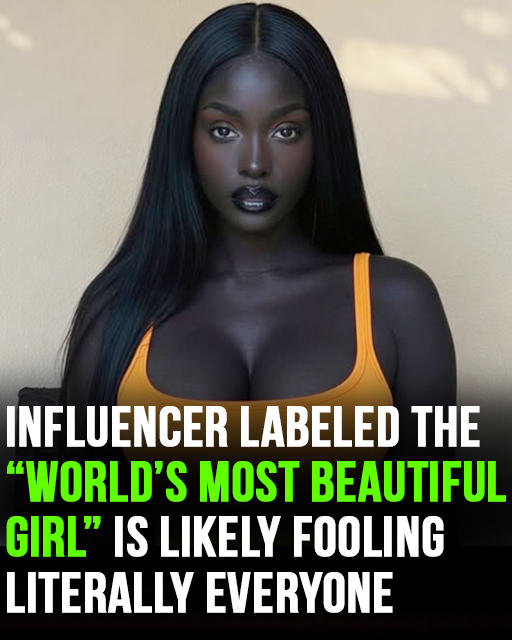
An influencer celebrated online as the “world’s most beautiful girl” is now at the center of a growing controversy, as thousands of viewers question whether she’s actually human — or a carefully designed AI creation.
Nia Noir has amassed massive attention across social media, drawing in more than 2.7 million followers on TikTok along with a rapidly expanding presence on Instagram and Facebook. Her striking visuals — flawless dark skin, intense eye contact, and a mysterious bio reading “Just a girl with a dark side” — have helped her dominate viral beauty content.
But as her popularity continues to surge, so does skepticism.
Fans Spot Strange Visual Details
While many admirers flood her posts with praise, calling her “breathtaking,” “otherworldly,” and “perfect,” others are noticing subtle details that don’t quite add up.
Some users have pointed out apparent visual errors across her content, including fingers that appear distorted or miscounted, smartphones without recognizable branding, and facial features that seem unnaturally smooth. The hyper-polished look has led many to believe that Nia Noir may not be a real person at all — but rather an AI-generated virtual influencer.
“That Should Be a Red Flag”
The debate intensified after a TikTok creator posted a viral breakdown questioning Nia’s authenticity. The video, which gained more than half a million views in just days, highlighted multiple inconsistencies across her posts.
“How are people still missing this?” the creator asked. “These videos rack up millions of views, yet no one questions what they’re seeing.”
He added that certain patterns — extremely short videos, lack of speaking, no visible brand partnerships, oddly rendered clothing, and unnatural hand details — are common indicators of AI-generated content.
“These are all red flags,” he said.
Suspicious Engagement Raises More Questions
Beyond visuals, users have also flagged unusual engagement behavior. Many comments under Nia’s posts appear repetitive, generic, and identical across multiple videos — a common sign of automated or bot-driven engagement designed to boost visibility and credibility.
This has only deepened speculation that the account is part of a larger digital marketing strategy rather than a real individual sharing personal content.
AI Influencers Are Already Making Millions
If Nia Noir is indeed virtual, she wouldn’t be the first — or the most profitable.
One of the most famous AI influencers, Lil Miquela, debuted back in 2016 and quickly became a household name in digital culture. The virtual model has partnered with major global brands including Prada, Calvin Klein, Samsung, and BMW. Reports estimate that Lil Miquela generated roughly $10 million in revenue in 2023 alone.
These AI personalities are intentionally designed with curated aesthetics, backstories, and brand appeal, making them powerful tools in influencer marketing.
The Future of Influencer Marketing
Industry experts say virtual influencers are no longer experimental — they’re strategic assets.
A spokesperson from online marketplace OnBuy previously explained that AI and CGI influencers are rapidly transforming social media advertising. Brands are increasingly drawn to digital personalities because they’re fully controllable, controversy-free, and available around the clock.
“With more virtual influencers appearing on platforms like Instagram every week,” the spokesperson said, “they’re becoming a serious force in influencer marketing.”
Real or Artificial — The Line Is Blurring
What unsettles many viewers is not just the possibility that Nia Noir is artificial — but how convincingly real she appears. As artificial intelligence continues to advance, creating lifelike images, voices, and personalities, it’s becoming harder than ever to distinguish between authentic creators and digital constructs.
So what do you think — is Nia Noir a real person, or a highly sophisticated AI influencer?
Share your thoughts and join the conversation as social media continues to redefine what “real” means in the digital age.