
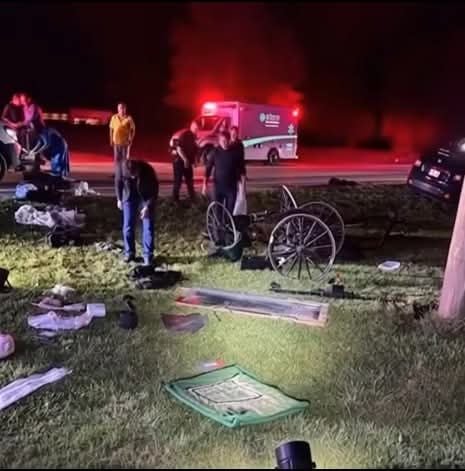
As the injured were transported to nearby hospitals, investigators closed the road and began reconstructing the collision. The Jeep driver remained at the scene and cooperated with authorities. Blood samples were taken as part of standard procedure, though officials have not yet released toxicology results. The investigation is ongoing, but the physical reality was already clear. A wooden buggy, even one marked with reflective triangles and lanterns, offers almost no protection when struck by a modern vehicle traveling at speed.
For the Amish community surrounding Berne, this was not just another traffic accident. It was a familiar fear made real again.
Amish families rely on horse-drawn buggies as part of their religious commitment to simplicity and separation from modern technology. These buggies share roads with SUVs, pickup trucks, and commercial vehicles capable of traveling at speeds that turn minor mistakes into catastrophic outcomes. While reflective markings and slow-moving vehicle signs are required, visibility does not equal safety, especially at night on rural highways where drivers may be fatigued, distracted, or moving faster than conditions allow.
Each trip after sunset carries an unspoken risk. Every curve, every straightaway, every passing car becomes a calculation between tradition and survival. For the Amish, the road is not just infrastructure; it is a daily negotiation with a world that moves faster than they do and often fails to slow down.
This collision reignites long-standing concerns about roadway design, driver awareness, and shared responsibility. Rural highways like State Road 218 were engineered for automobiles, not for vehicles traveling at the pace of a horse. Narrow shoulders, limited lighting, and long sightlines that encourage speed all work against the safety of slow-moving traffic. Even attentive drivers may not register a buggy in time, especially when closing distances shrink at higher speeds.
Safety advocates have long argued for additional measures: reduced nighttime speed limits in known Amish areas, improved roadway lighting, enhanced reflective technology, and stronger public education campaigns. Yet progress is uneven, and enforcement often relies on voluntary caution rather than structural change. For families who depend on buggies, the lack of comprehensive protection feels like a gamble forced upon them rather than a choice freely made.
The emotional toll of incidents like this extends far beyond the injured. Children who survive carry the memory of violence into a life built on peace. Parents grapple with fear that lingers long after physical wounds heal. Communities mourn not only injuries, but the reminder that their way of life exists at constant risk on roads that do not accommodate vulnerability.
In Berne, neighbors gathered quietly as news spread. Prayer circles formed. Families waited for updates from hospitals. In Amish culture, grief and concern are shared communally, without spectacle. There are no press conferences, no public statements crafted for cameras. There is only waiting, faith, and the slow processing of trauma.
For modern drivers passing through Amish country, this crash serves as a stark reminder of responsibility. Sharing the road means more than obeying posted signs. It requires awareness that not every vehicle is built to absorb impact, not every traveler is protected by airbags and steel frames. A moment of inattention, a few extra miles per hour, or the assumption that the road is empty can permanently alter lives.
As investigators continue their work and medical teams focus on recovery, the larger question remains unresolved. How can two worlds—one built on speed and convenience, the other on restraint and tradition—safely coexist on the same asphalt? Technology alone cannot answer that. It requires empathy, policy, infrastructure investment, and a cultural shift that values caution as much as efficiency.
For now, the road outside Berne has reopened, its surface cleared of debris. Cars will continue to pass. Buggies will return, because they must. But for the family involved and the community that surrounds them, the memory of that night will travel every mile with them. Each journey will carry the weight of knowing how quickly everything can change when steel meets wood and the modern world does not see what is in front of it until it is too late.