
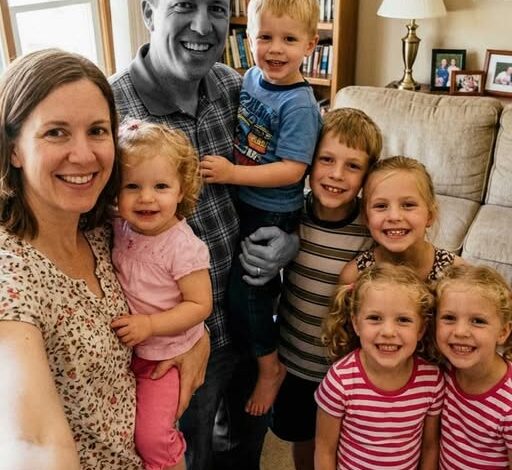
He was the dependable one. Bills paid on time. Broken cabinet hinges fixed without being asked. Every birthday remembered. He was a good husband—an even better father.
Then came the cancer diagnosis, and our “normal” disappeared.
For two years, our calendar was packed with doctor appointments, medications, and long nights where fear sat in the room like an extra person. I became the organizer, the decision-maker, the one who held it together for six children who still needed lunches, homework help, and bedtime stories.
Daniel tried to stay strong in front of them. Even when he was exhausted, he’d sit on the floor building Lego towers, pausing only long enough to catch his breath when the pain got too heavy.
He didn’t want them to remember him as sick.
The Night He Died, He Left Me One Promise
Daniel passed away at 2 a.m. in our bedroom. The oxygen machine hummed beside him while I held his hand and begged for more time.
He looked at me and whispered, “You’ll be okay. You’re stronger than you think.”
I didn’t feel strong. I felt like the ground had vanished.
After the Funeral, I Ran on Autopilot
After the burial, I did what a lot of widowed parents do: I forced the days to keep moving.
Lunches got packed. Permission slips got signed. Smiles got worn like armor. And at night, when the kids finally slept, I wandered the house touching his things—his jacket, his coffee mug, the spot on the couch where he always sat—trying to convince myself any of it was still real.
One detail kept bothering me: during his illness, Daniel had become oddly protective of the attic. He insisted on handling it himself, even when he was too weak to carry a box.
At the time, I told myself it was pride.
Now it felt like something else.
My Son’s Bed Was the First Clue
Four days after the funeral, Caleb came into the kitchen while I was making breakfast.
“Mom,” he said, shifting uncomfortably. “My back hurts. I can’t sleep in my bed.”
I checked him over—no bruises, no swelling. I told myself it was probably a strain from sports or a bad sleeping position.
But the next morning he stood in my doorway again, pale and frustrated.
I went into his room and inspected everything: bed frame, mattress, sheets. It all looked normal—until I pressed my palm into the center of the mattress and felt something firm that didn’t belong.
I flipped the mattress over.
There was a seam—hand-stitched with darker thread—where no factory seam should have been.
My stomach dropped.
I sent Caleb out of the room and sat there staring at it, torn between fear and the part of me that didn’t want to know.
Then I opened it.
The Hidden Envelope—and the Letter in His Handwriting
Inside the mattress was an envelope stuffed with documents, two unfamiliar keys, and a letter with my name on it in Daniel’s handwriting.
I stared at that letter longer than I want to admit. Some instincts are louder than logic. I already knew it wouldn’t be something comforting.
Finally, I opened it.
“My love, if you’re reading this, it means I am no longer with you. There was something I couldn’t tell you while I was alive. I’m not who you thought I was…”
He wrote about a mistake. About someone he’d known years ago. About consequences he never fully faced.
Then one line made my hands go cold:
“If you choose to look for the rest, use the smaller key. The first answer is in the attic. Please don’t stop there.”
I sat on the edge of the bed, numb, staring at the words.
But I also knew this: I would never sleep again if I didn’t find out what he meant.
The Attic Held What He Didn’t Have the Courage to Say
The attic ladder groaned as I pulled it down. Dust floated in the air, heavy and still. I searched for almost an hour, moving boxes I hadn’t touched in years.
Then I found it: a cedar chest pushed into the far corner.
Inside were letters, bank receipts, and tissue paper wrapped carefully around a bundle of documents.
And suddenly, I wasn’t reading a mystery anymore. I was reading a second life.
There was a name: Caroline.
There were letters that lined up with a painful memory I hadn’t thought about in years—the exact time Daniel and I separated for three months after one of our worst fights.
There were questions from a child he couldn’t ignore forever.
And there were bank transfers—monthly payments, steady and quiet, hidden in a way that now felt deliberate.
One line hit hardest:
“I told myself it was temporary… Ava didn’t ask to be born into my failure. Please meet her. Please help her if you can.”
I sank to the attic floor, the air suddenly too thin.
Grief is heavy. But betrayal has a different weight—sharper, more personal, harder to set down.
I whispered into the dusty silence, “You don’t get to die and make this mine.”
The Address Was Only Twenty Minutes Away
One of the letters included an address: Birch Lane.
Twenty minutes from our house.
I didn’t let myself overthink it. I asked a neighbor to watch the kids, grabbed my keys, and drove with my hands clenched tight around the steering wheel.
The house was modest—blue siding, white shutters, a small front yard that looked cared for.
When the door opened, my breath caught.
Caroline wasn’t a stranger.
She used to live three houses down from us years ago. She was the woman who brought banana bread after Emma was born. The one who smiled at neighborhood cookouts and waved from her porch like she belonged there—because she did.
She looked at me like she’d seen a ghost.
What She Said Didn’t Fix Anything—But It Changed Something
Caroline tried to explain. Tried to apologize. She said she never intended to destroy a family. She said she thought the past was buried.
But the monthly payments had stopped, and she’d already guessed something was wrong.
And then I saw her daughter.
A child who didn’t ask for any of it. A child who didn’t choose secrets, or lies, or complicated adults making selfish decisions.
In that moment, something inside me shifted.
Not forgiveness. Not acceptance. Not even understanding.
Just… clarity.
Daniel was gone. The truth was here. And an innocent child was standing in the middle of the mess he left behind.
I heard myself say, quietly, “I don’t know what happens next. But she didn’t do anything wrong.”
Driving Home, the Silence Felt Different
On the way back, the car was quiet, but it wasn’t the same kind of quiet I’d been drowning in since the funeral.
For the first time, I didn’t feel like everything had been taken from me.
I felt like something had been placed in my hands instead—something heavy, complicated, and unfair… but real.
And I realized that being “strong” wasn’t going to look like having it all together.
It was going to look like facing the truth, protecting my children, and deciding what kind of person I wanted to be in a story I didn’t choose.
If you’ve ever been blindsided by loss, betrayal, or a life change you didn’t ask for, share your thoughts in the comments—what helped you take the next step when everything felt impossible?