
Zach had tried to intervene, promising to “handle” his mother, but Diane was a woman who mastered the art of the polite insult. She once told me, while sipping expensive wine, that Skye should simply be happy he got anything at all since he wasn’t “really” family.
The true turning point came during Diane’s birthday dinner. It was a formal, curated affair where the porcelain was as cold as the hostess’s smile. Diane sat at the head of the table in her pearls and silk, presiding over the room like a queen who tolerated our presence rather than enjoyed it. Throughout the meal, she systematically ignored Skye. When he mentioned his upcoming piano recital, she pivoted the conversation immediately to Mason’s science trophy, her fork waving through the air like a conductor’s baton, orchestrating the exclusion of my son.
Halfway through dessert, Diane tapped her glass for a toast. “I am so lucky,” she announced, her eyes sweeping the room, “to be surrounded by my real family.” The word “real” hung in the air, sharp and jagged. I gripped my wine glass, the heat of a dozen unspoken retorts rising in my throat. But Skye remained calm. He folded his napkin with the grace of an old soul and reached for a gift bag he had stashed under his chair.
Earlier that week, I had found him on the living room rug, surrounded by watercolors and a silver frame he had purchased with his own allowance. He had painted a picture of our family standing beneath a sprawling oak tree. Zach, the cousins, and I were all there, each with a vibrant red heart floating above our heads. Diane was in the painting too, standing slightly off to the side. Her likeness was accurate, but there was one glaring omission: she was the only person in the portrait without a heart.
When I had asked him why he wanted to give her such a thoughtful gift despite her cruelty, Skye had looked at me with a wisdom that eclipsed his years. “I want her to feel seen, Mom,” he had said. “Even if she doesn’t do the same for me. I’m doing it for me, and for Dad. I want him to know I’m trying.”
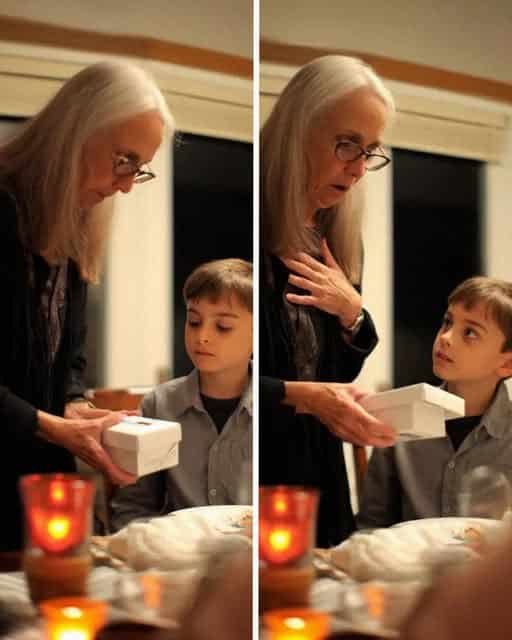
Now, in the silence of the dining room, Skye walked around the table and presented the bag to Diane. “I made something for you, Grandma,” he said softly.
Diane looked puzzled, almost pained, as she peeled back the tissue paper. When she saw the watercolor, her hand trembled. She traced the figures of her biological grandchildren, each with their little red heart, and then her finger stopped on her own image—the ghost in the corner, heartless and solitary.
“Why… why don’t I have a heart, Skye?” she whispered, her voice losing its sharp edge.
Skye looked her in the eye, his expression devoid of malice. “Because that’s how it feels sometimes,” he answered honestly. “It feels like everyone else gives me love except you. But I still wanted you in the picture, because you’re family to me. I used all my savings to frame it so it would last forever.”
The silence that followed was absolute. Then, a sharp, ragged sob broke from Diane’s throat. It wasn’t the delicate cry of a socialite; it was the sound of a woman finally seeing the ugliness of her own reflection. She clutched the silver frame to her chest, weeping openly as she stammered that she didn’t deserve such a gift. Skye didn’t gloat. He simply stood by her chair and said, “You do deserve it, Grandma. I just wanted you to see me.”
The drive home was quiet, filled with a peace we hadn’t felt in years. Zach looked at Skye in the rearview mirror, his voice thick with emotion. “That was brave, son,” he said. Skye just watched the houses pass by, noting that she “needed to cry.”
The change wasn’t overnight, but it was profound. Three days later, Diane called. Her voice was small, stripped of its usual armor. She asked if she could take Skye to lunch—if he was open to it. They went to a small café, and for the first time, she asked him questions about his life. She asked about his piano recital. She asked what he liked. He came home with a new watercolor pad and a stargazing journal, gifts that showed she had actually listened.
By the time Christmas arrived again, the gold foil was still there, but the grocery bags were gone. Beneath the tree sat a silver box with Skye’s name written in the same elegant gold ink as the others. Inside was a professional set of paintbrushes and a stunning silver compass. The card didn’t just say “Enjoy.” It read: You helped me find my way, my boy. You are my moral compass.
As Skye leaned against Zach on the porch that night, sharing a pint of ice cream, the distinction between “blood” and “family” vanished entirely. Zach tucked Skye under his arm and reminded him, “No matter what anyone says, I chose you. That kind of bond runs deeper than anything else.” Skye just smiled, finally resting in the knowledge that he was no longer a ghost in the family portrait, but the very heart of it.