
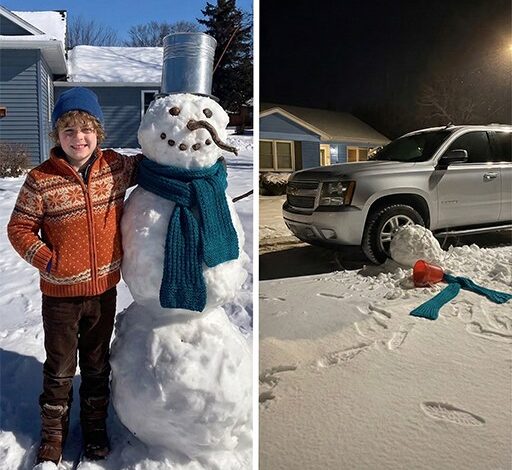
“Mom, can I go outside right now? I have to finish him before it gets dark.”
“Finish who?” I asked.
He stared like I’d asked the strangest question in the world. “The snowman.”
From then on, it was a routine. Backpack dropped. Gloves tossed. Hat pulled down too far. And out he went to the far corner of our front yard near the driveway—still clearly on our property, not blocking the sidewalk, not near the street, just his chosen “worksite.”
Each snowman had personality. Sticks for arms, stones for eyes, and an old red scarf he proudly declared “official snowman equipment.” He even gave them names and backstories.
“This one’s Baxter,” he’d say seriously. “He likes astronomy.”
I loved it. Watching him focus, create, and feel proud of something he made with his own hands was the best part of winter.
The Problem Wasn’t the Snow—It Was the Tire Tracks
At first, I noticed small ruts in the snow and tried to brush it off. Plows shift things. Cars slide. Winter is messy.
Then Leo came inside one afternoon unusually quiet. He took off his gloves slowly, snow dropping onto the mat in heavy clumps.
“Mom,” he said, voice thin, “he did it again.”
My stomach sank. “Did what?”
“He drove over it. Over Baxter.” Leo’s eyes filled up. “He looked at it first… then did it anyway.”
Our neighbor, Mr. Caldwell, had a long-standing habit: whenever he pulled into his driveway, he cut across the corner of our lawn instead of staying on the road and turning properly. I’d noticed it for years and let it go because, honestly, I didn’t want drama.
But driving across someone else’s lawn is one thing. Crushing a child’s snowman again and again is something else entirely.
I Asked Politely—He Didn’t Care
That night, I stared out the kitchen window at the wreckage: snapped sticks, half-buried stones, the red scarf soaked and freezing into slush. I felt that protective anger rise in my chest—the kind parents know well.
The next evening, when I heard Mr. Caldwell outside, I stepped out too.
“Hi,” I said, keeping my voice calm. “My son builds snowmen in that corner of our yard. Could you please stop driving over that part of the lawn? It really upsets him.”
He barely looked over. “It’s snow.”
“It’s our property,” I replied. “And it matters to him.”
He shrugged like it was nothing. “Kids cry. They get over it.”
Leo kept rebuilding. Not loudly, not dramatically—just with that quiet determination kids sometimes have when they know they’re right.
When I suggested he move his snowmen closer to the house, he shook his head.
“That’s my spot,” he said. “He’s the one doing the wrong thing.”
A week later, it happened again. I confronted Mr. Caldwell once more, and he gave me excuses: it was dark, he didn’t see it, it wasn’t a big deal.
Then he smirked and said, “You gonna call the cops over a snowman?”
That comment stuck with me. Not because I wanted conflict—but because it showed exactly how little he respected our home, our yard, and our child.
Leo’s “Plan” Was Smarter Than I Expected
A few days later, Leo came in with snow in his hair… but no tears.
“Mom,” he said, low and confident, “you don’t have to talk to him anymore.”
I blinked. “What do you mean?”
He hesitated, then leaned closer like he was sharing a secret.
“I have a plan. I’m not trying to hurt him,” he added quickly. “I just want him to stop.”
I assumed it was something harmless—maybe a sign, maybe a boundary line stamped into the snow. Kids’ plans are usually simple.
The next afternoon, I watched from the window as he built a snowman bigger than usual near the edge of the yard, closer to where our property met the street. The base was thicker. The middle was wider. And I noticed flashes of red tucked under the snow, like he was using that scarf again.
I didn’t think much of it until later.
The Moment Everything Changed
That evening, as I was starting dinner, I heard a sound that didn’t belong in a calm winter neighborhood—metal scraping, a hard thud, then a sudden roar.
Mr. Caldwell’s car had slammed into the fire hydrant.
Water shot into the air like a geyser, blasting the street and soaking everything in sight—his car, the curb, the yard. At the base was a mangled pile of snow, sticks, and that unmistakable red scarf.
Mr. Caldwell stumbled in the freezing water, shouting words I won’t repeat, then stormed to our door and pounded like it was an emergency.
When I opened it, he was furious.
“This is your fault!” he yelled. “Your kid did this on purpose!”
I kept my voice steady. “The hydrant is right at the property line.”
Then I paused. “So… you were driving on our lawn again.”
He opened his mouth, then shut it. Because there it was—the truth he couldn’t talk his way around.
“You chose to cut across our yard,” I said. “Just like you’ve done before.”
Authorities arrived soon after. The city had to handle the hydrant. There were fines. Repairs. And our front yard turned into a sheet of ice for weeks from all the water in the cold air.
But the biggest change was simple: Mr. Caldwell never drove over our grass again.
A Lesson About Boundaries—Delivered in Snow
When I look at that corner of the yard now, I don’t just think about snowmen. I think about a child who understood something many adults still struggle with: boundaries matter, even when the “damage” seems small.
Sometimes it isn’t about a snowman at all. It’s about respect—for property lines, for neighbors, and for the people living right next door.
If this story hit home for you, share your thoughts in the comments—have you ever dealt with a difficult neighbor or a repeated boundary issue? And if you enjoyed it, pass it along to someone who could use a reminder that small actions still have real consequences.