
A Quiet Hobby That Became His Lifeline
I taught Mason to sew the way my mother taught me—simple stitches first, then hems, then little projects. When he was younger, he’d steal scraps from my sewing basket and make tiny pillows for his toys. As he got older, he kept going. While other kids were glued to sports or video games, Mason could sit for hours at the table with fabric, thread, and complete focus.
People teased him sometimes. He didn’t argue back. He didn’t try to “prove” anything. He just kept sewing.
A few weeks after the funeral, I caught him repairing his backpack. He had thread between his teeth, his fingers steady and practiced. I tried to sound casual, even though my chest was tight.
“You doing okay?” I asked.
He nodded without looking up. “I miss Dad. Every day.”
Then I noticed the fabric he was using.
It was one of Ethan’s old shirts—the blue plaid one he wore on fishing trips.
I didn’t know what to say. I just stood there, watching my son stitch something back together when our own lives felt like they’d come apart.
When Ethan’s Shirts Started Disappearing
Over the next months, Mason stayed busy. He hemmed jeans, fixed towels, altered curtains, repaired anything that looked worn out. Late at night, after I’d gone to bed, I’d hear the soft whir of the sewing machine—steady, calming, almost like a heartbeat in a house that had felt too still.
And slowly, Ethan’s things began to vanish from the closet. Shirts. Old charity-run tees. Ties I couldn’t bring myself to donate yet.
At first, I assumed Mason was holding on because he didn’t know how to let go. But I started to realize he wasn’t just clinging—he was planning.
One afternoon, I found him standing in front of Ethan’s closet, hands clenched like he was working up the courage to speak.
“Mom,” he said, voice thin, “can I use Dad’s shirts?”
It hit me harder than I expected. Those shirts still smelled like Ethan—laundry soap, aftershave, the familiar comfort of a life that ended too soon.
But Mason wasn’t asking to destroy them. He was asking to transform them.
I took a breath, reached in, and pulled out Ethan’s favorite shirt. I placed it in Mason’s hands.
“Your dad spent his life helping people,” I told him. “I think he’d be proud of whatever you make.”
20 Handmade Teddy Bears, Each One Made to Comfort a Child
That night, Mason got to work.
He spread Ethan’s shirts across the dining table and sorted them by color and softness. He measured carefully, cut slowly, and stitched with the kind of patience you can’t teach—only life can.
Within days, our kitchen looked like a craft store exploded. Fabric scraps on the counters. Thread everywhere. Stuffing piled near the fridge. I pretended to be annoyed, but the truth was, it was the first time the house felt alive again.
“Are you building a teddy bear army?” I teased.
Mason finally smiled—just a little. “Not an army. More like… a rescue squad.”
Late one night, he finished.
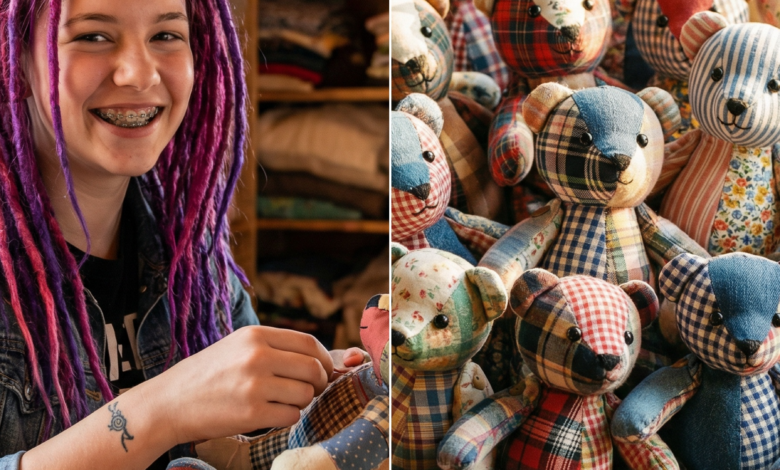
Twenty teddy bears sat in a neat row across the table. Each one was different—different patterns, different button eyes, different personalities. And every single one was made from pieces of Ethan’s shirts.
Mason looked at me like he wasn’t sure if I’d understand.
“Do you think I could give them away?” he asked.
“To who?”
“The local shelter,” he said. “The kids there… they don’t have much.”
I hugged one bear to my chest, and for a second the scent of Ethan nearly broke me. But Mason’s idea wasn’t about reopening the wound. It was about using love to make something useful.
“Your dad would have loved that,” I told him.
A Small Note in Every Bear
We packed the bears into boxes together. Mason added a handwritten message to each one:
“Made with love. You are not alone. —Mason”
At the shelter, the director, Spencer, looked at the bears like he couldn’t believe what he was seeing.
“You made all of these?” he asked Mason.
Mason nodded, suddenly shy. “Yes, sir.”
When the kids came in and started choosing bears, the room changed. Their faces softened. Their shoulders dropped. A little girl in pink pajamas hugged one so tightly it looked like she was afraid it might disappear.
Mason crouched to her level and said gently, “You can pick whichever one you want. They’re for you.”
On the way home, Mason was quiet—but not in the heavy way. More like he was finally exhaling.
That night, he left one small bear on my pillow.
“This one’s for you, Mom,” he said. “So you’re not lonely at night.”
I held it like it was a lifeline.
Then the Sheriff’s Cruisers Pulled Up Before Dawn
The next Wednesday morning, someone pounded on our front door.
I looked out the window and felt my stomach drop: two sheriff’s cruisers in front of the house, and a dark town car behind them. Neighbors’ blinds shifted. I could feel the unspoken questions from across the street.
Mason stumbled out of his room, half-asleep. “What’s going on?”
I pulled him behind me as I opened the door, bracing for bad news.
A deputy asked us to step outside. My mind raced—had someone complained? Did we do something wrong? Was this connected to Ethan?
Then one of the deputies opened a trunk in the cruiser.
Inside were brand-new sewing machines, stacks of fabric, boxes of thread, buttons, needles—enough supplies to run a real program.
Another deputy handed me an envelope with official paperwork.
“We need to know who made the teddy bears for the shelter,” he said.
Mason’s face went pale. “I did,” he admitted quickly. “I used my dad’s shirts. I didn’t mean to do anything wrong… I think one might’ve been one of his police shirts.”
Before I could respond, a well-dressed older man stepped forward from near the town car.
“Catherine? Mason?” he said. “My name is Henry.”
One Life Saved… and a Kindness Returned
Henry explained that years ago, Ethan had saved his life on Route 17. He’d tried to find a way to thank him, only to learn Ethan was gone. Then Henry visited the shelter, heard about the bears, and recognized the kind of heart they came from.
“Your husband saved my life with courage,” Henry told Mason. “You’re helping children feel safe with kindness. That matters more than you know.”
Henry wasn’t there to accuse us of anything.
He was there to invest in what Mason started.
Those sewing machines and supplies were a donation for the shelter. His foundation was also funding a scholarship for Mason and launching a year-round sewing program for children in crisis—built around teaching practical skills and creating comfort items for kids who are going through hard seasons.
They even had a name for it:
The Ethan & Mason Comfort Project.
Spencer stepped forward, practically glowing. “The county approved it this morning. We’re turning the back room into a real sewing space. And Mason—if you’re willing—we’d love for you to help teach the first class.”
Mason looked at me, unsure, like he was afraid to hope too much.
“If you want to,” I told him, “I’ll drive you every time.”
He let out a real laugh—the kind I hadn’t heard in over a year. “Yeah. I’d like that.”
Before Henry left, he handed Mason a small gift: a silver thimble engraved with Ethan’s badge number and the words:
“For hands that heal, not hurt.”
Grief Didn’t Disappear—But Something New Started Growing
That afternoon, the shelter’s new sewing corner was filled with laughter. Mason showed a little girl how to thread a needle, guiding her hands patiently like it was the most normal thing in the world.
I stood in the doorway and listened to the hum of the machine.
For months, that sound had been Mason’s way of coping in the middle of loss. Now it was something else entirely: a sign that our home—and our hearts—weren’t finished.
Grief had made our world feel smaller for fourteen months.
But my son found a way to build something bigger out of it—one stitch at a time.
Closing CTA: If this story moved you, share it with someone who could use a little hope today—and tell me in the comments: what’s one small act of kindness you’ve seen that turned into something bigger?