
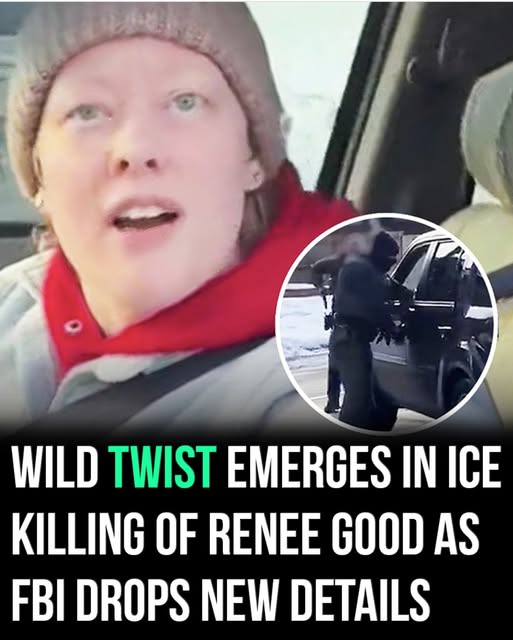
The fatal shooting of Renee Nicole Good during a federal immigration operation in Minneapolis has quickly become one of the most controversial law enforcement cases in the country.
Now, newly reported details are adding another layer to an already intense national debate over immigration enforcement, police use of force, and constitutional rights.
What Happened During the ICE Encounter
On January 7, Renee Nicole Good, 37, was driving her SUV in Minneapolis with her wife, Becca Good, and their dog when an encounter with Immigration and Customs Enforcement (ICE) officer Jonathan Ross turned deadly.
Multiple videos captured the confrontation from different angles. Footage shows Good turning her vehicle’s steering wheel as Ross stood near the front-left side of the SUV. Three gunshots followed — one striking the windshield and two hitting the side window. Good was critically wounded and later pronounced dead at a nearby hospital.
Moments before the shots were fired, Becca Good, who was recording the incident, can be heard urging her wife to leave the scene.
“Drive, baby, drive,” she says in the video.
Conflicting Narratives From Officials
In the immediate aftermath, former President Donald Trump, Vice President JD Vance, and Homeland Security Secretary Kristi Noem publicly defended the ICE agent’s actions, describing the shooting as self-defense. Federal officials claimed the officer feared for his life and characterized Good as a violent participant in unrest.
Minneapolis Mayor Jacob Frey strongly disputed that account after reviewing the video footage.
“They’re already trying to frame this as self-defense,” Frey said. “Based on what I’ve seen, that claim does not hold up.”
The sharply different interpretations have fueled widespread public outrage and ongoing protests.
Federal Focus Expands to Good’s Partner
According to NBC News, federal authorities are now examining whether Becca Good may have interfered with the officer in the moments before the shooting. Sources also say investigators are exploring possible connections between the couple and activist groups critical of U.S. immigration policies.
A source familiar with the inquiry told NBC News that investigators are reviewing whether any activist networks provided guidance related to protest activity.
However, Becca Good’s attorney, Antonio Romanucci, strongly denied that his client is under investigation.
“There has been no contact from the FBI or any federal agency suggesting Becca Good is a target,” Romanucci said.
Justice Department Declines Further Review
Reports also indicate that the Department of Justice is reviewing public comments made by Minnesota Governor Tim Walz and Minneapolis Mayor Frey to determine whether they may have interfered with federal law enforcement operations.
Deputy Attorney General Todd Blanche confirmed that the DOJ’s Civil Rights Division will not pursue additional investigation into Officer Ross.
“We investigate when appropriate,” Blanche said. “This is not one of those cases. We are not responding to political or media pressure.”
Legal Experts Challenge Immunity Claims
Despite federal officials standing by the officer, legal scholars have pushed back against claims that federal agents are immune from criminal accountability.
Michael J.Z. Mannheimer, a constitutional law professor at Northern Kentucky University, said the idea of absolute immunity is legally unfounded.
“There is no doctrine that gives federal agents a free pass for crimes committed on duty,” he said.
State Authorities Continue Evidence Review
Minnesota Attorney General Keith Ellison and Hennepin County Attorney Mary Moriarty confirmed they are independently reviewing evidence related to the shooting. While no charges have been announced, Moriarty has launched an online portal allowing the public to submit video footage and eyewitness accounts.
“We want transparency and community trust,” Moriarty said.
At the same time, the New York Times reports that federal investigators are also reviewing Renee Good’s possible involvement with activist organizations that opposed Trump-era immigration policies.
Free Speech Advocates Raise Alarms
First Amendment experts interviewed by USA Today questioned the relevance of examining Good’s past activism, noting it has little legal bearing on whether deadly force was justified.
Civil liberties groups warn that such scrutiny could discourage lawful political expression.
“That person’s past political activity is not relevant here,” said Teresa Nelson, legal director of the ACLU of Minnesota. “There’s a troubling history in this country of suppressing speech during periods of unrest.”
Courtney Hostetler, legal director for Free Speech for People, echoed that concern, calling the investigation into activism “a dangerous precedent.”
A Case With National Implications
The shooting has sparked renewed protests in Minneapolis and intensified scrutiny of federal immigration enforcement tactics. Critics argue that expanding investigations into political beliefs risks chilling constitutional rights.
Experts say the case underscores deeper tensions between federal authority, local governance, and civil liberties.
With multiple investigations ongoing at both the federal and state levels, the death of Renee Nicole Good remains a flashpoint in the national conversation about law enforcement accountability, immigration policy, and the limits of government power.
The country continues to watch closely as new information emerges and legal questions remain unresolved.