
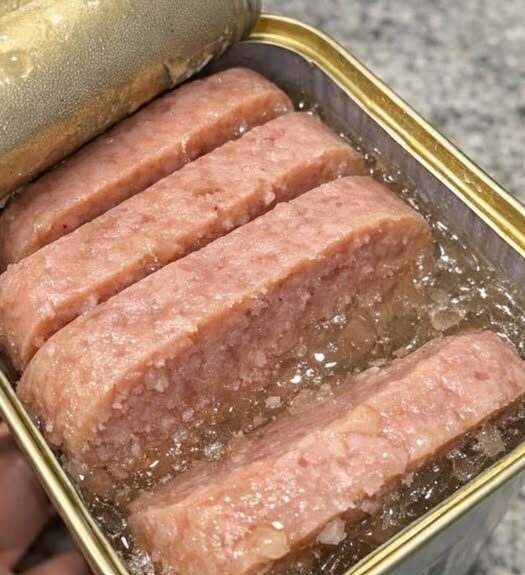
Here are three simple checks to use every time you open a can.
- 🥫 Check the Can First
Before you even look inside, inspect the can itself. It often tells the whole story.
Good signs:
Firm can with smooth sides
No dents, rust, or leaks
Flat top and bottom
Opens normally without spraying or pressure
Warning signs:
Bulging ends
Deep dents near seams
Rust that flakes or eats through
Leaking liquid
Hissing or sudden release when opened
If you notice any of these red flags, don’t taste the food. Discard the entire can.
- 👀 Look at the Jelly and the Meat
Once opened, take a close look before touching or smelling.
What’s normal:
Jelly that’s clear or pale amber
Smooth, gel-like texture
Meat that’s evenly pink and firm
Clean edges when sliced
What’s not:
Cloudy, greenish, or dark jelly
Stringy or unusually slimy texture
Meat that looks gray, green, spotted, or mushy
Foamy or bubbly separation
Texture matters just as much as color. Spam should feel solid—not sticky or soft.
- 👃 Use Your Nose
Smell is one of the most reliable indicators.
Normal smell:
Mild, salty, savory
Neutral and clean
Spoiled smell:
Sour, sharp, rancid, or rotten
If it smells off, trust your instincts and throw it out. Never taste canned meat to “check.”
Common Questions About Spam Jelly
Can cooking remove the jelly?
Yes. Frying, baking, or grilling melts it away. It either absorbs back into the meat or renders into the pan.
Does all Spam have jelly?
Most classic varieties do. Lower-fat or specialty versions may have less, but jelly is expected.
Is the jelly safe to eat?
Absolutely. It’s just gelatin—similar to what forms when broth cools.
What if the jelly looks watery?
That’s fine. Temperature changes can cause it to loosen. If color and smell are normal, it’s not an issue.
The Bottom Line
That clear jelly isn’t a flaw—it’s proof the Spam was properly cooked and sealed. If the can is intact, the meat is pink and firm, and the smell is mild, you’re good to go.
Slice it, fry it, add it to rice, or build a sandwich. That little bit of jelly is simply part of what’s made Spam a pantry staple for generations.
Sometimes the things that look strange are just food doing exactly what it’s supposed to do.
Have you ever been surprised by jelly in Spam? Share your thoughts or tips in the comments—we’d love to hear from you. 🥫