
Linda Hunt’s ascent to the heights of film history was as improbable as it was deserved. Standing at four feet, nine inches, she never possessed the traditional stature of a Hollywood leading lady, yet she commanded every frame she ever occupied with a psychological height that dwarfed her peers. Her watershed moment came in 1982 with Peter Weir’s masterpiece, The Year of Living Dangerously. In a casting decision that would have been controversial if it hadn’t been so brilliant, Weir selected Hunt to play Billy Kwan, a male Chinese-Australian photographer navigating the political upheaval of 1960s Indonesia.
The director had initially searched exclusively for male actors, but after a screen test with Hunt, the decision became undeniable. She didn’t just play a man; she captured the weary, hopeful, and tragic essence of a human being caught between worlds. When she accepted the Academy Award for Best Supporting Actress, she made history as the first person to win an Oscar for portraying a character of the opposite sex. It was not a victory for novelty, but a victory for the transformative power of the craft.
Long before she was a household name, Hunt was a creature of the theater. It was on the stage that she developed the ironclad discipline and the resonant, melodic voice that would become her signature. Whether she was appearing in the comedic chaos of Kindergarten Cop or lending a soulful, ancient wisdom to Grandmother Willow in Disney’s Pocahontas, Hunt possessed a rare ability to anchor a narrative. She never needed to dominate a scene to own it; she simply existed at its center, a point of gravitational stillness around which the rest of the story revolved.
Her television career proved that her appeal was as enduring as her talent. As Judge Zoey Hiller on The Practice, she brought a razor-sharp intellect and a moral weight to the courtroom drama. Later, for over a decade, she became a cornerstone of the NCIS: Los Angeles universe as Henrietta “Hetty” Lange. As the enigmatic and fiercely protective operations manager, Hunt created a character that was the personification of “soft power.” Hetty didn’t need to carry a weapon to be the most dangerous person in the room; she only needed a cup of tea and a perfectly timed observation.
Even a harrowing car accident in 2018, which necessitated a lengthy recovery and time away from the screen, could not dampen her spirit. When she eventually returned to her duties, she did so without fanfare or grand declarations of triumph. Her comeback was marked by the same quiet resilience that has characterized her entire life—a steady, unwavering light that refuses to be extinguished by circumstance.
Perhaps the most touching aspect of her recent public outing was the visible strength of her partnership with Karen Kline. The two have shared their lives since 1978, a timeline that spans nearly the entirety of Hunt’s professional journey. They officially married in 2008, but their bond was forged in the decades of quiet support and mutual respect that preceded the legal recognition.
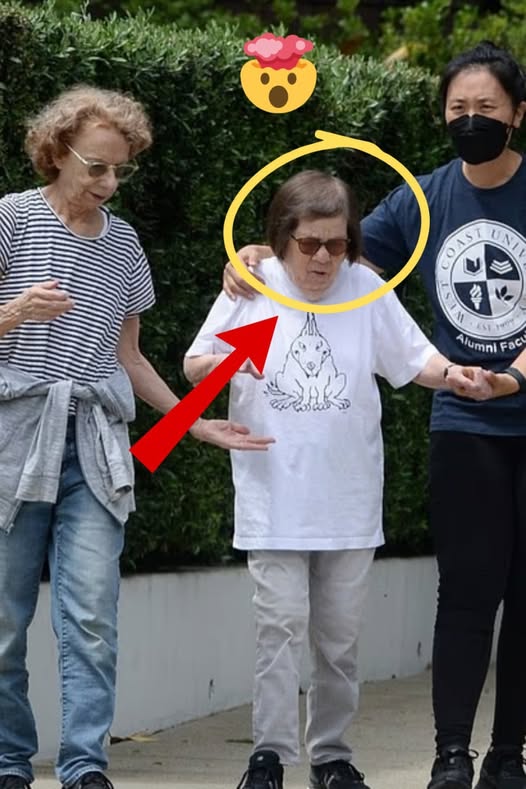
Walking hand in hand through the streets of Los Angeles, their pace was measured and synchronized. There was a beautiful, unselfconscious honesty in the way Hunt accepted assistance when needed, acknowledging the realities of age without allowing them to diminish her stature. In an industry obsessed with anti-aging treatments and the desperate maintenance of a youthful facade, Hunt’s willingness to inhabit her age with grace felt like a revolutionary act.
Linda Hunt’s legacy is a testament to the idea that true greatness does not require volume. In a world that often rewards the loudest and the most visible, she chose a path of restraint. She chose roles that carried weight, stories that demanded empathy, and a life that prioritized substance over spectacle. Her career serves as a blueprint for any artist seeking longevity, proving that if you focus on the truth of the work, the world will eventually find its way to your door.
Seeing Linda Hunt now, at 80, is not a cause for sorrow or a lament for the passing years. Instead, it is a celebration of a life well-lived. It is a reminder that the most powerful thing a person can be is themselves. As she moved down that Los Angeles street, unhurried and composed, she wasn’t just a film legend; she was a woman who had mastered the most difficult role of all: herself. Time has not taken her spark; it has merely refined it into a steady, brilliant glow that continues to inspire anyone fortunate enough to catch a glimpse of it.