
Few topics generate as much debate as the current state of public education. From lawmakers and school boards to media commentators and advocacy groups, nearly everyone has an opinion on what’s “broken” in today’s classrooms. Most of the blame is aimed at curriculum standards, testing policies, or administrative decisions. Yet one voice from inside the system managed to redirect the conversation in a way that continues to resonate years later.
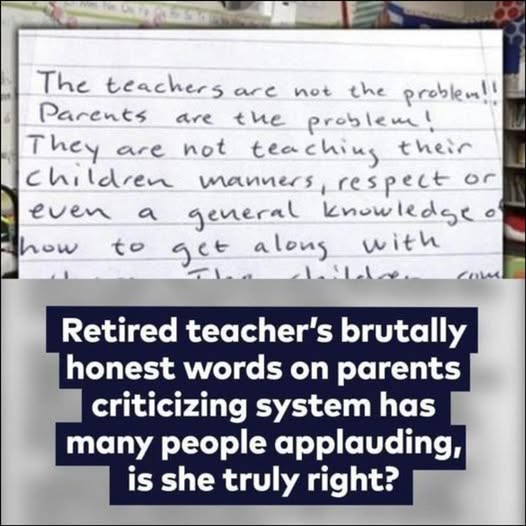
Lisa Roberson, a retired public school teacher, ignited a nationwide discussion after writing a sharply candid open letter to the Augusta Chronicle. Her message was simple, controversial, and impossible to ignore: the biggest challenges facing the education system are not rooted in teaching methods or school funding alone, but in a growing lack of parental involvement and accountability at home.
Although Roberson first shared her thoughts in 2017, the letter has repeatedly resurfaced online, gaining renewed attention as schools face ongoing struggles with student behavior, academic performance, and post-pandemic learning gaps. Her words continue to strike a nerve because they challenge a widely accepted narrative—that teachers and schools alone are responsible for student outcomes.
A Perspective From the Classroom, Not the Boardroom
Roberson opened her letter with a frustration familiar to many educators. She criticized the tendency of people far removed from classrooms to propose sweeping reforms without understanding daily realities. According to her, decisions about education policy are often made by individuals who haven’t spent meaningful time in modern public schools and therefore underestimate the challenges teachers face.
Her central argument flips the usual storyline. “Teachers are not the problem,” she wrote plainly. “Parents are.” The statement spread rapidly across social media, not because it was polite, but because it voiced what many educators felt but rarely said publicly.
Roberson argued that schools are increasingly expected to teach far more than academic content. Basic life skills—respect, self-discipline, responsibility, and appropriate behavior—were once primarily reinforced at home. Today, she claimed, teachers are often forced to manage these foundational issues before instruction can even begin.
The Cost of Misplaced Priorities
One of the most widely shared moments from Roberson’s letter highlighted a stark contradiction she observed repeatedly during her career. She described students arriving at school wearing expensive clothing and shoes, yet lacking essential learning supplies like pencils or notebooks.
In many cases, she explained, teachers step in and purchase supplies themselves to ensure students can participate. For Roberson, this wasn’t merely about materials—it symbolized a deeper issue. She argued that some families invest heavily in appearances while overlooking the practical tools and habits necessary for academic success.
Rethinking the “Failing Schools” Label
Roberson also challenged the common habit of labeling schools as “failing” based solely on test scores. Instead, she urged communities to look at parental engagement as a key indicator of school health.
Her questions were pointed:
- Are parents attending open houses and conferences?
- Do they respond to calls or emails from teachers?
- Are students arriving at school rested, prepared, and ready to learn?
- Can schools even reach parents when problems arise?
From her perspective, a school reflects the community it serves. When parental involvement is low, even the most dedicated teachers and best-funded programs struggle to produce results.
Why Teachers Can’t Do It All
Roberson emphasized that even highly skilled educators, armed with modern technology and innovative teaching strategies, cannot compensate for a lack of support at home. When classrooms are dominated by constant disruptions, missing homework, and disengaged students, learning slows for everyone.
Her message resonated strongly with educators who felt stretched beyond their job descriptions. Many teachers commented that they are expected to act as counselors, disciplinarians, and social workers—often before they can begin teaching core subjects.
Critics of Roberson’s viewpoint argued that her stance oversimplified complex issues like poverty, long work hours, and systemic inequality. These factors undeniably affect parental availability and student readiness. Still, supporters countered that acknowledging hardship doesn’t eliminate the need for shared responsibility.
A Call for Partnership, Not Blame
Roberson’s letter was not a policy proposal or academic paper. It was a call for balance. She concluded with a firm reminder that education works best as a partnership between schools and families.
Teachers, she wrote, cannot effectively do both jobs. Until parents actively participate in their children’s education—by reinforcing expectations, supporting learning at home, and communicating with schools—meaningful improvement will remain elusive.
Why the Message Still Matters
Years later, Roberson’s words continue to circulate because they address an uncomfortable truth. Governments can fund schools and update curriculum standards, but they cannot replace the influence of a supportive home environment.
Her viral letter didn’t change laws or rewrite education policy. Instead, it sparked conversations in teachers’ lounges, family kitchens, and online forums across the country. It reminded the public that student success depends on more than classrooms and textbooks—it begins with consistent guidance, structure, and involvement at home.
In the end, Roberson didn’t just criticize the system. She challenged families to reclaim their role in shaping the next generation. And that challenge, uncomfortable as it may be, remains just as relevant today.