
He was never prepared for applause. Never trained to perform charm or presence. In a family often defined by spectacle, he was raised as an exception. His life was meant to unfold privately, without branding or expectation, untouched by the need to impress.
Then came loss.
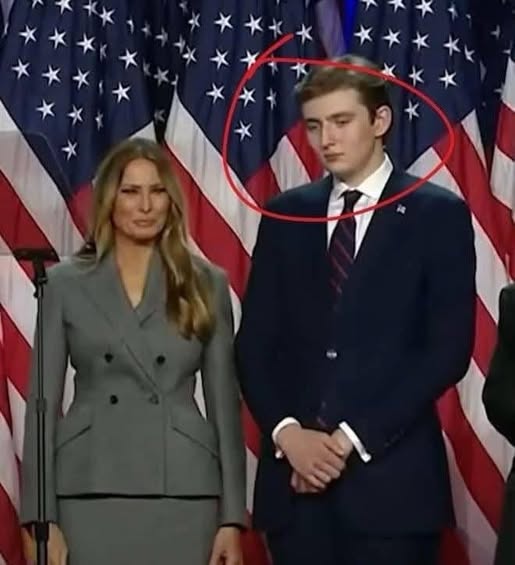
What should have been a deeply personal moment became another public scene. While headlines were written and images circulated, he stood in black as the world noticed him anew—not with empathy, but with curiosity. His height was commented on. His stillness interpreted. His silence questioned. Even restraint was treated as meaning.
Grief, which should belong to no one else, was pulled into the open. Where privacy should have existed, there was scrutiny. Where compassion should have led, speculation followed. He was no longer seen as a child mourning someone he loved, but as a figure expected to represent something—strength, weakness, legacy, symbolism. Anything but himself.
And yet, his response has been consistent: withdrawal.
In a culture that equates visibility with relevance, he has chosen distance as a form of control. He does not explain. He does not respond. He does not perform resilience or rebellion. He simply withholds. Not as a statement, but as self-preservation. In doing so, he resists a system that demands access to even the most private corners of a young person’s life.
There is strength in that refusal.
He carries loss without narrating it. Growth without advertising it. Curiosity without turning it outward. He allows himself to remain unfinished, undefined, unclaimed by expectation. In a world eager to predict futures and assign destinies early, his quiet insists on something rare—the right to develop without pressure.
That silence is often misunderstood. Distance is mistaken for arrogance. Privacy is labeled secrecy. But silence can be a boundary. Distance can be care. Not everything withheld is hidden out of fear. Sometimes it is protected out of respect.
He is not a political statement. He is not an extension of ideology, nor a preview of a future dynasty. He is not a referendum on a presidency. He is a young person moving through circumstances far larger than himself, asking for something that should never have required permission: the dignity of privacy.
There is a persistent belief that children in public families owe the world something simply by existing—a reaction, a narrative, a visible response. But childhood is not a contract. Grief is not public property. Curiosity does not outweigh the right to be left alone.
By choosing quiet, he makes no speeches and issues no corrections. Yet the message remains clear. Visibility is not obligation. Silence is not consent. A child—even one born near power and attention—does not lose humanity by proximity.
He stands, often silently, in moments the world insists on magnifying. And by refusing to play the role assigned to him, he offers a reminder that feels increasingly rare: it is still possible to exist without explanation.
He is not a symbol waiting to be decoded. He is not a metaphor. He is a boy carrying loss in a world that struggles to look away. And if dignity still exists in public life, it begins by granting him what he has never offered to surrender—the space to grieve, to grow, and to become, quietly, on his own terms.