
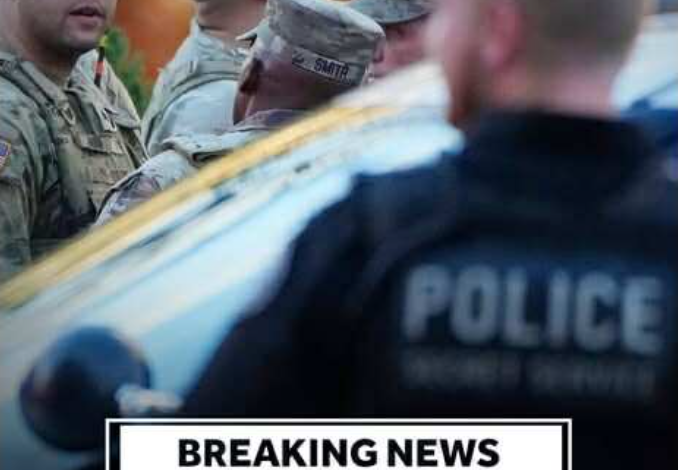
The first shot was sharp enough to slice through the city noise like a snapped cable. People froze. A flock of starlings lifted from a rooftop in a frantic wave. Before anyone could process what they’d heard, a second burst followed—louder, closer, unmistakable.
Screams erupted. A woman sprinted across the crosswalk and dove behind a concrete barrier. A man dropped his coffee as he shoved two strangers toward a building lobby. Cars jolted to a halt in the middle of the street. And in the center of it all, the two National Guard members were down—their bodies collapsing almost simultaneously, their equipment clattering loudly against the pavement.
For ten seconds, absolute chaos reigned. Then came the sirens.
They weren’t distant or gradual—they slammed into the scene all at once. Police cruisers tore through the gridlock. An armored response vehicle swung around a corner so fast its tires screeched against the asphalt. A helicopter rushed overhead, blades carving the air with violent insistence. Agents in tactical gear flooded the street, shouting directives that no one could understand over the sound of pure panic.
Downtown transformed with brutal speed. Barricades slammed into place. Officers formed protective walls. Pedestrians were pushed back, cleared out, redirected. Offices went into immediate lockdown. The blocks surrounding the White House shifted from everyday bustle to full-scale emergency zone in minutes.
One witness—a federal employee who’d been walking with earbuds in—later said, “It felt like the city suddenly remembered it was vulnerable.”
Within the swirl of flashing lights and tactical movement, officers pulled a single “person of interest” from the scene. The individual offered no fight, no explanation, no expression at all. They were led away silently, swallowed by the swarm of investigators before anyone could get a clear look.
But answers were scarce. And the silence around motive made the tension worse.
The injured Guardsmen were rushed into ambulances, shielded by layers of personnel. No details were released—not their conditions, not their identities, not their units. Families likely learned what happened through breaking news alerts before getting official calls. The lack of information created a vacuum that filled instantly with speculation, fear, and the raw reminder that even the most fortified spaces have seams.
This wasn’t just an attack near a national landmark—it was an attack on the expectation of safety that people assume exists around the heart of American power. For decades, the area near the White House has been symbolic—a place where security feels absolute, where danger feels distant. But gunfire echoing through those streets shattered that myth in an afternoon.
Investigators moved quickly. Evidence markers formed a constellation on the pavement. Surveillance footage was pulled from every angle. Drones scanned alleyways and rooftops. Analysts worked in mobile command units parked at the curb. Yet even as the response escalated, a sense of uncertainty lingered—an understanding that whatever had happened had been set in motion long before the first shot.
The city held its breath.
People locked inside offices stared at muted news broadcasts. Those stuck on the streets refreshed their phones endlessly, waiting for updates. Parents texted their children. Tourists gathered in hotel lobbies whispering about what they’d heard. Even the reporters who eventually swarmed the perimeter carried an edge of caution in their voices.
And beneath it all was the unspoken question: Was this a lone act of violence, or the first ripple of something deeper?
By evening, streets remained blocked. Investigators were still collecting fragments—shell casings, debris, witness statements, digital evidence. Officials prepared careful statements, the kind written to calm the public without revealing anything substantial. Meanwhile, rumors spread faster than facts.
But no amount of official reassurance could erase the image of two uniformed soldiers lying wounded only steps from one of the most protected addresses in the world.
The true impact wasn’t measured in sirens or barricades—it was felt in the uneasy quiet that settled over the capital afterward. People kept glancing over their shoulders. Security presence doubled overnight. Coffee shop conversations circled the same question: How could something like this happen here?
And until investigators release the full picture, that question hangs over the city like a shadow.
Washington has weathered countless storms—political, social, symbolic—but this one cut close. Too close. And as the nation waits for the truth to surface, one thing is clear: whatever cracked open on 17th Street wasn’t random. And until the city understands the why, the tension that erupted there won’t truly fade.