
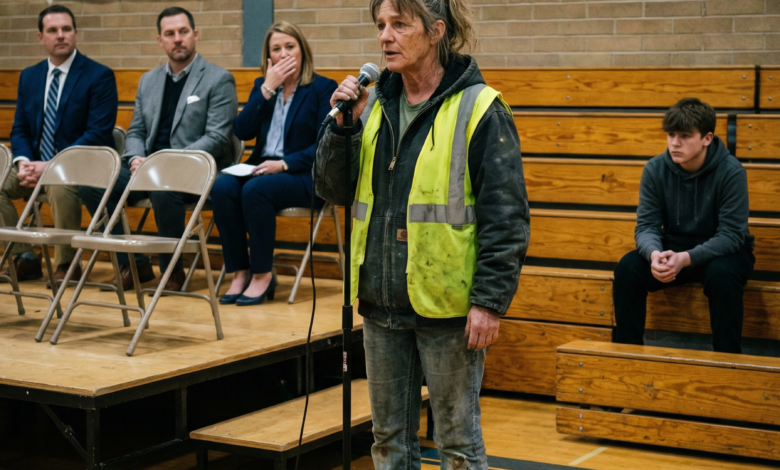
My daughter, Emma, begged me to speak.
“They need to hear from somebody real,” she said.
What she didn’t say—but what I heard anyway—was this: people like us don’t get invited into rooms like that unless someone wants a “feel-good” story.
“A Truck Driver?”
The gym filled with parents sitting in folding chairs, the kind that squeak when people shift their weight. A tech manager spoke about innovation. A consultant talked about leadership pipelines. The kids listened the way kids do when adults are performing confidence.
Then I heard it, from the back row.
“A truck driver?” a woman muttered. “That’s who they brought in?”
Someone laughed—small, polite, dismissive.
It landed in my chest the way a pothole hits through the steering column: sudden, sharp, familiar.
I walked up anyway. Boots on hardwood. Hands that have held a wheel through black ice, blinding rain, and nights so long they felt like they’d swallow you whole.
“I don’t save lives in an operating room,” I told them. “I don’t argue cases in court. I don’t sit behind a polished desk.”
“But when the country got scared and the roads went quiet, I was still out there.”
I talked about the loads nobody applauds:
- baby formula when shelves were empty
- medicine for towns with one pharmacy and no backup plan
- refrigerated food that can’t wait for better weather
I told them about what it costs.
Birthdays missed. School plays missed. One Christmas Eve eating crackers in my cab behind a dark loading dock because the trailer had to be delivered before dawn.
Not because I’m special.
Because that’s what “essential work” looks like when it isn’t a slogan.
The Question That Always Shows Up
When I finished, a boy in a gray hoodie raised his hand. He looked like he’d learned to be older than he should’ve had to be.
“Do you ever regret not doing something… bigger?” he asked. “Like college?”
I knew what he meant. The question people ask when they think they’re being helpful.
Why didn’t you become someone we would respect faster?
I held the sides of the podium and answered the truth.
“When people are cold, hungry, sick, or scared,” I said, “they don’t ask whether help arrived from a corner office or a loading dock.”
“No—I don’t regret honest work. I don’t regret feeding my family with it. And I don’t regret helping keep other families standing when life got hard.”
The Moment the Whole Room Changed
The boy stood up so fast his chair nearly tipped.
“My dad drives nights,” he said. “People joke that he just sits there and turns a wheel.”
His voice shook, but he kept going.
“He sleeps on our couch because he gave me his room after my mom left. He pays for my little sister’s inhalers. He misses almost everything. And he still says sorry like he’s the one letting us down.”
You could feel the air shift. No one checked their watch. No one whispered.
“So maybe people like you don’t wear suits,” he said, wiping his face with his sleeve. “But my dad is the reason we eat. He’s the reason the lights stay on. He’s the reason I get to be here.”
Then he looked at me like he was asking the room to finally see what he’d been carrying alone.
“He’s my hero,” he said. “And I think you are too.”
I’ve sat at a lot of lonely diner counters at 2 a.m. I’ve driven through weather that made me pray without realizing I was praying.
Nothing hit me like that.
“This Country Doesn’t Run on Applause”
I looked at the students and said what I wish someone had told my kids earlier.
“This country does not run on applause,” I said. “It runs on people who show up tired.”
“The drivers. The nursing aides. The mechanics. The warehouse teams. The janitors. The lineworkers. The people who miss dinner so somebody else can have one.”
“So don’t build your future around what sounds impressive. Build it around what’s honest. What’s needed. What lets you sleep at night knowing you carried your part.”
When it ended, kids lined up—not for autographs, but to confess the things they’d been taught to hide.
A girl whispered that her mom cleans offices at night and avoids writing it on school forms. A boy said his uncle fixes heating systems and gets treated like he’s “just a repair guy”—until the heat goes out.
Emma hugged me and said, “I told you they needed somebody real.”
I thought that was the end of it.
I was wrong.
The Backlash No One Likes to Admit Exists
After the applause faded, the polite smiles came back—the kind people use when they’re already preparing an argument.
The principal warned me, carefully, that some parents felt I’d given students “the wrong message.”
Not because I’d lied.
Because I’d made it harder to pretend that success only counts when it comes with a blazer and a title.
Outside, two well-dressed parents stopped me. One said my talk was “emotional,” and hoped I hadn’t “romanticized hardship.”
That phrase—romanticized hardship—is what people say when they want to sound compassionate while looking down on the jobs they rely on every day.
Emma stepped forward, eyes steady.
“My mom didn’t romanticize anything,” she said. “She just didn’t pretend some people matter less because their jobs come with steel-toe boots.”
When a Video Goes Viral, the Truth Travels With the Noise
By dinner, a short clip from the gym was everywhere. Someone posted the line about “people who show up tired,” and suddenly my phone wouldn’t stop buzzing.
Messages poured in from working families—truckers, single parents, healthcare aides, warehouse workers—people thanking me for saying out loud what they’d been swallowing for years.
Then came the other comments:
- “This is how small towns keep kids stuck.”
- “Why invite a driver when students need role models for advancement?”
- “Hard work is honorable. Settling is not.”
As if keeping your family afloat is “settling.”
As if dignity only counts when it photographs well.
The Real Fight: What the School Was About to Remove
The next morning, I was back on the road before sunrise. Because the internet can debate your worth all day, but freight still has to arrive on time.
Emma called while I was fueling up.
The school board, she said, was considering eliminating the auto shop and logistics program—pulling out the lifts, clearing the bays, removing training equipment—to build a glossy “future lab” designed to look good for donors.
In other words: trade education out, branding in.
That room mattered more than people realized. It wasn’t just engines and tools. It was:
- career training that leads to real jobs
- industry certifications
- workforce development for students who learn by doing
- a place where some kids finally felt smart
And it wasn’t an accident. A major donor family wanted the school to look more “aspirational.”
Aspirational, apparently, meant removing anything that reminded people the world still runs on skilled labor.
Money With Strings Attached
That evening, the board meeting was packed: nurses, mechanics, warehouse workers, parents in work boots, students with grease under their nails.
The donor family spoke in polished phrases—“realignment,” “future-facing identity,” “expanded opportunity.”
Then they mentioned a scholarship Emma had been considered for.
And suddenly the room understood the quiet threat: the money was for students who fit a certain image of success.
Emma stood up.
She thanked them—then declined.
“If ‘expanded opportunity’ means I have to stand by while people talk about working families like we’re a sad before-picture,” she said, “then I’m not your student.”
She told them she’d applied to colleges and to a state logistics and emergency supply program.
Because she wanted a future that was useful, not just impressive.
“Helping people and impressing people are not always the same thing,” she said.
The room rose to its feet.
What Changed Wasn’t Just a Program—It Was the Definition of Success
Something unexpected happened after that.
The donor admitted they’d confused “polish” with “safety.” The board agreed to pause demolition plans. Teachers brought data—job placements, certification pass rates, student attendance improvements.
Workers offered what workers always offer when systems fail: their time.
Mechanics volunteered weekends. A lineman offered electrical help. A warehouse supervisor offered shelving. A truck driver offered to teach routing and compliance one night a month.
The school didn’t just keep the program.
They expanded it.
And the scholarship? It was rewritten to support multiple pathways: four-year degrees, two-year programs, certifications, and apprenticeships.
Not one lane. A wider road.
The Lesson That Stuck
At the reopening, the new logistics room had photos on the walls: warehouses, utility crews, dispatchers, mechanics, clinic supply rooms—jobs kids are taught to overlook until something breaks.
Above the whiteboard, Emma painted a sentence in block letters:
NOT ALL ESSENTIAL WORK LOOKS IMPRESSIVE FROM FAR AWAY.
And standing there, watching students crowd into a room built for real skills and real careers, I understood something I wish our culture would stop forgetting:
A community isn’t held together by the people who look best on a brochure.
It’s held together by the people who refuse to look away from each other’s worth.
Closing CTA
If this story reminded you of someone who works hard without getting much credit, share it with them—and tell me in the comments: who’s the “tired hero” in your life?