
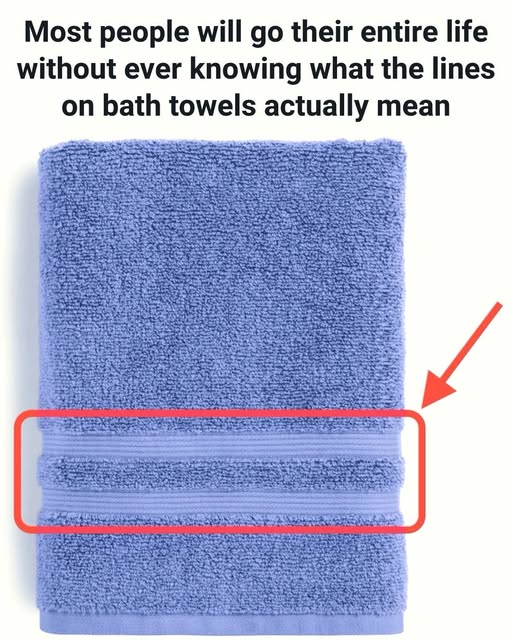
However, for those who prefer engineering over internet folklore, the truth is far more fascinating. That mysterious strip is known in the textile industry as a “dobby border.” While it may appear to be a decorative flourish intended to break up the monotony of the terry cloth, its primary reason for existence is rooted in structural integrity and long-term durability. Towels are some of the hardest-working fabrics in any home; they are subjected to constant moisture, friction, and high-heat laundering cycles. Without a dobby border, a towel would essentially be a loose collection of loops that would quickly succumb to the stresses of the washing machine.
The dobby border is created using a specialized loom—the dobby loom—which allows for the weaving of geometric patterns that are denser and more tightly packed than the rest of the towel’s pile. By integrating this flat, woven section near the hems, manufacturers provide the towel with a skeletal frame. This reinforcement prevents the edges from fraying and, perhaps more importantly, stops the towel from “puckering” or shrinking unevenly. Have you ever owned a cheap towel that eventually took on a bowed, hourglass shape after a few washes? That is typically the result of a missing or poorly executed dobby border. The strip ensures that the towel maintains its rectangular symmetry, allowing it to hang straight on a rack and stack neatly in a closet for years.
Beyond the realm of structural engineering, the dobby border plays a critical role in the tactile experience of the product. Textile professionals explain that absorbency is a delicate balance. A towel that is 100% thick loops would be incredibly heavy and take an eternity to dry, eventually leading to the buildup of mildew and musty odors. The dobby border provides a strategic break in the “loop density.” This allows the towel to remain lightweight and facilitates better airflow when hanging, ensuring that the fabric dries completely between uses. It is a masterful example of functional design where a reduction in material actually leads to an increase in performance.
Furthermore, the dobby border serves as a canvas for the branding and aesthetic identity of hospitality and retail giants. Because the border is a flat weave, it is the ideal location for intricate jacquard designs, embroidered logos, or subtle color accents. In luxury hotels, the number of lines in a dobby border often acts as a silent code for staff, indicating the size or quality grade of the towel at a glance. For the homeowner, these lines provide a visual guide for folding, ensuring that the linen closet looks organized and uniform. It is the “finishing touch” that transitions a piece of industrial fabric into an item of home decor.
The viral nature of this discussion also touched upon the broader psychology of household habits. The “towel line” debate inevitably veered into the age-old question of towel hygiene: “If I am clean when I use the towel, why does the towel get dirty?” While the dobby border keeps the fabric strong, it cannot defend against the accumulation of dead skin cells and moisture-loving bacteria. The internet’s fascination with the dobby border served as a gateway for experts to remind the public that even the most well-engineered towel requires regular care. The border itself can sometimes be the first place where “biofilm” or soap scum accumulates if a towel isn’t rinsed properly, making its flat, easy-to-clean surface a vital part of the towel’s hygienic maintenance.
Ultimately, the mystery of the towel line is a testament to the sophistication of everyday objects. We live in a world surrounded by “silent geniuses”—designs that have been perfected over centuries to solve problems we didn’t even know we had. The dobby border is a hero of the bathroom, quietly preventing our linens from falling apart while providing the structural grace necessary for a tidy home. It is a bridge between the ancient art of weaving and the modern demands of mass production.
As the social media storm eventually quieted, the consensus shifted from mockery to appreciation. The “face-to-butt” jokes were replaced by a genuine respect for the weavers and engineers who realized that a simple line could be the difference between a towel that lasts a decade and one that ends up in the rag bin after a month. The next time you step out of the shower and reach for that familiar piece of cotton, you might find yourself tracing the edge of that textured strip. It is no longer just a mysterious line; it is the dobby border—a small, woven marvel of durability, symmetry, and domestic science. Passing this knowledge along isn’t just about winning a trivia night; it’s about acknowledging the hidden intelligence in the world around us, one bath towel at a time.