
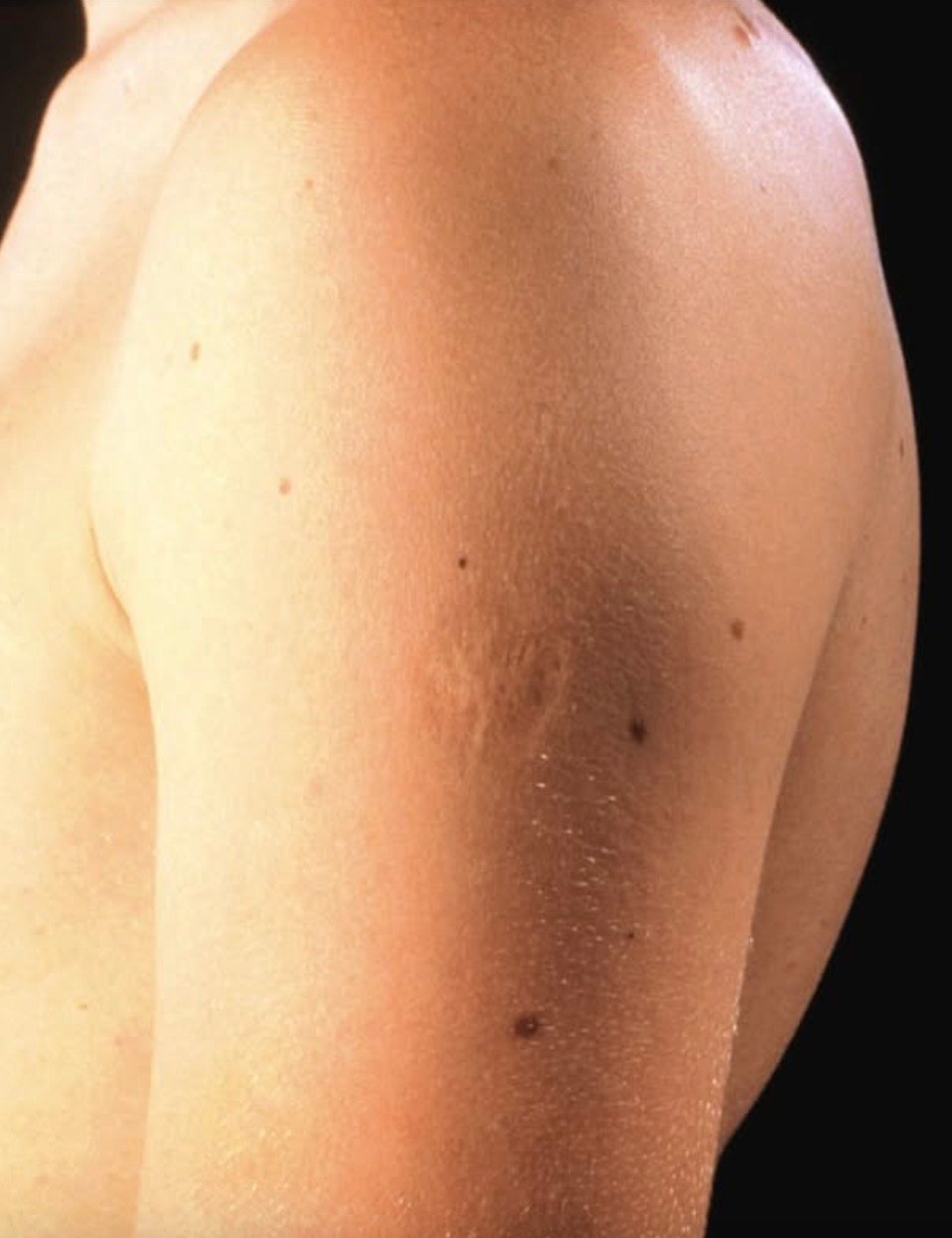
The smallpox vaccine was revolutionary—and its method left an unforgettable mark. Unlike modern shots, it used a bifurcated needle, a thin steel rod with two prongs. Medical workers dipped the prongs into live vaccinia virus—a safer cousin of smallpox—and rapidly punctured the skin, usually about fifteen times in seconds. This superficial injection activated the immune system, sparking a localized reaction: a red, itchy bump that grew into a fluid-filled blister, then a scab, and finally a permanent circular scar. That scar wasn’t just a mark—it was proof. Proof that you were protected, part of a global fight against one of history’s deadliest diseases.
For those vaccinated, the scar became a badge of survival, an early “vaccine passport.” A glance at the arm told officials you were safe. No digital records needed. The scar represented community, science, and collective action against an enemy that had haunted humanity for centuries.
The smallpox campaign remains a crowning achievement in public health. The World Health Organization coordinated ring vaccination strategies, tracking the virus to remote jungles, deserts, and war zones. By 1952, the U.S. was free of smallpox. Routine vaccinations ended in 1972, and in 1980, the WHO declared humanity had eradicated the disease entirely—the first and only human pathogen to be fully wiped from the planet.
Today, the scar is a generational marker. If you were born after the early 1970s, your arm is likely smooth, never carrying the circular mark of survival. For younger generations, smallpox exists only in history books, a theoretical threat never faced firsthand. The absence of the scar is, ironically, the ultimate evidence of triumph: the battle was already won for us.
For those who still bear the mark, it’s more than a medical relic. It’s living history. A reminder of what humans can achieve when science, will, and global cooperation collide. Every scar tells a story of survival, of a world that refused to accept a 30% death rate as fate, of the humans who stood up and said, “No more.”
So next time you spot that distinctive ring on someone’s arm, pause for a moment. It’s a scar of protection, survival, and hope—a tangible echo of humanity’s greatest victory over disease. A silent reminder that even the deadliest threats can be beaten when we work together.