
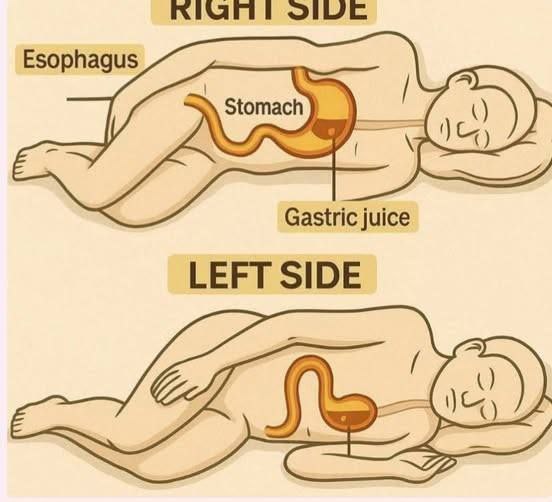
The spleen and liver—two of the body’s most important filtration organs—are also affected by sleep position. The spleen, located on the left, filters blood, recycles old red blood cells, and supports immune function. Left-side sleeping allows gravity to assist blood flow into the spleen, potentially improving its efficiency. Meanwhile, the liver, positioned primarily on the right, can become compressed when someone sleeps on that side. This pressure may slow bile flow and detoxification. Turning to the left relieves that load, giving the liver more room to perform its chemical balancing act during the night.
Digestive health, too, finds a quiet ally in left-side sleeping. The colon follows a specific path through the abdomen, moving upward on the right, across the body, and downward on the left. When lying on the left side, gravity assists the natural movement of waste from the transverse colon into the descending colon. This can promote regular bowel movements and reduce bloating, especially for people prone to constipation. It’s not a cure-all, but it’s a mechanical advantage—one that works while you sleep.
For pregnant women, the left-side position is often emphasized not as a preference, but as a necessity. As pregnancy progresses, the growing uterus can compress the inferior vena cava, a major vein that returns blood from the lower body to the heart. This compression is most pronounced when lying on the back or right side. Left-side sleeping alleviates pressure on this vein and on the liver, improving circulation to the heart and placenta. The result is better oxygen and nutrient delivery to the fetus and reduced swelling, dizziness, and fatigue for the mother. In this context, left-side sleeping becomes a protective posture for two bodies at once.
Despite these advantages, changing sleep habits isn’t easy. The body develops strong positional preferences over time, reinforced by muscle memory and comfort cues. Someone who has slept on their right side for decades may initially find left-side sleeping awkward or restless. But the body is adaptable. Simple tools—such as a body pillow, a wedge pillow, or placing a cushion behind the back—can gently prevent rolling over during the night. Over time, the nervous system adjusts, and the new position begins to feel natural.
What makes left-side sleeping especially compelling is that it belongs to a broader philosophy of passive wellness. It asks nothing dramatic of us—no supplements, no schedules, no discipline beyond awareness. It recognizes that health is shaped not only by what we actively do, but by how we position ourselves during the long hours of rest that make up nearly a third of our lives. These hours are not empty; they are filled with cellular repair, hormonal regulation, and neurological maintenance. How we lie during them matters.
In many traditional systems of medicine, including Ayurveda, sleeping on the left side has long been recommended for digestion and vitality. Modern research is now catching up to what intuition and observation suggested centuries ago: that the body works best when its internal pathways are unobstructed and supported by gravity rather than challenged by it.
Ultimately, the wisdom of left-side sleeping reminds us that health is often a matter of alignment—literal as much as metaphorical. When we align our habits with our anatomy, we reduce friction within the body and allow its natural intelligence to function more smoothly. Sleep becomes more than unconscious rest; it becomes an active collaborator in well-being.
And in a world obsessed with doing more, optimizing more, pushing more, there is something quietly profound about the idea that better health might begin with something as simple as turning to the left, closing your eyes, and letting the body do what it has always known how to do.