
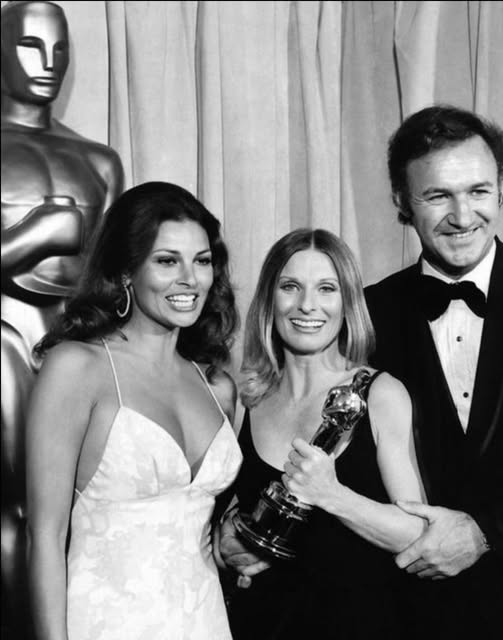
That recognition extended to Gene Hackman, whose Best Actor win for his portrayal of Popeye Doyle remains one of the most emblematic Oscar moments of the era. Hackman did not fit the classical mold of a movie star. He looked worn, intense, and unvarnished—more like a man shaped by his work than elevated above it. When he later described the grueling production, his words matched the film’s texture: long winter shoots, relentless pressure, and a director who demanded everything. It felt like a performance forged under strain rather than polished under lights.
What made the 1972 Oscars particularly fascinating was not just what won, but what shared the stage. A Clockwork Orange stood as a provocation—violent, philosophical, and deeply polarizing—challenging audiences to confront discomfort rather than retreat from it. Meanwhile, Fiddler on the Roof reminded viewers that tradition, music, and emotional sweep still held power, even as cinematic language evolved. The coexistence of these films on one ballot spoke volumes about an industry unsure where it was headed, but certain it could no longer stay still.
Then there was The Last Picture Show, a quiet, devastating portrait of fading youth and vanishing small-town America. Its wins for Cloris Leachman and Ben Johnson felt less like spectacle and more like acknowledgment. These performances didn’t shout for attention. They lingered. They bruised. The Academy’s recognition suggested a growing respect for subtlety and character over scale.
Outside the Dorothy Chandler Pavilion, the world pressed in. The Oscars did not exist in a vacuum that year. Protests gathered near the venue, including demonstrations connected to Dirty Harry, reflecting broader anxieties about violence, authority, and the cultural direction of American storytelling. The tension between art and politics was not theoretical; it was visible on the streets. The ceremony felt porous, influenced by the same unrest shaping the nation.
Inside, music carried its own revolution. Isaac Hayes won Best Original Song for “Theme from Shaft,” a landmark moment that resonated far beyond the category itself. His win symbolized a shift in whose voices were being amplified and what kinds of stories were being validated. Unlike modern broadcasts where musical performances often feel like intermissions, the music that night felt integral—another signal that the culture was broadening its definition of excellence.
Yet the emotional center of the evening belonged unmistakably to Charlie Chaplin. After decades of exile and controversy, his return to accept an honorary award produced what is still cited as the longest standing ovation in Oscar history—roughly twelve minutes of uninterrupted applause. It was not loud for effect. It was sustained, collective, and deeply human. In that moment, the room acknowledged not just a career, but the complicated relationship between legacy, politics, forgiveness, and time.
Chaplin’s brief remarks landed precisely because they were unpolished. He did not perform humility; he expressed it. The applause that followed felt less like celebrity worship and more like reconciliation—a room full of people recognizing that art outlives the eras that judge it.
When you look closely at the original photograph from that night, what stands out is not perfection, but friction. The audience appears attentive rather than distracted. The winners look surprised rather than rehearsed. The atmosphere feels charged, not curated. Hollywood, in that instant, seemed aware that it was redefining itself—experimenting, arguing, and listening all at once.
That is why comparisons to modern ceremonies so often feel unflattering. It is not that contemporary cinema lacks talent or ambition. It is that nights like 1972 carried the sensation of risk. The industry was not celebrating consensus; it was negotiating identity. The applause contained uncertainty. The controversy felt alive. The victories mattered because they signaled direction, not just success.
The unedited Oscars photo endures because it documents that tension honestly. It shows a moment when glamour had not yet been fully smoothed into branding, when rebellion had not yet been packaged, and when legacy and disruption shared the same stage without apology. It is a reminder that cinema evolves most powerfully when it is willing to sit with discomfort, contradiction, and change.
That single night did more than distribute statues. It captured Hollywood in motion—handing the microphone to a new generation while still acknowledging the ghosts that built the room. And that is why, decades later, the image still invites us to look closer, to read between the smiles, and to remember what it feels like when an art form is brave enough to reinvent itself in public