
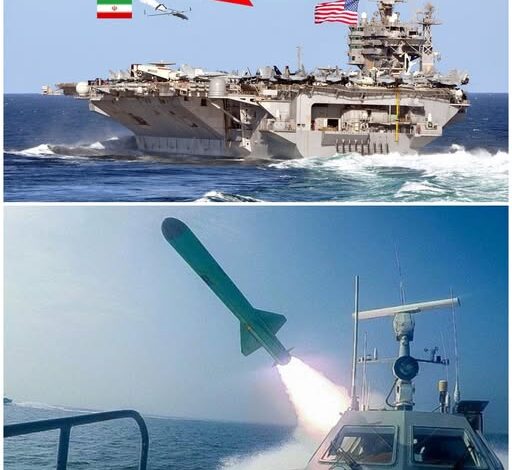
When the Iranian Revolutionary Guard Corps released slick footage showing a swarm of loitering munitions “striking” a mock-up of the USS Abraham Lincoln, the world watched—but the truth is far more technical than cinematic. The video’s message was clear: Iran wants Washington to fear that cheap, mass-produced drones could overwhelm a multi-billion-dollar aircraft carrier. But in reality, modern naval defense is a highly choreographed system of sensors, networks, and layered firepower—far removed from a Hollywood-style drone apocalypse.
In a real-world scenario, drones like the Shahed-136 wouldn’t drop from the sky in a perfect cloud. Launches from coastal sites near Bandar Abbas would happen in waves, relying on pre-programmed GPS paths. These aren’t smart, autonomous killers—they’re low-cost, one-way cruise missiles. Their strength isn’t intelligence—it’s sheer numbers.
Detection happens long before a drone swarm gets close. The E-2D Advanced Hawkeye acts as the fleet’s “digital quarterback,” using AN/APY-9 radar to spot small, low-flying targets against the ocean surface. Data flows instantly through the Cooperative Engagement Capability (CEC) network, letting destroyers and cruisers fire on targets they haven’t directly seen. A Carrier Strike Group isn’t just a collection of ships—it’s a single, synchronized combat system.
Defense is layered. Large-caliber guns engage threats at range, while Phalanx CIWS and Rolling Airframe Missiles protect closer targets. Standard Missiles (SM-2, SM-6) add an outer layer of protection. Critics worry about cost asymmetry—shooting a $1M missile at a $5K drone—but the U.S. Navy is adapting. Directed energy systems, like high-powered lasers and microwave emitters, can neutralize dozens of drones using electrical power, not ammunition, reducing reliance on limited missile stocks.
Continue reading on next page…