
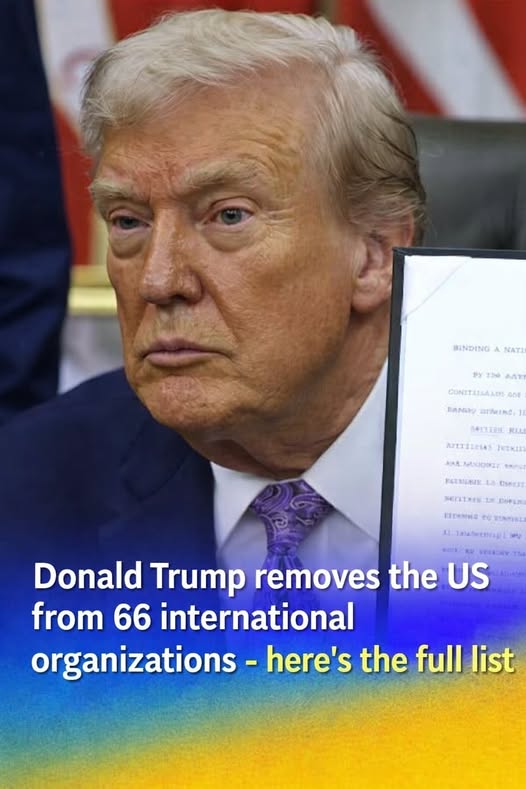
The United States is undergoing one of the most consequential changes in modern foreign policy, marked by a large-scale withdrawal from dozens of international organizations under President Donald Trump. According to a detailed White House memorandum, the federal government has moved to exit a total of 66 international bodies, including 31 organizations connected to the United Nations and 35 additional global institutions outside the UN system.
This sweeping move represents a clear departure from the multilateral approach that has guided U.S. diplomacy since World War II. Instead, the administration has embraced a strategy centered on national sovereignty, reduced international obligations, and a preference for bilateral agreements over global governance frameworks—an extension of the long-standing “America First” doctrine.
Rationale Behind the Withdrawals
Administration officials argue that many international organizations no longer reflect their original missions and instead promote agendas that conflict with U.S. economic interests and domestic policy priorities. According to senior officials, some institutions have evolved into platforms for ideological initiatives, regulatory expansion, or climate-related mandates that the administration believes limit economic growth and undermine U.S. self-determination.
By exiting these organizations, the White House estimates that billions of dollars in taxpayer funding could be redirected toward domestic priorities. These include infrastructure investment, healthcare system stabilization, economic development programs, and workforce support initiatives aimed at strengthening the U.S. economy.
United Nations Agencies Affected
Among the most visible changes is the United States’ withdrawal from several high-profile UN-affiliated agencies. This includes UN Women, which focuses on gender equality and global development programs, and the United Nations Population Fund (UNFPA), an organization long at the center of political debate in the U.S. due to differing views on reproductive health policy.
Officials cited ideological disagreements as a primary reason for ending participation, emphasizing that federal funding should align with domestic policy values and national interests.
Broader Impact Beyond the UN
The scope of the withdrawals extends well beyond humanitarian agencies. The 35 non-UN organizations affected operate across a wide range of sectors, including international trade, energy policy, arms monitoring, development finance, and peacebuilding efforts.
By stepping away from these institutions, the United States is relinquishing formal roles in forums where global standards and regulations are negotiated. The administration contends that such organizations often impose regulatory expectations—sometimes referred to as “soft law”—that reduce U.S. competitiveness. The preferred alternative is a flexible foreign policy model based on direct, country-to-country negotiations.
Legal and Congressional Considerations
While the White House has outlined its intent clearly, the memo acknowledges that withdrawals will proceed “to the extent permitted by law.” Many U.S. commitments to international organizations are rooted in Senate-ratified treaties or congressional funding mandates, which limits unilateral executive authority.
Legal experts and lawmakers are expected to closely examine how these exits are implemented to ensure compliance with constitutional and legislative requirements. Despite this, the administration has signaled it will exercise executive authority as broadly as possible in pursuit of what it defines as the national interest.
Expansion of an Existing Policy Direction
This initiative builds on earlier Trump-era decisions, including the U.S. withdrawal from the Paris Climate Agreement and steps taken to exit the World Health Organization. In those cases, the administration argued that participation costs outweighed benefits and that institutional bias reduced fairness for the United States.
Applying that same logic to more than 60 additional organizations represents a significant escalation, effectively challenging the postwar international system that the U.S. helped design and lead for decades.
Economic and Strategic Debate
Supporters of the policy argue that leaving multilateral trade and regulatory bodies gives the U.S. greater leverage in negotiations, allowing it to use its economic strength to secure more favorable bilateral agreements. They view the move as a correction to decades of international overreach that diluted U.S. negotiating power.
Critics warn, however, that reduced participation could weaken America’s ability to influence global rules. They caution that other major powers—particularly China—could step into leadership roles within these organizations, shaping standards that disadvantage U.S. industries, supply chains, and long-term economic competitiveness.
Environmental and Humanitarian Implications
Environmental groups have expressed concern that withdrawing from climate-focused organizations reduces U.S. involvement in global emissions monitoring and international coordination. While the administration sees climate mandates as costly and restrictive, critics argue that U.S. disengagement could undermine global environmental cooperation.
Humanitarian organizations are also affected. Agencies such as the UN High Commissioner for Refugees (UNHCR) and the UN Development Programme (UNDP) may lose a key partner in funding and coordination. Opponents of the policy argue that reduced U.S. involvement could complicate disaster response and refugee management, potentially creating long-term regional instability.
Global and Domestic Reactions
International allies in Europe and Asia have largely reacted with concern, warning that a less-engaged United States could lead to a more fragmented and unpredictable global order. Diplomats worry that challenges such as pandemics, financial instability, and regional conflicts become harder to manage without U.S. leadership.
At home, reactions are sharply divided. Supporters view the move as a responsible defense of taxpayers and a reaffirmation of national independence. Critics see it as a strategic retreat that could erode U.S. influence and credibility for years to come.
A Defining Moment for U.S. Global Strategy
As the U.S. begins the formal process of disengaging from these 66 international organizations, the long-term consequences remain uncertain. While the administration has left open the possibility of selective re-engagement where strategic interests align, the overall direction is clear.
This policy marks a historic gamble: the belief that the United States can maintain economic strength, national security, and global relevance while operating outside much of the multilateral system it once led. Whether this approach results in greater sovereignty and domestic growth—or diminished influence in a rapidly changing world—will shape the next decade of international relations.
For now, global attention remains fixed on how the United States redefines its role on the world stage.