
A lighthearted moment that circulated online captured this confusion perfectly. A couple joked about restroom terminology, pointing out the obvious mismatch between words and actions. Their playful debate resonated with viewers who had experienced similar moments of uncertainty while traveling—asking for a washroom in a country that didn’t use the term, or hesitating in front of a “WC” sign while mentally translating. These exchanges weren’t just jokes; they revealed how deeply regional language habits are ingrained. What feels obvious in one place can feel oddly formal or foreign somewhere else.
So what does “WC” actually stand for?
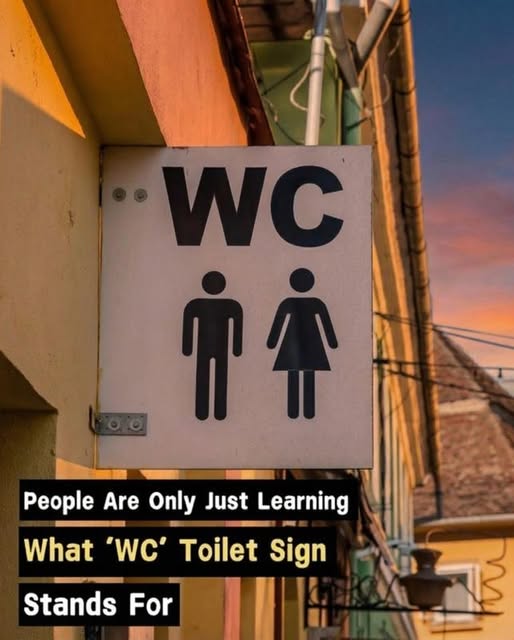
The answer lies in history. “WC” is short for “water closet,” a term that dates back to the early days of indoor plumbing. Before modern sanitation systems became widespread, toilets were not standard fixtures inside homes. When they were introduced, they were often placed in small, enclosed rooms separate from living spaces and bathing areas. These rooms housed a water-flushed toilet, a major technological upgrade at the time, and were referred to as water closets to distinguish them from outdoor privies or chamber pots.
The term “closet” originally meant a small private room, not a storage space. A water closet was literally a private room containing a water-based sanitation system. At the time, this innovation represented modernity, hygiene, and higher living standards. As plumbing technology advanced, the phrase entered dictionaries and everyday language, eventually being shortened to “WC” on signs for convenience and clarity.
While “water closet” may sound antiquated to some ears today, its continued use makes practical sense. “WC” is short, language-neutral, and instantly recognizable across borders. In international environments—luxury hotels, global airports, high-end shopping centers, and major transportation hubs—clarity matters. Two letters can communicate the function of a space without relying on English fluency or regional slang. From a design and wayfinding perspective, “WC” is efficient, inclusive, and globally understood.
The persistence of the term also reflects how architecture and daily life evolved. In earlier eras, bathing and toilet facilities were separate by necessity. Bathrooms were places for washing, often without a toilet. The toilet lived elsewhere. As indoor plumbing became standard in the late nineteenth and early twentieth centuries, these spaces merged for convenience, giving rise to the modern bathroom as we know it today. Still, the language lagged behind the architecture. Old terms remained in circulation, even as their original meanings blurred.
In many regions today, “WC” is used specifically to indicate a room containing only a toilet, sometimes separate from a larger bathroom with a sink or shower. This distinction still appears in floor plans, real estate listings, and architectural design, particularly in Europe and parts of Asia. In high-end residential design and luxury property marketing, specifying a “WC” versus a full bathroom can signal efficiency, layout optimization, and functional zoning.
Cultural attitudes toward politeness also play a role. Talking about bodily functions has long been considered impolite in many societies. As a result, euphemisms emerged. “Restroom” avoids mentioning toilets altogether. “Bathroom” implies cleanliness rather than necessity. “Washroom” emphasizes hygiene. “WC,” in contrast, is clinical and neutral, sidestepping social discomfort by relying on abbreviation rather than description.
Language around bathrooms also reflects power and class history. In older European homes, the water closet was once a luxury feature, associated with wealth and modern living. Even today, certain labels carry subtle social signals. A restaurant sign marked “WC” may feel more formal or international than one labeled “bathroom.” A hotel brochure listing “en-suite WC” suggests efficiency and European design sensibility, while “full bathroom” signals a different expectation in North American real estate markets.
Despite all this variation, the purpose remains the same. Whether labeled bathroom, restroom, washroom, loo, or WC, the space exists to meet a universal human need. The differences in terminology don’t divide people as much as they quietly connect them, revealing how shared experiences are filtered through local language and cultural norms.
In a globalized world shaped by international travel, digital nomadism, and cross-cultural exchange, “WC” has become something of a linguistic bridge. It doesn’t belong exclusively to one country or dialect. It simply works. That practicality is why it endures, even as other terms come and go.
The next time you see those two letters on a door, you’re not just reading a sign. You’re seeing the imprint of industrial innovation, cultural etiquette, architectural evolution, and linguistic compromise—all distilled into a universally understood abbreviation. It’s a small reminder that even the most ordinary parts of daily life carry stories shaped by history, habit, and the human desire to make things just a little more comfortable to talk about.