
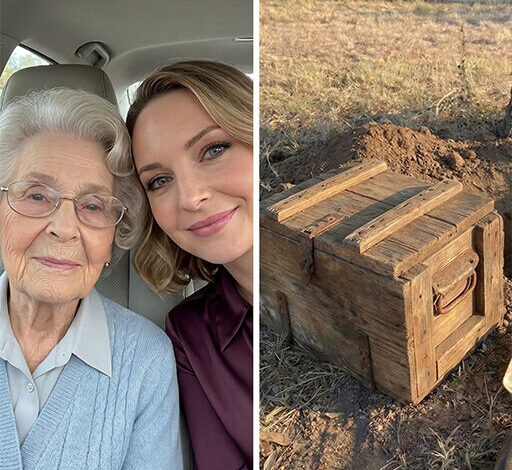
And it all started with a request she made right before she passed away.
A Move Made Out of Love—and a New Life Under One Roof
My husband, Karl, grew up in Carla’s old farmhouse. He always said his parents died when he was little, and Carla raised him alone. She wasn’t just a grandmother to him—she was his whole foundation: caregiver, protector, and the person who “saved” him.
When Carla’s health began to decline, Karl and I made the decision many families face: we moved in to help. It felt like the responsible thing to do—especially with two young daughters, Mia and Amelia, who adored their great-grandmother.
The farmhouse had that comforting, lived-in warmth—lavender cleaner, creaky wooden floors, shelves full of aging books. Even the backyard felt peaceful, with an old apple tree leaning slightly as if it had weathered decades of storms and still refused to fall.
It didn’t feel like a place where lies could survive.
But secrets don’t always announce themselves. Sometimes they hide in plain sight.
The Night Carla Asked Me to Dig Under the Apple Tree
As Carla grew weaker, her mood shifted. She’d stare out the window toward the garden like she was waiting for someone to appear at the gate. It happened often enough that I noticed—and started to worry.
One night, after helping her into bed, she grabbed my wrist with surprising strength.
“There’s something in the garden,” she whispered. “Under the old apple tree. I buried it years ago.”
I asked what it was, but she didn’t answer—not really.
“When I’m gone,” she said, “promise me you’ll dig there. Because he won’t tell you.”
The next morning, Carla passed away quietly in her sleep.
Grief filled the house in a strange, hollow way. Karl threw himself into work, and within days he left for a business trip he insisted couldn’t wait. I offered to go with him, but he shut it down fast.
“Not this one,” he said. “It’s complicated.”
Something about his tone didn’t sit right.
The Buried Chest That Exposed the Truth
The morning after Karl left, I stood in the backyard holding a shovel.
I told myself I was honoring Carla’s final wish. But deep down, I knew I was also chasing a feeling I couldn’t name—like there had always been a missing piece in Karl’s story.
The soil was dense. My arms burned. Sweat soaked through my shirt. For a moment I thought Carla might have been confused, that grief and illness had mixed her memories.
Then my shovel hit something solid.
A dull metal sound echoed across the yard.
I knelt and cleared the dirt until a small rusted chest appeared.
Inside were folders, envelopes, and documents yellowed with age.
The first thing I pulled out was a birth certificate.
Karl’s first name was there—but the last name wasn’t the one he uses now.
My stomach dropped.
Underneath were legal papers: emergency custody forms, guardianship filings, notes connected to a social services case. The language was official, cold—and impossible to misread.
Karl hadn’t been orphaned.
He had been placed into Carla’s care after suspected abandonment.
Then I found the letters.
Dozens of them. All addressed to Karl. All tied together with a faded ribbon. And every envelope was stamped with the same heartbreaking message:
RETURN TO SENDER.
The sender’s name was written neatly in the corner again and again:
Marissa Cole.
At the bottom of the chest was one final item—a sealed envelope, clearly meant for me.
My hands shook so badly I had to sit down in the grass.
The Facebook Comment That Opened a Door
I didn’t know who Marissa was, but I knew one thing: Carla had hidden these letters on purpose.
Not sure what else to do, I posted a simple question on the community page under the funeral announcement:
“Does anyone know someone named Marissa who might have been connected to Carla? I found letters addressed to Karl from her.”
Within hours, replies rolled in.
Carla’s neighbor messaged me privately with an address.
Then a former post office employee commented something that made my chest tighten:
“Marissa is Karl’s mother. Carla used to pick up the returned letters herself so they’d never reach him.”
So Karl had a living mother.
And Carla made sure he never heard from her.
Karl Came Home—and Everything Exploded
That evening, Karl returned earlier than expected. The moment he stepped inside, his eyes went straight to the dirt stains on my shirt.
“You didn’t dig under the apple tree,” he said—slowly, like he already knew the answer.
“I did,” I replied. “I found the chest.”
His face went tight.
I told him what I found: the birth certificate, the legal documents, the letters from Marissa.
When I said the word mother, he flinched like it physically hurt.
He told me his version of the story: that Marissa left him when he was two, that she wrote a note for a babysitter saying she couldn’t do it anymore, and that social services called Carla. Carla took him in and adopted him.
But the documents—and the letters—said something more complicated.
Marissa didn’t disappear. She wrote. She tried. She kept reaching out.
And Carla intercepted every single attempt.
Karl’s voice turned sharp. “She abandoned me.”
I tried to keep mine calm. “Or she was young and overwhelmed. Maybe she did the only thing she thought would keep you safe. And then she tried to come back.”
He shook his head like he couldn’t stand the idea.
That’s when he said something that cracked the room open:
“If you walk out of this house with those documents, don’t come back.”
Then, like he needed to convince himself more than me, he added:
“I’d choose the woman who raised me over the one who threw me away.”
So I made the hardest decision I’ve ever made.
I packed the girls’ things that night and went to stay with my cousin, Madison.
The Will Reading—and the Clause That Forced the Truth into the Light
Three weeks later, we met at the lawyer’s office for Carla’s will.
Karl sat across from me, rigid and silent. Near the window sat a woman twisting her hands nervously—someone I recognized from the address I’d been given.
Marissa.
The lawyer cleared his throat and read a clause that changed the entire room:
Karl’s inheritance would only be transferred if he signed a declaration stating that Marissa Cole had no parental claim and no relationship to him.
In other words: to receive what Carla left him, he had to legally erase his own mother.
I looked at Karl and realized the real issue wasn’t money. It was control—Carla’s final attempt to keep her version of the story intact.
I kept my voice steady. “If love requires someone to erase the truth, it isn’t love. It’s control.”
Then I said what mattered most:
“We have daughters. They deserve honesty.”
Karl held the pen for a long time, frozen between the past he clung to and the truth he couldn’t bury anymore.
What I Chose to Teach My Daughters
That night, as I tucked Mia and Amelia into bed at Madison’s house, Mia whispered, “Is Daddy mad at us?”
I swallowed the lump in my throat. “No, sweetheart. He’s just trying to figure things out.”
After they fell asleep, I drove back to the farmhouse one last time.
The apple tree still leaned over the spot where I’d dug up the chest—like it had been guarding that secret for decades.
I opened the chest again and stared at Carla’s letter, the one she left behind like a final confession.
“You weren’t trying to hurt him,” I whispered into the quiet yard. “You were afraid.”
Fear makes people hold on too tightly. It makes them protect the ones they love in ways that harm everyone else.
But one truth settled in me with absolute clarity as I covered the chest with soil again:
I will never teach my daughters that silence matters more than truth.
Because eventually—always—someone digs it up.
Closing Call to Action
If you’ve ever uncovered a family secret or faced a painful truth that changed how you saw someone you love, share your thoughts in the comments—what would you have done in my place? And if stories like this resonate with you, bookmark the page and come back for the next one.