
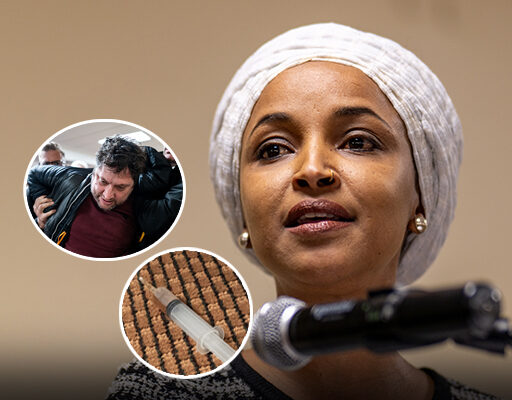
That decision reshaped the narrative.
It wasn’t a dramatic gesture or a political stunt. It was controlled, deliberate, and quietly defiant. In a moment designed to intimidate, she refused to let fear dictate the outcome.
Authorities later confirmed the liquid was apple cider vinegar—harmless and non-toxic. But by then, the deeper impact had already landed.
Because the substance was never the real issue.
The syringe itself carried the threat. It exploited modern anxieties around chemical exposure and unseen danger. Even without physical injury, the act injected fear into a space meant for dialogue. The intent was disruption, not damage—and it succeeded.
The suspect was detained, and investigators examined whether the act constituted assault and deliberate intimidation of a public official. The legal focus centered on what mattered most: the use of fear as a weapon.
Omar framed the incident as part of a larger pattern. As one of the most visible figures in Congress, she has long faced hostility, threats, and dehumanizing rhetoric. In the aftermath, she pointed to years of inflammatory language, arguing that words framing public officials as dangerous or illegitimate do not remain abstract—they carry consequences.
Former President Donald Trump dismissed the incident, suggesting it may have been staged. The remark intensified public reaction, highlighting the growing divide between lived events and political narratives. To many, it underscored how even acts of intimidation can be minimized or reframed depending on who is speaking.
The public response reflected that divide.
Town halls are supposed to be among the most accessible expressions of democracy—places where disagreement is voiced face-to-face. Seeing hazmat teams inside one unsettled many observers. When emergency protocols become part of civic participation, something fundamental has shifted.
Security experts warn that incidents like this accelerate a troubling trend. Increased screening, barriers, and distance may improve safety, but they also erode accessibility. The openness democracy relies on becomes harder to preserve.
Importantly, this incident reignited discussion about political violence that doesn’t fit traditional definitions. No one was seriously hurt. No conventional weapon was used. Yet the psychological impact was undeniable.
Extremism researchers note that intimidation often begins not with injury, but with disruption—forcing people to weigh personal safety simply for showing up. A syringe, even filled with something harmless, accomplishes that efficiently. It plants a lingering question: what if next time it isn’t?
Omar’s return to the microphone was widely shared. Supporters praised her resolve. Critics accused her of dramatizing the moment. Both reactions revealed the same reality—resilience itself is now filtered through partisan lenses.
As investigators continued reviewing footage and background information, the headlines eventually moved on. But the image remained: a syringe raised in a public forum, emergency responders replacing folding chairs, and an elected official choosing to speak anyway.
The confirmation that the substance was harmless closed one chapter, but not the larger question it raised. Democracy depends on disagreement without intimidation. When fear becomes performance and threats replace dialogue, the line between rhetoric and action grows dangerously thin.
In Minneapolis, that truth arrived quietly—not with an explosion or a gunshot, but with a syringe and a message meant to unsettle.
And that may be the most troubling part.
What does this moment say about the future of public dialogue? Share your thoughts below and join the conversation.