
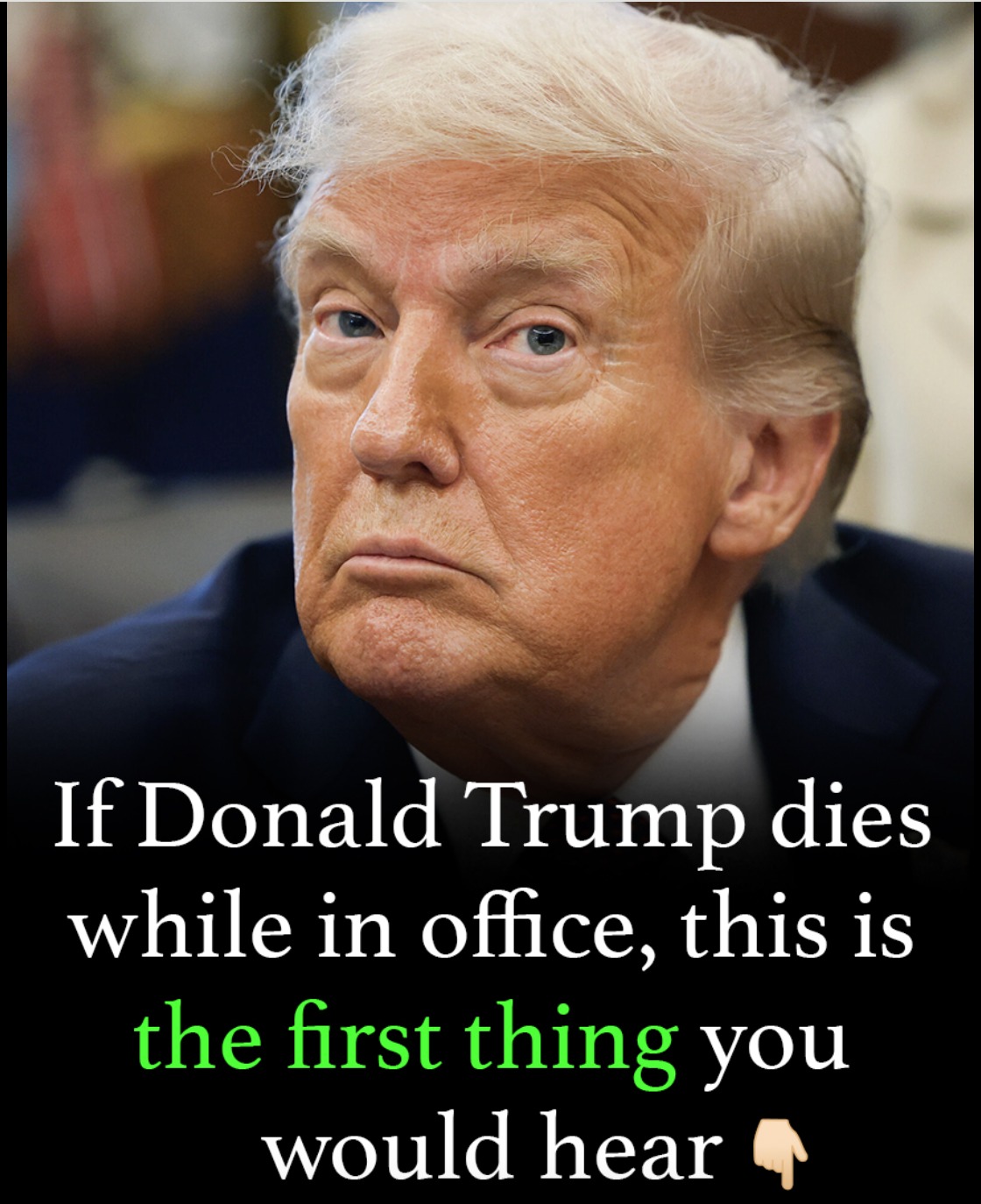
President Donald Trump’s age and health are frequently discussed topics in political media — especially because the president often emphasizes his energy, stamina, and fitness while in office.
Still, many Americans wonder what would actually happen if a sitting U.S. president were to die while serving in the White House.
Here’s how that process would unfold — and what the public would notice first.
A Question That Comes Up Often
Donald Trump is the oldest person ever elected president of the United States and is approaching his 80th birthday. While he has repeatedly stated that he is in excellent condition, conversations about presidential succession naturally arise whenever an older president is in office.
Commentators and analysts sometimes speculate about presidential health, though predicting life expectancy is impossible. Trump himself has frequently dismissed such concerns, saying medical professionals are impressed with his vitality.
Occasional images showing bruising on his hands have also fueled public curiosity, though no official medical concerns have been announced.
Although rare, U.S. history shows that presidents have died while in office — which is why clear constitutional procedures exist to ensure stability and continuity of government.
What Happens If a President Dies in Office?
The U.S. Constitution is explicit when it comes to presidential succession.
If a president dies, resigns, is removed from office, or becomes unable to carry out the duties of the role, power immediately transfers to the vice president.
This is outlined in Article II, Section 1, Clause 6, which states that presidential authority “shall devolve on the Vice President” in such circumstances.
In practical terms, there is no waiting period, election, or delay. The vice president is sworn in as president as quickly as possible to prevent any leadership vacuum during a national emergency.
The First Thing the Public Would See
If Donald Trump were to die while serving his current term, the very first major development would be Vice President JD Vance taking the presidential oath of office.
That ceremony would likely occur within hours, possibly even minutes, depending on circumstances. From that moment forward, Vance would hold full presidential authority.
What Happens After the Oath?
Once sworn in, the new president immediately assumes all constitutional powers of the office.
They may:
- Retain the existing cabinet
- Replace cabinet members
- Nominate a new vice president
Any vice presidential nominee would need confirmation by both the House of Representatives and the Senate.
There are also constitutional rules governing future elections. If the new president serves less than two years of the remaining term, they may still run for two full terms of their own. If they serve more than two years, they may only seek one additional term.
A Modern Historical Example
The most recent time this process occurred was in 1963, following the assassination of President John F. Kennedy.
Vice President Lyndon B. Johnson was sworn in aboard Air Force One in Dallas just over two hours after Kennedy’s death. Johnson kept much of Kennedy’s cabinet, won election in 1964, and later chose not to pursue another full term.
That moment continues to shape modern White House transition protocols.
How Often Has This Happened?
Out of all U.S. presidents, eight have died while in office.
Four were assassinated:
- Abraham Lincoln
- James A. Garfield
- William McKinley
- John F. Kennedy
William Henry Harrison died of pneumonia in 1841, only one month into his presidency — a death once blamed on exposure at his inauguration, though historians have since dismissed that claim.
Three others — Zachary Taylor, Warren G. Harding, and Franklin D. Roosevelt — died from illness while serving.
What a Trump-Era Transition Might Look Like
If Donald Trump were to die while still in office, the transition could be unusually complex.
Trump’s presidency has often broken from tradition, and his administration has been known for challenging established norms and protocols. While constitutional succession would still apply, the political response could be unpredictable.
A large, high-profile state funeral would almost certainly take place. However, unlike the unifying national response following President Kennedy’s death, today’s political environment is deeply polarized.
Given the intense divisions in modern American politics — many of which have intensified during Trump’s time in office — public reaction would likely be mixed, with mourning far from universal.
Final Thoughts
While the death of a sitting U.S. president is rare, the Constitution provides a clear, immediate roadmap for continuity of leadership. Regardless of politics or personality, the process is designed to ensure stability, calm financial markets, protect national security, and maintain confidence in American democracy.