
Montgomery’s personal life during these years was marked by transitions and multiple marriages, none of which brought lasting stability. It was later, in her long-term partnership with actor Robert Foxworth, that she found enduring companionship, a source of emotional balance during her later career.
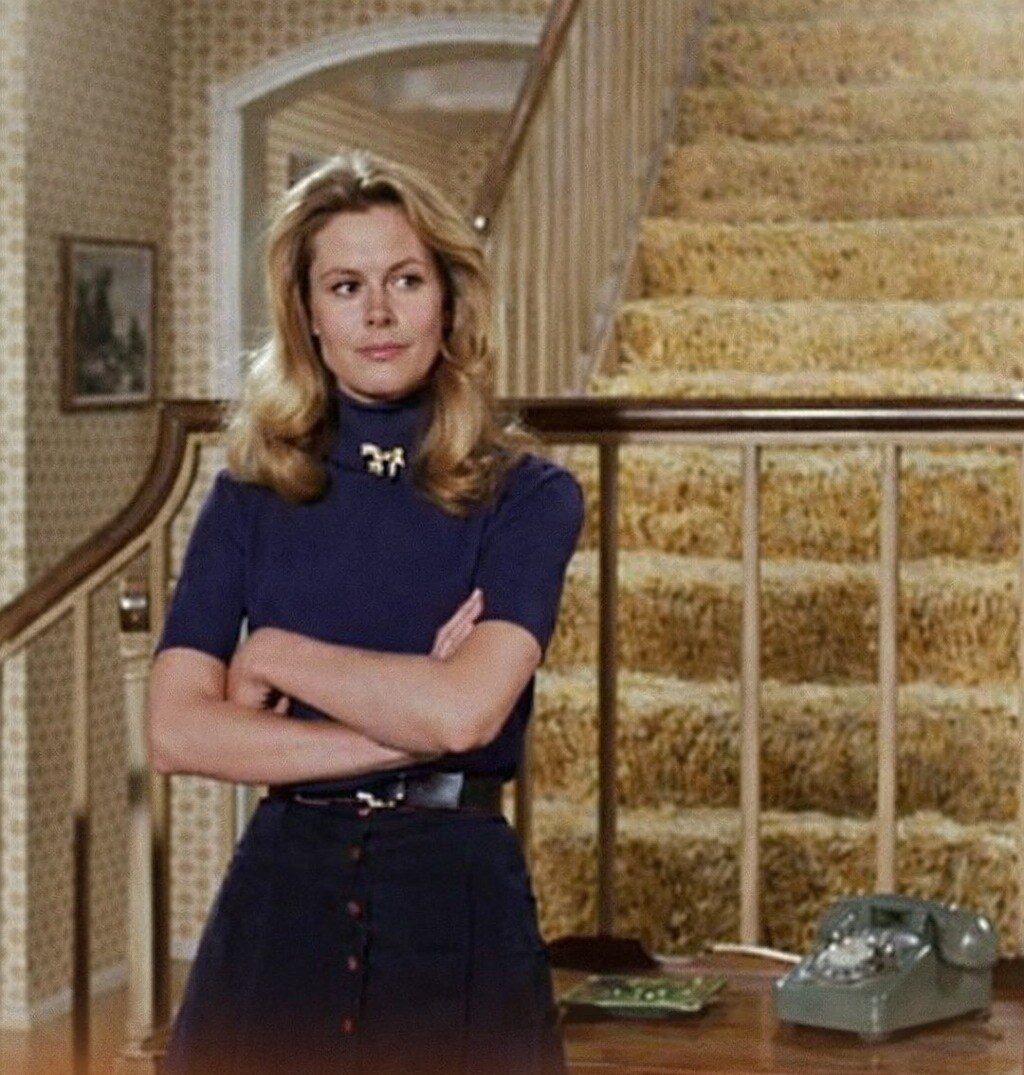
The turning point that cemented Montgomery’s public legacy came in 1964 with Bewitched. Created by Sol Saks, the series centered on a witch who marries a mortal man and suppresses her magical abilities to fit societal expectations. Montgomery’s Samantha was never a novelty; she was intelligent, empathetic, and quietly assertive—often more perceptive and practical than the men around her. Her restraint, rather than her magic, became the show’s emotional core.
Bewitched ran for eight seasons, from 1964 to 1972, becoming one of the era’s most beloved sitcoms. Montgomery earned multiple Emmy nominations, but the cultural impact went beyond awards. Samantha Stephens emerged as a symbolic figure—a woman negotiating autonomy, identity, and social expectation during a decade of change. Montgomery’s nuanced performance made her more than a TV star; she became a quiet icon of intelligence and dignity.
Even during the show’s success, Montgomery continued pursuing dramatic roles, resisting typecasting. After Bewitched ended, she embraced the rise of made-for-television films in the 1970s, taking on challenging, socially relevant material. In A Case of Rape (1974), she portrayed a woman navigating the aftermath of sexual assault and a flawed legal system, earning widespread acclaim. In The Legend of Lizzie Borden (1975), she delivered a psychologically complex performance, leaning into ambiguity and silence to unsettling effect. These roles cemented her reputation as one of television’s most formidable dramatic actresses.
Throughout her career, Montgomery remained socially engaged. She advocated for civil rights, women’s equality, LGBTQ+ issues, and HIV/AIDS awareness—always privately grounded, never performative. Her activism reflected the same emotional intelligence and empathy that defined her performances.
In the early 1990s, Montgomery scaled back her public presence, continuing to work selectively. She was diagnosed with colon cancer in 1995 and chose to keep her illness private. She passed away on May 18, 1995, at 62, surrounded by loved ones.
Montgomery’s death shocked fans, but her legacy endures. While Samantha Stephens remains beloved, her broader body of work reveals a career defined by courage, intelligence, and reinvention. She refused to be confined by expectation, continuously challenging herself and her audience.
Elizabeth Montgomery bridged eras—bringing warmth and magic to early television comedy while redefining the possibilities of television drama. Decades later, her performances remain studied and admired for their authenticity and quiet power. In an industry often driven by image, her career stands as proof that integrity, depth, and conviction leave the longest shadow.