
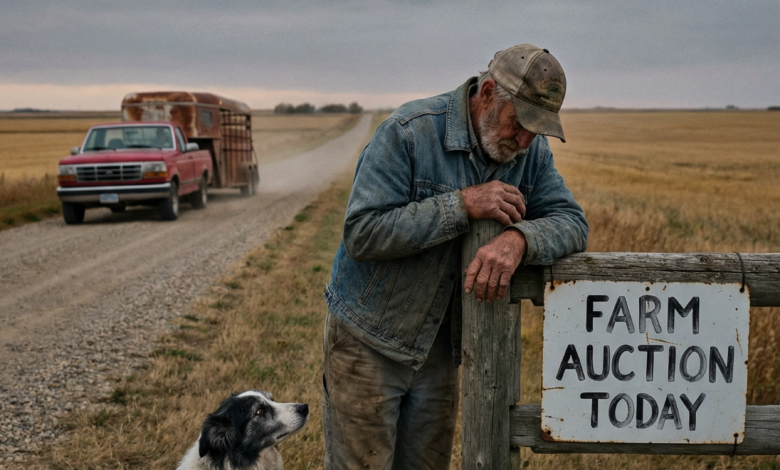
But the math had finally turned against him. Feed cost more. Equipment repairs cost more. Even simple supplies felt like luxury purchases. And an old man’s labor—his strongest currency for decades—didn’t stretch as far as it used to.
His children called from far away. His son, Daniel, checked in when work allowed. His daughter, Claire, called more often, always careful, always trying to sound calm.
“You don’t have to prove anything anymore,” Claire told him.
Walter didn’t know how to explain that, out here, proving you could still do things was half the reason you got out of bed.
When the Work Disappears, the Silence Gets Loud
After the flock was gone, the land looked the same—but it didn’t feel the same. The wind moved across empty pasture like it was searching for something that used to be there. Blue still limped out every morning, circling the places where sheep once gathered, then looking back at Walter with a question in his eyes.
At night, the farmhouse seemed smaller. The kitchen clock ticked too loud. Walter started talking just to break the quiet—about old animals, old storms, old jokes his wife Ruth used to laugh at.
Ruth had been gone eight years, but the house still carried her in small, stubborn details: a chipped bowl she refused to throw away, an apron still hanging where she left it, the sense that she might walk back in any minute.
Then one morning, Walter found Blue in the back pasture near the cedar stump where he used to turn strays back toward the flock. Blue had stayed until there was no work left.
Walter buried him under the maple tree behind the house. He stopped twice to catch his breath. And when the shovel finally hit still earth, Walter realized the hardest part wasn’t the grief—it was the question that came after it:
Who are you when nothing depends on you anymore?
A Phone Call That Changed Everything
Not long after, the county school called. A young teacher, Ms. Avery Bell, asked if Walter might donate a few old farm tools for a hands-on class. The program taught teenagers practical skills—how to mend wire fencing, sharpen blades, repair gates, grow food in small plots, and handle basic maintenance.
Walter looked out at his empty field and surprised himself by saying, “I can bring them over.”
At the school, students gathered around his worn equipment like it belonged in a museum. One boy with oil-stained hands—Eli—lifted a fence stretcher carefully, like it mattered.
“You really used all this?” the boy asked.
Walter gave a dry half-smile. “Son, that stretcher held my north fence together through ice storms and bad livestock. Tools work if the hands do.”
And just like that, the silence inside Walter loosened its grip.
The teacher asked him to say a few words. He didn’t plan a speech. He didn’t need one. The kids started asking questions—real questions. The kind grown men stop asking when they decide they already know enough.
- How do you spot illness in an animal before it’s obvious?
- How do you calm livestock during a storm?
- How do you know if a fence will survive one more winter?
- How do you read the ground before rain hits?
Walter answered honestly. He taught them what weather and time had taught him: how to mend instead of replace, how to work with patience, and how pride can keep you moving—until it becomes the reason you’re alone.
One student asked, “Do you miss having sheep?”
Walter paused. He thought about Blue waiting by an empty fence line.
“Every day,” he said. “But missing something ain’t the same as being finished.”
The Students Wanted the Real Thing—Not a Classroom Demo
A few mornings later, a white van climbed Walter’s lane. Ms. Bell stepped out with a group of students carrying notebooks, gloves, and the kind of energy that doesn’t yet understand how heavy life can get.
They asked to see a real farm. Not a small school garden. Not a demonstration bed behind a shop. The real thing—leaning fences, tired posts, weathered barns and all.
Walter didn’t pretend it was easy to say yes. Letting strangers onto your land can feel like letting them into your private history. But the kids moved with respect, quiet as if they’d stepped into a place that deserved it.
They didn’t come to play. They came to learn.
Walter walked them through the property and asked them to look closely: Which beams were weakening? Which posts were shifting? Where would spring flooding hit hardest? Where did the wind do the most damage?
Then he put tools in their hands.
They repaired a leaning corner post. Rebuilt a gate hinge. Cleared vines from fence lines. Salvaged old lumber to strengthen a coop that hadn’t held life in years.
Walter corrected them sharply when they rushed. Not to humiliate them—because on a farm, carelessness costs more than pride.
“That ain’t a hammer,” he told one boy. “That’s an apology waiting to happen.”
By noon, the fence stood straighter than it had in two winters.
A Tempting Land Offer—and a Family Torn Between Safety and Meaning
As the program grew, another reality arrived in Walter’s mailbox: a land purchase offer from a development company. The number was large enough to make him reread it. Then reread it again.
His children found out quickly. Daniel argued for selling—moving Walter closer to family, closer to healthcare, closer to safety. Claire tried to hold the middle ground, but her worry showed through every careful sentence.
Walter understood their fear. He lived alone now. He’d already sold the flock because he couldn’t keep up. And no matter how stubborn a man is, the body eventually collects its payment.
Still, Walter couldn’t accept the idea that the farm was just “property.” To him, it was a life. A record of work. A place built by repetition and responsibility.
And now—unexpectedly—it had become something else too: a training ground where young people learned skills that could lead to real careers in mechanics, construction, agriculture, and maintenance trades.
These weren’t “small” dreams. They were durable ones.
When Walter Fell, the Community Stepped In
One day, Walter pushed too hard and took a bad fall in the shed. The kind that steals your breath and makes you furious at your own limits.
Eli found him and helped him up without making a spectacle of it. He made tea—quietly, naturally—like he’d seen it done somewhere before.
Word traveled fast, as it does in small towns. Daniel called, demanding Walter sign the land papers before the deadline. Walter refused to be bullied, but he did something new:
He sat still for two days.
And from the porch, he watched the students work. He watched them measure, brace, patch, and fix with care. He watched Eli move through tasks like he belonged to them.
Walter felt something shift—an unfamiliar mix of relief and grief.
The world could continue without him being the only set of hands.
Three Orphan Lambs Opened a Door Walter Thought Was Locked Forever
Ms. Bell approached him with a careful request. The school had access to three orphan lambs that needed bottle feeding and gentle, consistent care. The school couldn’t legally keep livestock on campus beyond short demonstrations.
Would Walter allow a temporary lamb-care setup in his north enclosure—if the students did the work and the teacher handled logistics?
Walter’s first answer was “no.” It felt like reopening a wound.
But then he learned Eli might leave school to work full time. Bills were stacking at home. The urgent was swallowing the useful.
Walter drove to Eli’s house, sat down at their table without waiting to be invited, and made a decision that surprised even him.
“Tell Ms. Bell I’ll take the lambs,” he said. “Three only. Temporary. Students handle the feed schedule. She handles paperwork. I handle the teaching. And you stay in school.”
The lambs arrived on a drizzly Thursday. The pen filled with the sound of life demanding attention. The farm—quiet for so long—started breathing again.
Even Daniel, still worried, showed up with practical help: motion lights, safety equipment, grip tape for the steps, a personal alert device—support disguised as stubbornness.
A Storm Tested the Farm—and Proved What Walter Had Been Learning
One night, a hard spring storm rolled over the ridge. Wind slammed the north pen gate. A lamb cried out—thin and panicked.
Walter limped into the rain with a flashlight and cane. Daniel arrived because Claire had warned him the weather looked ugly. Students showed up too—soaked, determined, moving fast without losing their heads.
Under flashing motion lights and sideways rain, they cornered the lambs, stabilized the gate, and drove a temporary hinge pin through with quick, accurate hammer strikes.
Walter held the light steady and called out angles.
Everyone was drenched. Everyone was grinning.
And Daniel finally saw what Walter had been trying to explain all along: this wasn’t his father refusing help.
This was his father building a safer way to keep living—by letting people in.
Not a Restored Past—A Shared Future
By early summer, the pasture stood greener, the fences straighter, and the farm felt like a place with purpose again. The lambs grew stronger. The students grew steadier.
Eli started looking at technical institute applications. June talked about studying agricultural systems and education. Miguel sketched structures and trusses like he could see buildings before they existed. Laney announced she’d own chickens one day “if civilization deserved her.”
Walter didn’t pretend everything was solved. Aging doesn’t reverse. Loss doesn’t vanish. But the farm had changed shape—from a private burden into a community effort, from a lonely responsibility into a living classroom.
And when the land company’s deadline passed, Walter didn’t sign.
Because he finally understood something grief had tried to hide from him:
Purpose doesn’t always end when one chapter closes. Sometimes it gets handed forward.
“`