
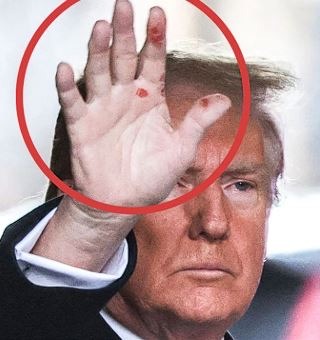
Former President Donald Trump is once again dominating headlines—but not because of an election speech, courtroom development, or policy announcement. Instead, recent photographs showing noticeable red areas on his hands have sparked widespread online discussion, proving how quickly even minor visual details can become a major talking point when they involve one of the most recognizable figures in American politics.
The conversation began after Trump appeared at several public events where he greeted supporters and posed for photos. In multiple images, observers noticed reddish patches on his right hand, especially near the thumb, index finger, and palm. Because the discoloration appeared in more than one photo and under different lighting conditions, many viewers concluded it was unlikely to be a simple camera or lighting issue. That assumption fueled curiosity across social media platforms, where users began sharing close-ups, comparisons, and theories.
As often happens in today’s digital media landscape, speculation moved faster than verified information. Online discussions ranged from casual curiosity to confident claims made without any direct knowledge of Trump’s personal health or daily routines. Some dismissed the marks as insignificant, while others treated them as something worth decoding, demonstrating how easily visual details can take on outsized importance.
The explanations offered online varied widely. On the lighter side, many suggested harmless, everyday causes—such as minor irritation, contact with everyday substances, or residue transferred during frequent handshakes. Others jokingly attributed the redness to common mishaps, leaning into humor rather than concern. These reactions reflected the internet’s tendency to fill uncertainty with entertainment.
More serious-sounding theories also surfaced, though without evidence. A handful of commentators speculated about health-related explanations, despite the lack of confirmation or professional insight. One outspoken political figure even made a tongue-in-cheek remark comparing the appearance to symptoms of illness. While clearly intended as humor rather than a diagnosis, the comment spread quickly and highlighted how easily speculation can escalate when it involves a high-profile public figure.
At the same time, many people pointed to a far more ordinary explanation tied to Trump’s well-documented lifestyle. As an avid golfer for decades, Trump spends significant time gripping golf clubs, often for extended periods. Repetitive motion, pressure, exposure to sun, and outdoor conditions can all contribute to temporary redness or irritation on the hands—especially with frequent play. Some observers noted that this explanation aligns closely with habits Trump has openly discussed and publicly displayed over the years.
This possibility resonated with many because it fits within what is already known about his routine. Unlike hidden or speculative causes, golf-related wear and tear requires no leap in logic. Still, without confirmation, it remains only one reasonable theory among several.
Adding fuel to the discussion is the absence of an official explanation. Trump has not commented on the marks, and his representatives have offered no clarification. In the world of modern media, silence often invites more attention rather than less. For polarizing figures in particular, unanswered questions tend to prolong online engagement.
The situation underscores a broader trend in political and celebrity coverage: the intense scrutiny of physical appearance. From wardrobe choices and hairstyles to posture and facial expressions, public figures are constantly analyzed. In Trump’s case, this scrutiny has been especially persistent, shaped by his visibility, media presence, and sharply divided public opinion.
It also raises questions about privacy and perspective. Something as minor as hand redness—normally overlooked in everyday life—has become a subject of national conversation simply because of who it involves. Supporters argue that such focus is unnecessary and distracting, while critics say transparency comes with public life.
Experts generally warn against drawing conclusions based solely on photographs. Skin appearance can change for countless routine reasons, including pressure, temperature, friction, or minor irritation. Without direct information, assigning meaning to such details is inherently speculative.
Still, public interest remains strong. In an era driven by viral images and algorithm-powered engagement, even the smallest mystery can dominate online discourse. Whether the marks are related to golf, daily activity, or something entirely mundane, their significance has already been amplified by the media environment itself.
Ultimately, the episode reveals less about Donald Trump’s hands and more about modern attention culture—where curiosity, humor, skepticism, and speculation blend together, and where even a fleeting visual detail can become headline news.
Until the marks fade from view or are addressed directly, they will likely continue to resurface with each new public appearance. For now, they remain unexplained, heavily discussed, and emblematic of how intensely public figures are examined in the digital age.