
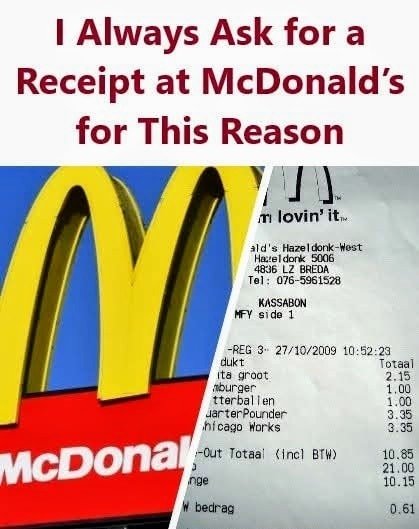
Because of this, when an employee hears a customer ask for a receipt, they can’t immediately tell whether that person is an ordinary guest or an undercover evaluator. The safest response, from the employee’s perspective, is to treat the order with extra care. Not dramatically. Not obviously. Just enough to make sure everything is done by the book.
That small moment of uncertainty changes behavior.
Food is more likely to be prepared fresh instead of pulled from a holding tray. Fries are less likely to have been sitting under a heat lamp. Burgers are assembled with closer attention to accuracy. Drinks are filled properly. Bags are checked twice. Smiles come more naturally. The pace stays efficient without feeling rushed.
None of this requires confrontation. No complaints. No raised voices. Just one simple sentence: “Can I have my receipt, please?”
The effect is subtle but consistent, especially during busy periods when corners are more likely to be cut. When staff believe an interaction might be evaluated, training kicks in more fully. Procedures are followed more carefully. Standards matter again, if only for a few minutes.
There’s also a practical advantage that has nothing to do with mystery shoppers: accuracy. Fast-food restaurants move quickly. Mistakes happen. Orders get swapped. Items are missed. Special requests are forgotten. When that happens, the receipt becomes a friction-free solution.
Instead of explaining what you ordered or arguing about what you paid for, the receipt provides clarity. It shows exactly what was requested and charged. Corrections happen faster. Stress drops. Conversations stay calm. For older customers, parents with kids, or anyone who simply wants a smooth transaction, that little slip of paper removes unnecessary tension.
Receipts also matter when it comes to pricing transparency. Promotions, digital deals, app discounts, and limited-time offers change frequently. A receipt allows you to confirm that discounts were applied correctly and that no extra charges slipped in. In an era of dynamic pricing, loyalty programs, and automated ordering kiosks, having a written record protects the customer without requiring any extra effort.
From the employee side, receipt requests are not an inconvenience. They’re a routine part of the system. In many locations, receipts are printed automatically unless the customer declines them. Asking for one simply signals engagement, not distrust. It reminds staff to slow down just enough to do things right.
This habit is especially effective for customers who value consistency. Seniors who prefer predictable service. Families ordering multiple items. Anyone picking up food to go and wanting it correct the first time. Over time, the difference becomes noticeable. Meals arrive hotter. Orders are right more often. Interactions feel more attentive.
It’s not because employees suddenly care more about one customer than another. It’s because systems respond to perceived accountability. When someone might be observing, standards rise. This isn’t unique to fast food. It’s human nature.
The best part is that this approach doesn’t rely on entitlement or complaint culture. There’s no confrontation. No demand for managers. No negative energy. Just a quiet alignment of incentives that encourages the best version of the service you’re already paying for.
For people interested in consumer behavior, operational psychology, and everyday efficiency hacks, this is a textbook example of how small actions can produce outsized results. In customer experience management, these micro-signals matter. They shape how transactions unfold without either side explicitly acknowledging it.
Asking for a receipt also reinforces a mindset shift. Instead of being a passive participant in the transaction, you become an engaged customer. That engagement alone often leads to better outcomes, not just at McDonald’s, but anywhere service quality depends on consistency and speed.
Over time, this habit becomes second nature. You don’t think about it as a strategy. It’s just part of how you order. And once you notice the difference, it’s hard to go back.
The next time you stop for a coffee, grab a quick lunch, or treat your grandchildren to fries and a milkshake, ask for the receipt. Not because you expect something to go wrong, but because the system works better when it thinks someone is paying attention.
Sometimes the simplest habits deliver the most reliable improvements. And sometimes, better service starts with a question that takes less than three seconds to ask.