
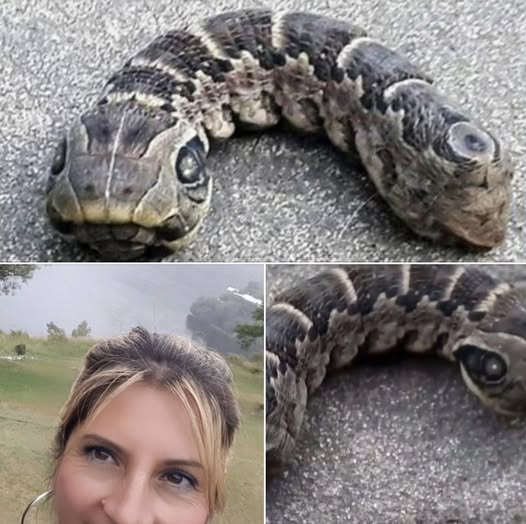
“I looked down and encountered the strange animal, and fear struck me knowing it could have been poisonous,” Eroles later explained. “It looked exactly like a snake, but the eyes were so strange.” The resemblance was convincing enough that some neighbors wondered whether pollution or environmental changes had produced a mutant species.
Rather than attempting to touch or remove the creature, Eroles made a decision that would soon turn a local scare into an international learning moment. She uploaded a video online, asking viewers if anyone could identify the mysterious animal. Within hours, the footage began circulating widely, attracting comments from amateur naturalists, wildlife enthusiasts, and professional biologists alike.
What followed was a textbook example of how the internet can occasionally do something right.
Experts quickly recognized that this was not a snake at all, but a caterpillar employing one of the most effective survival strategies in the natural world: mimicry. Specifically, it was identified as a rare hawk-moth caterpillar species known for its extraordinary ability to imitate the appearance of a small serpent when threatened.
The illusion is no accident. This caterpillar lacks fangs, venom, speed, or physical defenses. Instead, evolution provided it with deception. When disturbed, it retracts its head, inflates the front of its body, and reveals large eye-like markings that instantly resemble those of a reptile. The result is a convincing visual warning that triggers fear in predators such as birds, rodents, and small mammals.
In evolutionary terms, this is brilliance.
Predators rely on quick decisions to survive. If something looks dangerous, hesitation alone can be enough to save the prey. The caterpillar’s snake-like display exploits this instinct perfectly. It doesn’t need to fight or flee; it only needs to be believed.
Biologists describe this as Batesian mimicry, a phenomenon where a harmless species evolves to imitate the warning signals of a harmful one. Over thousands of generations, individuals whose patterns most closely resembled snakes were more likely to survive and reproduce. The result is a caterpillar so convincing that it can fool not only animals, but humans as well.
The discovery fascinated researchers because sightings like this are relatively rare, especially in residential settings. While hawk-moth caterpillars are native to parts of Central and South America, their defensive displays are usually witnessed only by trained observers in natural habitats. Seeing one in a backyard garden, perfectly executing its survival routine, offered a rare glimpse into evolutionary strategy at work.
Beyond the shock value, the encounter became a powerful reminder of the biodiversity that exists just beyond our doorsteps. Even in urban or semi-urban environments, complex ecosystems continue to thrive, often unnoticed. Insects, in particular, represent some of the most diverse and adaptive life forms on the planet, playing essential roles in pollination, soil health, and food chains.
The caterpillar’s behavior also highlights a broader truth about nature: danger is often perceived rather than real. While snakes themselves are frequently misunderstood and feared, many are harmless and avoid human contact entirely. In this case, the fear was amplified by a creature that had mastered the art of looking dangerous without being so.
For Eroles, the experience shifted quickly from fear to awe. What began as panic turned into admiration as she learned what she had actually witnessed. “We thought it was something unnatural,” she said. “But it turns out it was something incredibly intelligent in its own way.”
Her video continues to circulate as an educational example, used by teachers, wildlife organizations, and science communicators to explain mimicry, adaptation, and the importance of respecting unfamiliar animals rather than reacting with aggression.
In an age where viral content often centers on conflict or spectacle, this story stands out for a different reason. It shows how curiosity can replace fear, and how a single encounter can spark global interest in the natural sciences. It also underscores the value of observation over assumption, especially when dealing with wildlife.
The snake-like caterpillar did exactly what evolution designed it to do. It scared away perceived threats, survived the encounter, and continued its life cycle. Humans, meanwhile, gained a moment of perspective—a reminder that the natural world is filled with strategies far more sophisticated than they appear at first glance.
What looked like a monster turned out to be a masterpiece of adaptation. And in a quiet garden in Argentina, one small caterpillar reminded the world that nature’s greatest defenses are often illusions perfected by time.