
Alex Pretti was, by all accounts, a pillar of his community. A 37-year-old intensive care nurse at the local VA hospital, his career was defined by the preservation of life and the care of veterans. On the morning of his death, witnesses describe a scene of escalating tension during a targeted immigration operation. Pretti did not appear to be an aggressor; rather, bystander video depicts him acting as a de facto mediator. He was seen holding his phone aloft, documenting the behavior of agents, and attempting to direct civilian traffic away from a woman who had reportedly been pepper-sprayed and shoved.
The official statement from federal authorities was swift and definitive. Agents claimed they acted in self-defense against a resistant, “serious threat” who was armed with a lethal weapon. While a firearm was indeed recovered—a handgun that Minneapolis police later confirmed was legally owned and carried with a valid permit—the timing of its discovery is the focal point of the current dispute. Eyewitnesses and video analysis suggest that the weapon remained in Pretti’s waistband throughout the encounter, only becoming visible to agents after he had been wrestled to the ground and incapacitated.
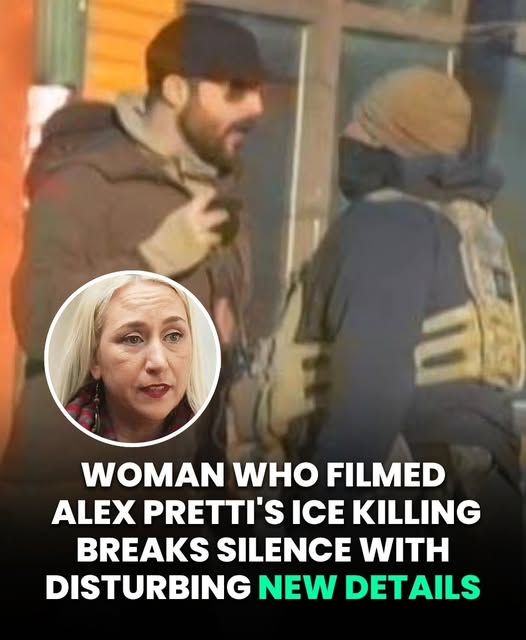
The most compelling challenge to the government’s account comes from Stella Carlson, the woman who filmed the most comprehensive footage of the shooting. Carlson, a member of a local community monitoring group, had been shadowing the enforcement team from a distance. In her first public testimony, she described a scene that bore little resemblance to the “lethal threat” described by officials. Carlson observed Pretti approaching the perimeter not with malice, but with a nurse’s instinct to assess harm.
“He was trying to reduce the temperature,” Carlson stated in a sworn affidavit. “He was recording, he was talking, and he was trying to make sure people were okay.” She noted that the agents’ response was almost instantaneous, moving from verbal commands to physical restraint and lethal force in a matter of seconds. Most disturbingly, Carlson detailed a perceived lack of urgency in providing medical care to Pretti after he was shot. Despite his status as a medical professional surrounded by federal agents equipped with trauma kits, witnesses claim several minutes passed before any life-saving measures were initiated.
The fallout from Carlson’s video has been seismic. The initial characterization of Pretti as a dangerous insurgent began to crumble as the footage circulated through social media and news outlets. The discrepancy between the “armed resistor” described in press releases and the man on the video holding a smartphone led to an immediate shift in tone from Washington. President Donald Trump, citing the need to de-escalate the “unrest in the Twin Cities,” signaled a tactical withdrawal of certain federal personnel from the area, though he maintained that the agents involved were operating under extreme duress.
Pretti’s family has remained steadfast in their pursuit of an independent investigation. His parents have publicly condemned the initial federal reports as “character assassination,” designed to justify an unjustifiable use of force. They point to his unblemished record of service and his professional training in de-escalation as proof that he would never have initiated a violent confrontation with federal officers. Their grief has become the heartbeat of a movement calling for a complete overhaul of how federal agencies interact with the public during enforcement actions.
The broader implications of the Pretti case are staggering. Civil liberties advocates argue that if a U.S. citizen and healthcare worker can be killed while legally documenting public enforcement activity, then the First and Second Amendments are being treated as secondary to federal administrative convenience. The incident has highlighted a dangerous “accountability gap,” where federal agents operating within municipal boundaries often circumvent the transparency requirements imposed on local police departments.
Minneapolis local leaders have renewed their demands for a civilian oversight board with the authority to subpoena federal records—a move that has sparked a complex legal battle over state versus federal jurisdiction. Meanwhile, the mistrust in the streets has only deepened. For many, the case of Alex Pretti is not an isolated error in judgment, but the logical conclusion of an enforcement strategy that prioritizes speed and intimidation over community safety.
As the investigation moves into its second month, the significance of Stella Carlson’s video remains paramount. In an era where “official truths” can be manufactured and disseminated within minutes, the presence of an independent lens acts as the ultimate check on power. The demand in Minneapolis is no longer for mere reform, but for a fundamental reckoning with the value of a human life in the face of state authority.
The story of Alex Pretti is still being written in the courtrooms and the corridors of power, but on the corner of Nicollet Avenue, the narrative is already settled. To the people who knew him, and to those who have seen the footage, he wasn’t a threat to be neutralized; he was a man who died trying to make a dangerous situation just a little bit safer. The struggle now is to ensure that his death results in the clarity and accountability that the community so desperately seeks.