
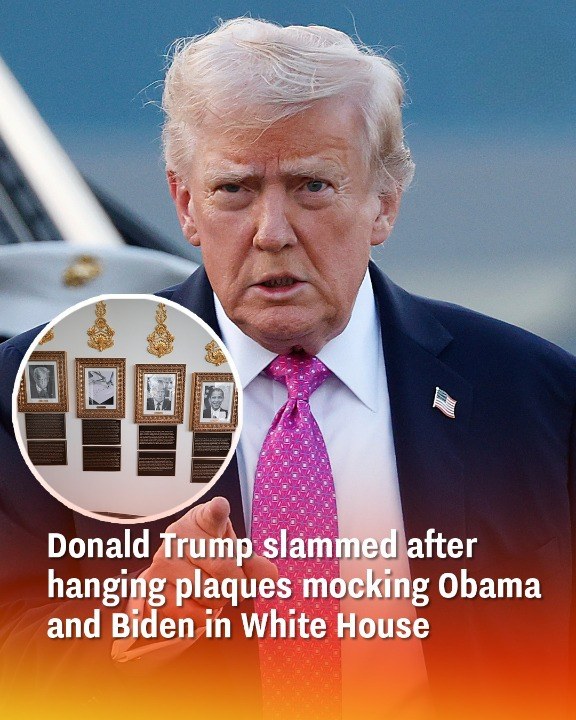
The White House has long been viewed as a place of shared national history, where symbolism, restraint, and continuity traditionally outweigh partisan expression. Recently, however, that sense of neutrality has been challenged following the installation of new plaques beneath presidential portraits in a display being referred to as the “Walk of Fame.” Unlike past descriptions that focused on dates, milestones, and broadly accepted historical context, these new plaques have drawn attention for their openly opinionated tone and sharp political judgments. According to statements from the administration, the language was personally written by former President Donald Trump, a move that many observers see as a significant break from long-standing custom.
The plaques describing recent Democratic presidents have proven to be the most controversial. The text beneath Barack Obama’s portrait presents a highly critical assessment of his presidency, emphasizing claims of division, economic stagnation, and disputed foreign policy outcomes. Rather than offering a balanced overview, the wording highlights contested interpretations of major policies and global events, placing them firmly within a partisan frame. Critics argue that embedding such judgments into a permanent White House display transforms a historical exhibit into a political statement.
Even stronger reactions have followed the plaque associated with Joe Biden. The language departs from traditional presidential decorum by using campaign-style rhetoric and harsh characterizations. It assigns blame for a range of domestic and international challenges and repeats disputed claims related to recent elections and policy outcomes. For many historians and political analysts, this approach represents an unprecedented personalization of criticism within a space normally reserved for collective national memory.
Continue reading on the next page…