
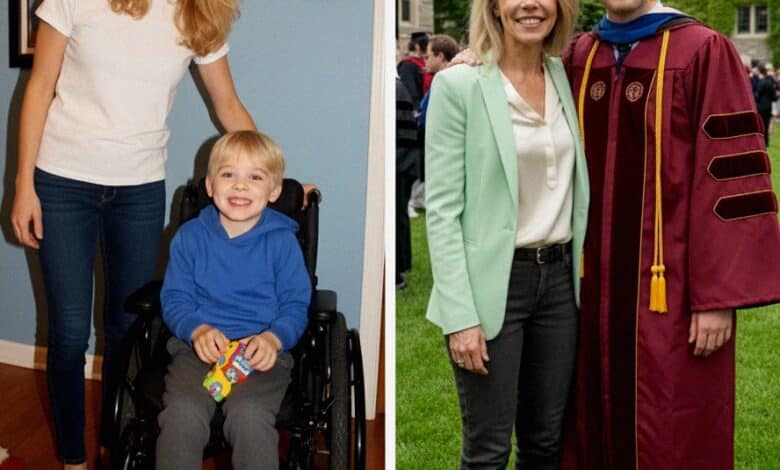
I nodded like I understood, even though my mind was spinning. Warren didn’t nod at all.
He stood near the window, jaw tight, staring at our baby like he was looking at a problem he didn’t want to solve. Not like a father meeting his son—more like someone realizing the life he pictured was going to require real work.
Warren had always imagined a certain kind of child. The sports weekends. The roughhousing. The easy milestones. In his world, a kid who needed braces, therapy, and extra support wasn’t “challenging”—he was “broken.”
Warren turned to me and said, flat and emotionless, “I’m not doing this, Bella.”
That was it. No questions for the doctor. No “we’ll figure it out.” No hug. He grabbed his jacket, took his keys, and walked out of the delivery room as if he were leaving an appointment that had run too long.
He left me there with stitches, an IV in my arm, and a newborn who deserved a father who could handle reality.
The Real Cost of Walking Away
The years after that weren’t inspirational in the movie-trailer way people like to imagine. They were expensive. Exhausting. And painfully lonely.
While other parents celebrated first steps, I learned how to stretch Henry’s legs during therapy exercises while he cried in frustration. I became the person who knew insurance policies better than the insurance reps. I learned how to argue with school administrators who smiled politely while lowering expectations for my child.
And I learned something else too: some people speak to single moms raising kids with disabilities in a tone I can only describe as a “funeral voice”—soft, pitying, and ultimately useless.
One woman from church asked me how Warren was “handling everything.” I told her the truth: he left before my stitches even had time to heal.
Her shock didn’t pay for specialist visits. It didn’t cover equipment. It didn’t make the nights easier when Henry woke up hurting and I had to be calm enough for both of us.
I cleaned when I was anxious. I scrubbed counters when I didn’t know what else to do. Our small apartment always smelled like formula and lemon cleaner, not because I loved housekeeping—but because fear has to go somewhere.
My Son Refused to Be Defined by Anyone’s Limits
As Henry grew, something became clear: he wasn’t fragile. He was fierce.
By seven, he was already pushing back when adults tried to place him in a smaller box. Once, in a principal’s office, he looked an administrator in the eye and asked, “Do you think I’m physically slow—or do you think I’m stupid?”
I had to press my lips together to stop myself from smiling too wide. Not because I wanted him to be rude—but because I wanted him to know he never had to accept someone else’s low expectations as truth.
Physical therapy became the place where frustration turned into strength. Henry worked through pain, repetition, and setbacks. He grew up surrounded by medical offices and clinical language, but he didn’t become bitter—he became curious.
As a teenager, he read medical articles at our kitchen table like other kids read sports pages. One night he told me, “I don’t want to be the person people talk about. I want to be the one who talks to the patient.”
That’s when he decided: he was going to become a doctor.
Not to prove people wrong—though he did. But because he understood what it felt like to be treated like a diagnosis instead of a human being.
Success Didn’t Bring His Father Back—It Attracted Him
Henry got into medical school. He worked relentlessly. He pushed through the long shifts, the physical strain, the pressure, and the constant need to be “twice as good” just to be seen as equal.
We built a life out of determination and love. It was never easy, but it was ours.
Then, a few days before Henry’s graduation, Warren resurfaced.
He found Henry online—because of course he did. Now that my son was on the edge of a prestigious career, suddenly Warren had pride to share. Suddenly he wanted to be included.
He wasn’t there for the therapy appointments, the equipment we couldn’t afford, the nerve pain nights, the school meetings, or the years where I held everything together with sheer willpower.
But he wanted a seat in the audience. He wanted the photo. The “proud father” moment.
When Henry told me he’d invited him, I was furious. But Henry said something I didn’t expect:
“I don’t want him walking around with the wrong version of my story.”
The Graduation Speech That Changed Everything
Graduation night was packed with families, cameras, and black gowns swaying through the aisles. When Warren walked in, he looked exactly the same—polished suit, practiced smile, the confidence of a man who assumes forgiveness is automatic.
He approached Henry, eyeing him like he was inspecting the finished product. Then he said, “You’ve done well, son. You don’t even walk with a limp.”
Henry didn’t argue. He didn’t correct him. He just waited.
When Henry’s name was called, the room quieted. He was delivering the final address as the top student in his class.
Warren sat near the front, visibly pleased with himself, ready to absorb the attention like it belonged to him too.
Henry stepped to the podium and began speaking.
He didn’t give a highlight reel of personal grit. He didn’t turn his life into a motivational poster. Instead, he told the truth—calmly, clearly, and without cruelty.
He spoke about the day he was born. About the diagnosis. About the man who saw “hard” and chose to disappear.
You could feel the room shift. The kind of silence that makes your skin prickle.
Henry talked about the parent who showed up—every time. He talked about the late nights, the appointments, the advocacy, the sacrifices no one claps for. He told them his success wasn’t the result of “two proud parents.”
Then he looked directly at Warren and said, “Everything good in me learned your name first, Mom.”
The applause hit like thunder. People stood. I covered my mouth and cried—real, shaking tears that had been waiting for decades.
I didn’t turn to look at Warren. I didn’t need to.
The same silence he once left me with in the hospital followed him out of that auditorium—only this time, everyone understood why.
He wanted the ending without ever showing up for the beginning.
But the story didn’t belong to him anymore.
Closing Thoughts
That night, Henry found me in the hallway afterward. We didn’t need a speech between us. We’d already lived the truth—step by step, appointment by appointment, year by year.
And for the first time, it felt like the world had heard it too.
If this story moved you, share your thoughts in the comments—have you ever had to succeed without the support you deserved? Your voice might be exactly what someone else needs to hear today.