
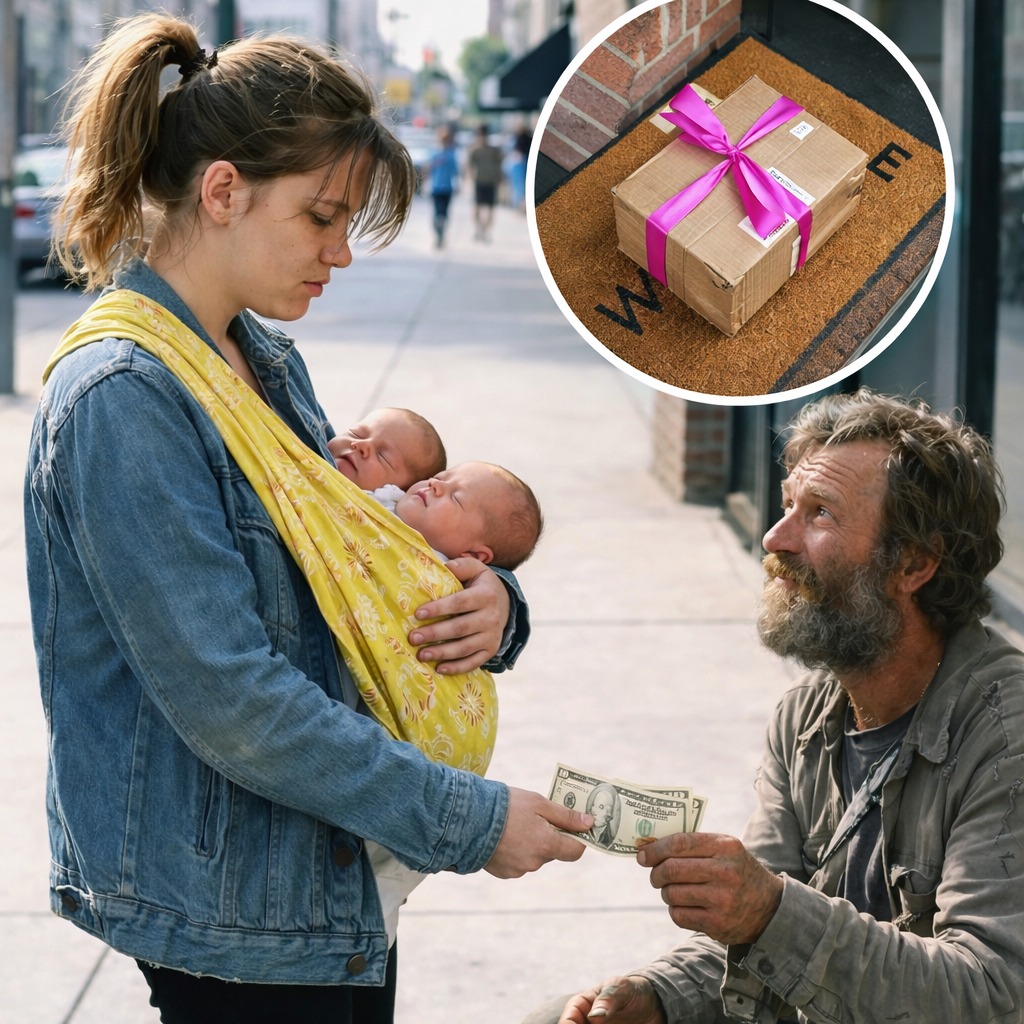
I stepped outside, adjusted the sling so the babies stayed dry, and tried to shield all three of us with a flimsy umbrella. That’s when I noticed him across the street: an older man hunched under a rusted awning, drenched and shivering so badly it looked painful.
He wasn’t yelling. He wasn’t chasing people down. He wasn’t even holding a sign.
He was just… there. Quiet. Frozen. Invisible.
And I recognized that look—because I’d worn it myself, just in a different form.
Before I could talk myself out of it, I crossed the street, reached into my pocket, and pressed the entire ten dollars into his hand.
“Please,” I told him, “get something warm.”
He looked up, startled, like he’d forgotten people could still see him. I asked his name.
“Arthur,” he said softly.
I told him mine—Nora—and showed him the twins. He repeated my name like he was trying to lock it into memory.
That night, I didn’t take the bus. I walked the three miles home in the rain, holding the umbrella over the babies and letting the cold hit me instead. When I finally got to our tiny apartment, my shoes were soaked through and my hands were numb. I stood there staring at my empty wallet, wondering if I’d just made a reckless decision I couldn’t afford.
Because when you’re struggling, kindness can feel like a luxury item.
Years of Hard Work—and One More Fall
Life didn’t suddenly get easier. It was still long shifts, short sleep, and constant math in my head: diapers, rent, food, bus fare. I worked afternoons at a diner and nights at the library. I studied one class at a time, because that was all I could handle.
Then a neighbor—Mrs. Greene—became one of those rare people who changes your life without asking for credit. She offered to watch the babies while I worked.
I tried to pay her. She refused.
“Just finish school,” she said.
So I did.
Over time, I built something stable. Not perfect, but steady. The girls grew up, we moved into a slightly better place, and I eventually landed reliable administrative work at a small firm. I thought the hardest chapters were behind us.
But life has a way of circling back.
When I was forty-four, my daughter Mae—twenty-five at the time—got seriously ill. One appointment turned into many. Tests turned into procedures. Procedures turned into bills that stacked faster than I could open them. I picked up extra work, cut every corner possible, and still felt like I was sinking.
I remember sitting at my desk one morning, staring at an overdue notice, trying to decide which bill could wait without something getting shut off.
That’s when someone stepped into my cubicle.
A Lawyer, a Box, and a Name from the Past
A man in a charcoal suit introduced himself as Carter. He asked if I was Nora.
I said yes—carefully, because life teaches you caution.
He placed a small, worn box on my desk and told me he was an attorney handling the estate of a man named Arthur.
My chest tightened.
Arthur.
The man in the rain. The ten dollars. The night I walked home shaking and unsure.
Carter explained that Arthur had left specific instructions: this box was to be delivered to me personally. Not mailed. Not passed along. Handed to me.
My hands trembled as I opened it.
Inside was a weathered leather notebook. The pages were filled with dates and short entries—simple, almost like reminders. But the first page I saw stopped me cold:
“November 12, 1998. Girl named Nora. Two babies. Gave me $10. Do not forget this.”
I couldn’t breathe for a second.
I turned more pages and saw my name written again and again over the years—like a thread he refused to let snap. Tears blurred the ink. That ten-dollar moment hadn’t been small to him. It had been a turning point.
What Arthur Had Been Carrying All Along
Carter told me Arthur hadn’t always been homeless. Years earlier, he’d owned a small machining business. When it failed, everything unraveled—work, housing, stability. He drifted, and eventually the street became his reality.
But that night in the rain mattered to him because I didn’t treat him like a problem to avoid. I treated him like a person.
According to Carter, Arthur slowly rebuilt his life. He found maintenance work, saved what he could, and managed to rent a small place. He never became flashy or wealthy. He just stayed steady—and he never forgot the young mother who gave him her last ten dollars.
Then Carter explained something else: two years earlier, Arthur had seen a community fundraiser online. My name was attached to it, and there was a photo with my daughters. He recognized us. By then, his health was failing, and he decided to put his affairs in order.
That’s when Carter pointed to something else inside the box.
A cashier’s check.
I looked down, and my breath caught.
$62,000.
Every dollar Arthur had managed to save.
He left it to me—no conditions, no strings—because in his mind, it belonged to the moment that helped him choose life again.
When Ten Dollars Comes Back as Hope
I cried right there at my desk. Not quiet tears, either—the kind that shake your whole body. Because I understood what it meant: the ten dollars I gave away when I had nothing had somehow returned when my family needed help the most.
That night, I brought the check home and showed Lily and Mae. They sat in stunned silence. Mae, exhausted from everything she’d been carrying, whispered something I’ll never forget:
“So… he just wanted to be seen.”
Yes. That’s what it was. Not charity. Not pity.
Human dignity.
In the weeks that followed, I paid down the medical debt that had been crushing us. For the first time in a long time, I could breathe without fear sitting on my chest.
I also went to find Mrs. Greene. I tried to repay her for all those years she helped me—because I never stopped remembering what she did. She resisted, but I told her the truth: this wasn’t just repayment. It was a promise to keep the chain of kindness moving forward.
I bought a new notebook of my own and started writing down small ways to help—covering someone’s bus fare, buying groceries for a struggling neighbor, tipping extra when I could, quietly showing up for people who felt invisible.
And months later, I visited Arthur’s grave. I placed a ten-dollar bill at the base of the stone—not as payment, but as a symbol.
A reminder.
Kindness doesn’t disappear. Sometimes it just takes time to find its way back.
Closing CTA
If this story moved you, share it with someone who needs a reminder that small kindness can create real change. And if you’ve ever experienced a moment where a stranger’s help—or your own—came back around, leave a comment below. I read every one.