
That kitchen used to be the center of everything.
My wife, Jean, cooked with the kind of confidence that didn’t require being on-key. Grace—back when she was little—would steal bacon straight from the pan and flash that “you didn’t see that” grin. I’d pretend to miss it until Jean would laugh and say, “Vincent, if you keep letting her do that, she’s going to think rules don’t apply.”
And I’d answer, “They don’t. She’s four.”
That’s how old Grace was when I met her—four years old, missing her front teeth, and determined not to let me matter.
Jean warned me early. On our third date, in a diner with bad coffee and a sticky table, she leaned in and said, “Grace never had a father. If you aren’t all-in, don’t start.”
I didn’t hesitate.
Grace tested that promise constantly. I was “Mom’s husband.” “Mom’s friend.” Temporary. Convenient. Replaceable.
So I did what you do when you love a kid who doesn’t want your love yet: I showed up anyway.
I learned patience in small, daily ways. I taught her to tie her shoes. Held her hair back when she got sick. Sat through school plays and cheered too loud. Glared at prom dates from the porch like it was my job. Somewhere between scraped knees, late-night fevers, and weekends in the garage, she became my daughter in every way that counted.
We talked once about making it official—adoption. Jean smiled and said, “When life calms down.”
Life didn’t calm down.
Jean died suddenly—an aneurysm. No warning. No goodbye. Just a phone call that split the world into “before” and “after.”
Grace was eighteen. I was barely functioning. The house filled with casseroles and condolences and people telling us to “stay strong,” as if strength was something you could order and unpack.
Grace went quiet. When she did speak, her words were sharp—like grief had turned into something she could throw.
I made the mistake of trying to keep things normal. I kept cooking dinner. Kept asking about school. Kept using “we” because I couldn’t imagine a future that didn’t include her.
What I didn’t understand then is that grief looks for a place to land—and sometimes it lands on the closest person still standing.
A few years later, I opened Jean’s closet.
Her clothes had been untouched since the funeral. The faintest trace of her perfume still clung to the fabric. I stood there a long time before moving anything, telling myself I was doing the responsible thing, the practical thing.
A family at church had lost their home in a fire. They needed basics—clothes, coats, anything. So I packed up Jean’s things and donated them.
I truly believed Jean would have wanted it that way.
Grace came home, saw the empty closet, and went still. Not calm—dangerously quiet.
“I donated them,” I said carefully. “Someone needed them.”
Her face changed like a door closing.
“Grace, your mom would’ve wanted—”
“We?” she cut in, laughing without warmth. “There is no ‘we,’ Vincent. You’re not my dad. You were just her husband. Just some guy living in our house.”
I felt it hit, but I didn’t let it show.
Then she grabbed her bag and started throwing clothes into it like she couldn’t get away fast enough.
“She’s gone,” Grace said, voice shaking. “So you don’t matter anymore.”
And then she was out the door.
That sound—the finality of it—lived in my head for years.
I tried everything after that. Phone calls. Emails. Letters. Old addresses. Friends-of-friends. Dead ends.
Silence.
One morning started like all the others: I crossed off another day, poured coffee, stared at the quiet house.
Then I heard a truck outside.
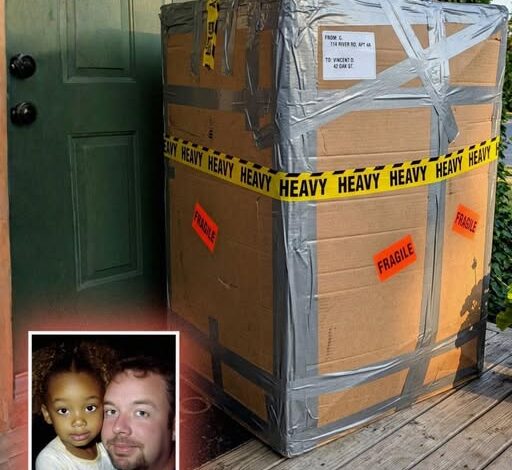
Through the window, I watched a delivery driver wrestle a huge box up my porch steps.
“I didn’t order anything,” I said, stepping outside.
The driver shrugged. “Somebody did. This thing weighs like a small car.”
I signed, still confused, and looked at the label.
No company name. A return address from three states away.
My heart started pounding so hard I could feel it in my throat.
I dragged the box inside, my back complaining the whole way, and just stood over it for a moment—afraid of what it might contain. An insult? A final rejection? Something meant to reopen everything I’d spent years trying to survive?
There was no careful packing. Just a thick moving blanket wrapped around something heavy and uneven.
The moment I pulled the blanket back, the smell hit me—oil, metal, the unmistakable scent of a garage on a Saturday morning.
My knees almost gave out before my brain caught up.
Under the blanket was an engine block.
Not just any engine block.
The engine from the 1967 Mustang Grace and I hauled home from a scrapyard when she was fourteen. I recognized the casting number. I recognized the tiny weld mark where I’d messed up years ago. I recognized the shape of a dream we started together and never finished.
Only this engine wasn’t rusted or half-dead.
It was rebuilt.
Honed cylinders. Fresh paint. Chrome valve covers shining like mirrors. I stared at the color and felt my throat tighten.
Grace always wanted it red. We argued about that for weeks.
I touched the metal with shaking fingers, half-expecting it to disappear.
It didn’t.
And in that instant, I understood something that knocked the air out of me:
She hadn’t spent five years erasing me.
She’d spent five years finishing what we started.
I made a sound I didn’t recognize—raw, embarrassing, human. I leaned forward and rested my forehead against that engine block, wrapping my arms around it like it was alive.
Like it was proof.
Inside one of the cylinder bores, there was an envelope—white, smudged with grease—with my name written across the front.
I opened it with hands that wouldn’t steady.
I know I’m five years late. I know I said things I can’t take back.
When Mom died, it felt like if I let you be my dad, I was admitting she was really gone. I was angry. I wanted you to hurt because I was hurting. I’m so sorry.
I took the engine block when I left. I dragged it through three apartments. I didn’t know how to fix it, so I took classes. I learned machining, polishing, rebuilding. Every time I worked on it, it felt like talking to you.
It took me five years to get good enough to finish it the way you taught me. I needed to grow up before I knew how to repair us.
I saw the house listing online. Please don’t sell the garage tools. We still have an engine to install.
I laughed and cried at the same time, clutching that letter to my chest like it could vanish if I loosened my grip.
At the bottom of the box, there was a photo.
Grace looked older—leaner, tired around the eyes—but unmistakably Grace. In her arms was a newborn baby boy wrapped in a blanket covered in tiny cars. His little fist was tucked against her chest.
Clipped to the frame was a plane ticket for the next day.
On the back of the photo, in her handwriting, it said:
Come meet your grandson, Vincent Junior. He needs his Grandpa to teach him how to use a wrench.
I sat on the hallway floor with that photo in one hand and her letter in the other, completely undone.
Through the window, I could see the “For Sale” sign in the yard.
After years alone, I’d convinced myself the house was too big—too quiet, too full of memories that hurt. The realtor called it “a home with good bones.”
But with that photo in my lap, the house didn’t feel empty anymore.
I called Denise, the realtor.
“We’ve had interest,” she said.
“I’m taking it off the market,” I told her. “I’m going to need the garage.”
She laughed softly. “That’s the easiest cancellation I’ll do all week.”
After I hung up, I looked around the kitchen and the hallway—the same walls that had held all that silence.
For the first time in years, none of it felt final.
The engine block gleamed in the light like a promise: love can keep working even when you can’t see it.
I looked at the ticket. Then the photo. Then the engine.
“I’m coming,” I whispered. “And I’m not going anywhere.”
For years, I thought silence was all she had left for me.
Turns out, she was building her way back the whole time.
Closing Thought
If this story hit close to home—whether you’re navigating grief, family conflict, or a long silence you don’t know how to break—share your thoughts in the comments. And if you’d like more real-life stories about healing, second chances, and rebuilding relationships, bookmark this page and come back soon.